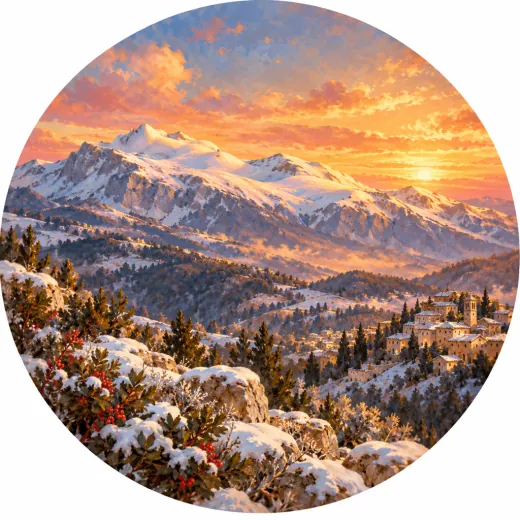
La Bella Addormentata della Majella
the Sleeping Beauty, the nymph Maja
not scary at all
Maja, the most beautiful of the Pleiades, was the mother of Hermes, son of Zeus. When her son was wounded in battle, she fled with him from Phrygia across the sea and landed at the port of Ortona. She climbed the mountains looking for a herb that could heal him, but snow covered everything and her son died. His body was buried on a peak of the Gran Sasso, which from a distance really looks like a sleeping giant. Maja died of grief on the mountain opposite, which took her name: Majella. From Chieti you can see the profile of a woman lying down.
Did you know? The profile of the “Bella Addormentata” (the Sleeping Beauty) can really be made out when looking at the Majella from the coast on clear days.
The story
Seen from the coast of Abruzzo, on a clear day, the Majella looks like a woman asleep. You can make out the forehead, the nose, the chest, the long legs stretched out towards the sea. Many people in Abruzzo call her the Bella Addormentata, the Sleeping Beauty, although some give that name to other mountains, seen from other sides. And they tell why she sleeps. There is more than one version: the land Maja comes from changes, so does the way her son dies, even his name. This is one of them.
It all began far away, in a land called Phrygia, in the heart of Anatolia, where Turkey is now. It was the age when the gods walked among men and the nymphs lived in the woods. Among these nymphs, the one everybody talked about was a young woman called Maja.
Maja was the most beautiful of the Pleiades. She had hair as dark as night, big eyes, and a voice that made the birds stop. She was happy. But above all she was a mother.
Her child, now grown, was called Hermes. He was the son of Zeus, the king of the gods. He was lively, fast, brave. One day, in a battle, he was badly wounded.
Maja lifted him in her arms. She saw him pale, bleeding. And she understood that in Phrygia there was no longer room for them. If they stayed, their enemies would find them.
So she fled. She took her son, put him on a raft, and set out on the sea.
They say the crossing was long and hard. Days and days on the water, with the waves rising and falling, with the sun burning by day and the cold stinging by night. Maja never slept. She kept her hand on her son's forehead, and spoke to him softly, to let him feel that she was there.
At last, one morning, a coast appeared. A dark, low line, with mountains behind. It was Abruzzo. The raft reached the port of Ortona, and Maja stepped ashore with her son in her arms.
But she did not yet feel safe. She looked for a refuge. She climbed up towards the mountains, and found a cave, high up, on the Gran Sasso. There she hid her son. She laid him at the back, covered him, and tended him as best she could.
But Hermes did not get better. His breathing grew shorter and shorter. Maja understood that she needed a herb, a special plant that grew somewhere on those mountains and could heal him.
She left the cave. But outside, winter had come. The snow was deep, white, silent, and covered everything. Maja searched for hours, for days, walking in the frost, with bare feet and frozen hands. She rummaged under the snow, under the rocks, among the dry bushes. She found nothing.
When she came back to the cave, it was too late. Hermes was dead.
Maja stayed there, motionless, beside her son's body. For days she did not eat, did not drink, did not speak. She stared into space, as if waiting for something to change. But nothing changed.
In the end, she got up. She took Hermes's body in her arms and climbed to a peak. There she buried him, under the stars.
At dawn something extraordinary happened. When the pink light lit up the mountain, the local people raised their eyes and saw that the summit was no longer the same. It was bigger, longer, with a distinct profile. It looked like a man lying on his back, with his chest rising and falling. A sleeping giant. It was Hermes's body, turned into a mountain. They called it the Gran Sasso.
Maja had no strength left. Grief consumed her, as fire consumes wax. She died soon after, on the mountains opposite her son's. Her relatives buried her with garlands and gems.
And when people looked up again, they saw that she too had become a mountain. A long, gentle mountain, stretched out, with the profile of a woman. A woman turned to stone by grief, with her face towards the sea, from which she had come.
She was called Majella, from her name.
The people of Abruzzo say that the Majella is the "mother of all". And they tell that, at certain times of the year, on the highest pastures, shepherds hear a thin sound, carried by the wind, that seems like a lament. It is Maja, still weeping.
Today the two mountains look at each other from afar, one facing the other. She, reclining. He, motionless. In between, the valley and the sea.
And if you climb up on an evening of snow, and stop for a moment in silence, remember that every mountain has a story. And that this is the story of a mother who searched for a herb, and did not find it.
Relatives around the world
Listen / Read next
- Music to read by: Cinematic JourneyEpic film-style music, no lyrics, by Ciro Simone IrmiciSpotifyYouTube Music
