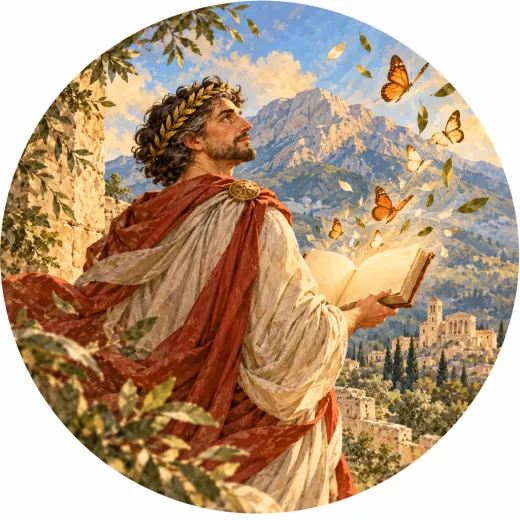
Ovid the Wizard of Sulmona
“Uiddiu”, in the dialect of Sulmona
not scary at all
The Latin poet Ovid really was born in Sulmona, in 43 BC, and wrote the “Metamorphoses”, a book full of people turning into trees, animals and stars. For centuries, though, the people of Sulmona did not remember him as a poet: in their tales he had become a very powerful wizard. On the slopes of Mount Morrone there were great ancient ruins everyone called “Ovid's villa”, and it was said the wizard had hidden his treasures there. Those ruins were in fact an ancient sanctuary of Hercules, first Italic and then Roman.
Did you know? Sulmona's coat of arms still bears the letters SMPE, standing for a line by Ovid: “Sulmo mihi patria est”, Sulmona is my homeland.
The story
On the twentieth of March in 43 BC, in a small town among the mountains of Abruzzo that the Romans called Sulmo, a baby boy was born. They named him Publius Ovidius Naso. He would become one of the greatest poets of antiquity.
But this is the story of when he stopped being a poet.
Let us begin with real life, which on its own already has a little magic.
Ovid's family was well off, the kind that knew how to read and pay for teachers. At twelve they sent him to Rome to study. Then he went to Athens, the city of philosophers, and travelled around Sicily. All doors were open to him for a political career. But he was not interested. He preferred verse.
He wrote love poems, letters from betrayed heroines, a manual of seduction that caused a scandal. He married three times. He had a daughter, Ovidia, who wrote too. Then, in maturity, he wrote the work that would make him immortal: the "Metamorphoses". A great book in which people are transformed. Daphne becomes a laurel. Arachne becomes a spider. Narcissus becomes a flower. And the gods, when they are angry or in love, change shape at will.
He was the best-loved poet in Rome. Then, in the year 8 AD, it all ended.
The emperor Augustus sent him into exile at Tomis, an icy place, at the edge of the empire, on the Black Sea, where today stands the city of Constanța, in Romania. Why? Nobody knows for certain. Ovid himself wrote that there were two causes: "a poem and a mistake". A poem of his, perhaps the Art of Love, and something he had seen or done that he should not have. What mistake, he never said.
He stayed there until his death, which came between 17 and 18. He wrote poignant, sad letters, full of homesickness. In one, speaking of his homeland, he recalled the place of his birth with a line the people of Sulmona have never forgotten: "Sulmo mihi patria est". Sulmona is my homeland.
For this reason the city still bears that motto on its coat of arms, in four letters: SMPE.
Then the centuries went by. The Roman world ended. The barbarians came, then the Middle Ages, and Latin books gathered dust in convents. The people of Sulmona, who knew Ovid's name but no longer his verses, did what one does with things half remembered: they invented.
They began to say that Ovid had not been a poet, but a magician.
They said he knew everything. That he knew spells and formulas, and transformed things as he pleased, just as in his book. After all, they reasoned, someone who writes of men turning into trees must surely know how to do it.
On the slopes of Monte Morrone, which overlooks the city, there were great ancient ruins. Enormous walls, squared stones, that nobody could explain. The people of Sulmona called them "the villa of Ovid". And they said that there, among those walls, the magician had hidden his treasures. Who knows how many farmers, over the centuries, dug beneath those stones hoping to find a chest.
The truth is that those ruins were not the home of any poet. They were an ancient sanctuary, first Italic and then Roman, dedicated to Hercules.
But in Sulmona it did not matter. Their Ovid was a magician, and that was that.
When you know the true story, the legend seems almost like another metamorphosis. The poet who wrote of transformations was transformed by his own people. From a man of letters to a sorcerer, from an exile to a keeper of treasure. And in all this there is a kind of justice: Ovid had spent his life changing the shape of stories, and stories changed his.
In December 2017 the city of Rome officially rehabilitated him, two thousand years after Augustus's order. A late pardon, but a pardon all the same.
If you go to Sulmona, look at the city's coat of arms and read the four letters. SMPE.
Someone, down there, has never stopped coming home.
Relatives around the world
Listen / Read next
- Music to read by: Cinematic JourneyEpic film-style music, no lyrics, by Ciro Simone IrmiciSpotifyYouTube Music
Sources
- Antonio De Nino, «Ovidio nella tradizione popolare di Sulmona» (1886)
- Ovidio, «Tristia», IV, 10
