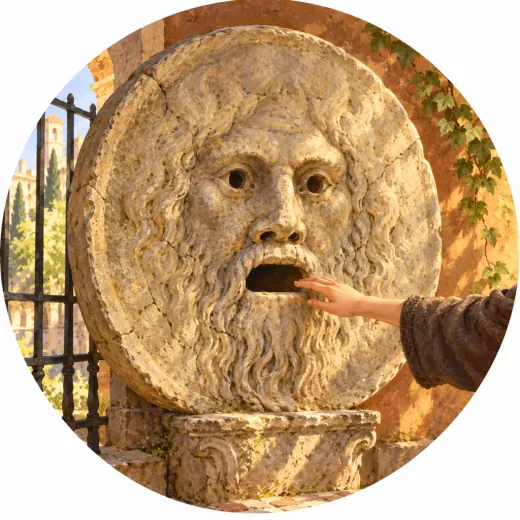
La Bocca della Verità
the Mouth of Truth, perhaps the face of the god Oceanus
a little scary
Under the portico of a church in Rome there is the Bocca della Verità (the Mouth of Truth), a big marble disc with a bearded face and an open mouth. The legend says it can tell when someone is lying and expose them. Already in the Middle Ages a guidebook for pilgrims described it as a stone able to tell truth from falsehood. In reality it is an ancient Roman sculpture, perhaps the face of the god Oceanus, and it was probably just a drain cover. It was moved under the portico in 1631.
Did you know? It became famous worldwide thanks to the 1953 film “Roman Holiday”, with Audrey Hepburn and Gregory Peck.
The story
Rome is full of strange things, but there is one that every tourist wants to touch, even if they are afraid. It is a marble face, big and round, set into the wall of a church portico, a short walk from the Tiber. It has a beard, empty eyes, a nose worn down by the years. And it has a wide open mouth, black, with darkness inside.
It is called the Bocca della Verità, the Mouth of Truth.
It is said that if you put your hand in the mouth and tell a lie, it closes and bites you.
Nobody knows who carved it. Some say it is a sea god, because in its hair there are two crab claws, by now almost invisible. Others say a river god, or a faun, or an oracle. Scholars, when they are honest, make a funny face and say that perhaps, two thousand years ago, it was only a drain cover: a lid to let rainwater run down under a street of ancient Rome. With its mouth open, to drink the rain.
A joke of fate, isn't it? A face made to swallow water, and turned into the city's greatest nuisance for liars.
But people, when they see a dark mouth, start telling tales. And the stories about the Mouth are almost as old as it is.
One says that it was built by a certain Virgil, a medieval scholar whom the legends turned into a magician, to help suspicious husbands. It worked like this: the wife put her hand inside and swore she had been faithful. If she lied, the Mouth held her fast.
Another, grimmer, comes from a German tale of the twelfth century: it says that the emperor Julian, the one who wanted to bring back the old pagan gods, had deceived a woman, and one day put his hand inside the Mouth and swore falsely. And a voice, under the stone, held him still. In the story, that voice was the devil in person, who had disguised himself to promise him good fortune.
But the funniest of all is a legend born in Germany in the fifteenth century, where the wife was no less than an empress. Later, with a few changes, it was told in Rome too, and this is how it goes.
Once upon a time there was a married woman. And there was a husband who suspected. And there was, naturally, a lover. The husband, tired of doubts, decided to take his wife before the Mouth, before all of Rome, to make her swear that she had never betrayed him.
The evening before, the woman went to see the lover. "We are ruined," she told him. "If I swear falsely, the Mouth will crush my hand. If I tell the truth, my husband will throw me out of the house."
The lover thought for a while. Then he smiled, like someone who has an idea.
The next day, the square was full. The husband walked with his chest puffed out, the wife with her eyes lowered. They approached the portico. The crowd opened to let them through. Everyone held their breath.
And just at that moment, a man came out of the crowd.
He had torn clothes, untidy hair, wide staring eyes. He was singing a song that made no sense and laughing to himself. He looked like the district madman, one of those that every city has, and nobody looks at any more. He went up to the woman with his arms open and, before anyone could stop him, hugged her tight, in front of everyone, with a bear hug.
Then he let her go, laughing, and went off skipping.
The people started to laugh. The husband, red in the face, freed her from the hug and pushed her towards the Mouth.
"Now swear," he said.
The woman put her hand in the marble mouth. She breathed. Then, in a steady voice, in front of everyone, she said: "I swear that no man, apart from my husband and that madman who hugged me a moment ago, has ever held me in his arms."
The hand stayed where it was. No bite, no cry. The Mouth, after all, had heard only the truth.
The husband, in front of all Rome, could not say a word. He apologised, perhaps. The woman took out her hand, smiling, and walked away with her head held high.
And the man who had played the madman? He was never found. Or at least, so the story goes. They say that in the evening, at the tavern, he was seen toasting alone.
The name "Bocca della Verità" appeared for the first time in 1485. And since then the fame of the Mouth has never declined. To make it known all over the world, many centuries later, there was a film of 1953, Roman Holiday, in which the journalist pushes his hand into the marble mouth and pretends to lose it, to frighten the princess.
Today, in front of the Mouth, there is a queue. People from every country wait their turn to put their hand into the dark, smile for the photo, and pretend, with a nervous laugh, that they have nothing to hide.
The Mouth, from its wall, looks at everyone with those empty eyes. And perhaps, under the marble, it laughs.
Because it has already heard everything.
Listen / Read next
- Music to read by: Cinematic JourneyEpic film-style music, no lyrics, by Ciro Simone IrmiciSpotifyYouTube Music
- The words of the dialect: RomanNonnese, the dictionary of Italian dialects
Sources
- Anonimo, «Mirabilia Urbis Romae» (XII secolo)
- Italy Guides, «La Bocca della Verità»
