The Legend of the Due Torri
the Two Towers: the Torre degli Asinelli and the Garisenda
not scary at all
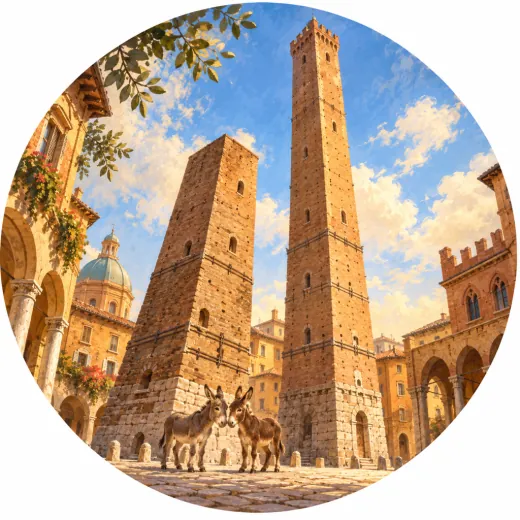
The Due Torri (the Two Towers) of Bologna are real: the taller one is the Torre degli Asinelli, almost a hundred metres high, and beside it stands the Garisenda, shorter and very crooked. The legend says a poor farmer, thanks to his two little donkeys digging in the field, found a chest full of gold. His son fell in love with a noble girl, and her father demanded a test: build the tallest tower in the city. The donkeys' gold paid for the tower, which took their name. Another story says the towers were born from a contest between two rival families.
Did you know? Dante saw the Garisenda and put it in the Divine Comedy, in canto XXXI of the Inferno.
The story
If you arrive in Bologna by train, you notice at once that something does not add up. The houses are low, of red brick, with long arcades. And then, all of a sudden, in the middle of all that red, two towers rise.
One is very tall, straight as a pencil. The other is lower, and crooked. So crooked that, looking at it, you are tempted to lean a shoulder against it to hold it up.
They are the Due Torri, the Two Towers, and they are called the Torre degli Asinelli and the Garisenda. They have stood there, side by side, for nine hundred years. And each has a story.
Let us begin with the one about the donkeys.
A long time ago, outside the walls of Bologna, there lived a poor farmer. He had no land of his own. He worked a field that was not his, with two grey donkeys, small and stubborn, that pulled the plough. It was a hard life. Every evening he went home with cracked hands and a piece of bread in his pocket.
One day, while he was ploughing, one of the two donkeys dug in its heels. It planted its hooves in the ground and would walk no more. The farmer pulled, shouted, lost his patience. The donkey did not move. Instead, it began to dig with its hoof.
And the other donkey, imitating it, dug too.
The farmer watched them, resigned. Then, suddenly, he heard a dry sound, of wood against stone. He bent down. The little donkeys had uncovered a chest.
The two of them pulled it out, with effort. It was heavy. The farmer lifted the lid, and for a long moment he did not breathe.
It was full of gold.
From that day, the farmer stopped being poor. He did not change at once, out of caution. But little by little he bought land, a bigger house, decent clothes. He became a rich man. And he never forgot those two donkeys, whom he always treated like kings.
The farmer had a son. And the son, one day, fell in love.
Not with just any girl. He fell in love with a young noblewoman, from an old family, who lived in a palace with tall windows. The boy, who had a farmer's hands and a heart full of hope, went to her father to ask for her hand.
The nobleman looked him up and down.
"You want to marry my daughter?" he said. "Then prove to me that you are worthy. Build a tower. The tallest in Bologna."
The boy was speechless. A tower. In a city full of them, each built by a rich family to show how powerful it was. But he had the gold.
He went back to his father. He told him everything. And the old farmer, who had not forgotten the hard work, opened the chest.
The tower rose in a few years. Brick after brick, masons and labourers worked under the sun. When it was finished, it was the tallest of all, so tall that it seemed to touch the clouds. The nobleman looked at it, was left speechless, and had to keep his promise.
The boy married the girl. And the tower, in honour of the two animals that had dug in the field, was called the Asinelli, the Little Donkeys.
This is the legend. The truth, as always, is a little longer and a little less comfortable. The tower was built between 1109 and 1119, and its name comes not from donkeys but from a family, the Asinelli, linked to the tower at least since 1185.
The Torre degli Asinelli is almost a hundred metres high: ninety-seven point two, to be precise. It leans a little too, by about two metres. Its top, in the fifteenth century, was shortened. Over the centuries it served as a prison, as a lookout post, and during the last war volunteers climbed to the top to see where the bombs were falling and to guide the rescuers.
The Garisenda, instead, is lower: forty-eight metres. But it leans much more, by over three. Originally it was about sixty metres high. But the foundations gave way while it was being built, and in 1351 it was shortened for fear that it would collapse.
Dante saw it. He tells of it in the Inferno, when he meets a giant who bends down, and he says that the giant looked like the Garisenda seen from underneath, when a cloud passes in the direction opposite to its lean. Perhaps he looked at it many times, in that city full of towers.
Because in Bologna, once, there were about a hundred towers. Every important family had one, to defend itself and to be envied. Twenty-four remain.
Today the Garisenda is monitored, propped up, cared for. Since 2023 it has been being made safe, with a technique learned from the tower of Pisa. The hope is that it will be in order by 2028.
And the students? They say that the students of Bologna never climb the Torre degli Asinelli before they graduate. Whoever does, according to tradition, does not graduate. A superstition, of course. But it is almost five hundred steps, and nobody wants to take the risk.
So, if you pass through Piazza di Porta Ravegnana, stop for a moment. Look up, towards the Due Torri, and think of two little donkeys that dug in their heels one day in a field.
Sometimes luck comes from where you least expect it. You only have to dig.
Listen / Read next
- Music to read by: Cinematic JourneyEpic film-style music, no lyrics, by Ciro Simone IrmiciSpotifyYouTube Music
Sources
- Bologna Welcome, «Le torri tra leggende e curiosità»
- Dante Alighieri, «Inferno», canto XXXI
