The Krivapete
“crooked feet”, in the Slovene dialect of the valleys
a little scary
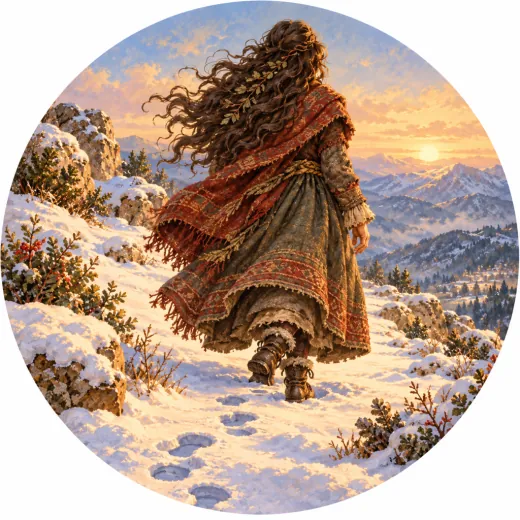
In the Natisone valleys, where a Slovene dialect is spoken, lived the Krivapete: wild women with crooked feet, the mark that set them apart and gave them their name. On full-moon nights, it is said, they danced in the clearings. They lived in caves near springs, knew all about herbs and could tell when rain was coming. In Vernasso people say the villagers once caught a young one: in exchange for her freedom she taught them to make cheese, bread and baskets. Only sweets, the story says, she did not teach them.
Did you know? Mount Matajur, the mountain of the Krivapete, is also called “the great grandmother” in the dialect of the valleys.
The story
In the Natisone Valleys, in Friuli, near the border with Slovenia, people still speak a language with a soft sound, different from Italian and different from Friulian. It is the language of green mountains, of narrow valleys, of villages called Vernasso, San Pietro, Pulfero. And on these mountains, they tell, the Krivapete lived.
The name means "crooked feet". That was their sign, the detail everyone noticed. For the rest, little is known of them, and that little is wrapped in mystery. They were women, or something that looked like women.
They lived in the most hidden places. In small caves near streams, where water is born from the rock. In clearings sheltered by trees. On steep slopes where nobody climbed. And above all on Monte Matajur, the highest peak of the valleys, which the inhabitants also call "Monte Re", "King Mountain", or "the Great Grandmother".
They knew a great many things. They knew the herbs that heal, and those that harm. They knew when rain would come and when the harvest would go well. They knew how to weave, and how to read fate. Whoever fell ill could ask their advice, and they answered. But woe to whoever ruined a wood or a spring without respect. The Krivapete also knew how to punish.
On full-moon nights, they say, they came out of the caves and danced.
Now, this is a story told at Vernasso, and it is the most famous one.
One day, some shepherds from San Pietro took their cows to graze along the stream, not far from the caves. They did not want to disturb anyone, but they saw all the same. Some Krivapete had come down to the brook and were washing their feet. Crooked, curious feet, which the shepherds watched from far away, holding their breath.
The news reached the villages. And in one village, at Vernasso, there was a man who got an idea. The Krivapete knew so many things. If he caught one, perhaps he would learn some of them.
He waited. One day he found a young Krivapeta asleep on the grass, in a quiet corner. Very gently, he picked her up and took her home.
When she woke up, the girl found herself in an unknown village, surrounded by people looking at her. She did not scream. She did not rebel. She stayed calm. And she proposed a pact.
"If you let me go," she said, "I will teach you everything I know."
The men looked at one another. They accepted.
The Krivapeta kept her word. For days, for weeks, she taught. She showed how to make butter, beating the cream in the churn until it thickened. She taught how to turn milk into cheese, with rennet and patience. She taught how to make bread, to weave baskets, to work leather to make shoes. She taught how to sharpen scythes, so that they would cut the grass better. She taught how to preserve meat for the winter.
In the end, the people of Vernasso knew more things than they had ever imagined. And the girl asked for what was due to her.
The men kept the pact. They let her go.
She ran off, fast, without looking back, towards the mountain. When she was far enough, she stopped on the slope, turned round, and with a laugh shouted down:
"But the sweets, I did not teach you those!"
And from that day, says the story, in the village of Vernasso nobody has ever known how to make a sweet.
Now, about the Krivapete scholars have different ideas. Two scholars, Luciana Percovich and Aldina De Stefano, have written about them at length. According to them, these figures are not mere goblins, but the remains of a very ancient religion, that of a great mother goddess worshipped in the mountains even before the Christians. They think that over time, those goddesses were made smaller, turned into witches, reduced to creatures to be hidden in the woods. And that the crooked feet were a way people had of mocking and belittling independent, wise women. In the valleys four witchcraft trials were held, and the inquisitors of Aquileia went hunting for women with similar knowledge.
It is a fascinating thesis, not a certain truth. But it recalls something true: behind every story of strange creatures, often, there are real people, with real knowledge.
Today, if you climb the Matajur on a clear day, you see the valleys spread out below you like a green carpet. If you are lucky, you find a spring hidden among the rocks. Stop for a moment. Listen to the water.
And if you feel like having a sweet, remember Vernasso.
Listen / Read next
- Music to read by: Cinematic JourneyEpic film-style music, no lyrics, by Ciro Simone IrmiciSpotifyYouTube Music
Sources
- Aldina De Stefano, «Le Krivapete delle Valli del Natisone. Un'altra storia» (2003)
- Luciana Percovich e Aldina De Stefano, Preistoria in Italia (2022)
