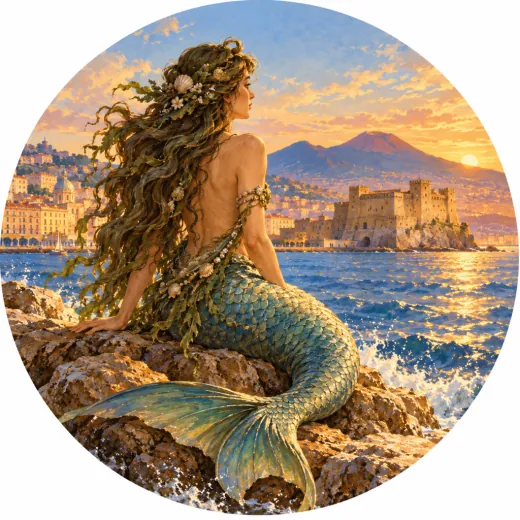
The Siren Parthenope
“Parthenope”, maiden, in Greek
not scary at all
Parthenope was one of the Sirens of Greek myth, who lured sailors with their song. When Ulysses sailed past them without being enchanted, tied to the ship's mast, in one version Parthenope was so desperate that she threw herself into the sea. The waves carried her body to a small island in the gulf, Megaride, where tradition says Castel dell'Ovo stands today. Greek sailors buried her, and a Greek city named after her was born there. Matilde Serao tells another version, in which Parthenope is a Greek girl who ran away for love.
Did you know? The oldest Sirens were bird-women: those with fish tails are a medieval idea.
The story
There is something every Neapolitan knows, even if they do not remember where they learned it: Naples has a birth that comes not from the land, but from the sea. And not from a king, nor from a hero with a sword. From a voice.
The voice was that of a siren.
She was called Parthenope, and she was not alone. With her were two sisters, Ligea and Leucosia. They say that originally they were three maidens, companions of Persephone, the girl carried off beneath the earth by the god of the dead. When Persephone vanished, her mother Demeter sought someone to blame, and found it in them: they had not known how to protect her. She turned them into sirens, creatures half woman and half bird, condemned to the sea for ever.
From then on they sang.
Theirs was a song no sailor could forget. It came from the shore, in the evening, when the water is smooth as oil, and promised everything: a harbour, a home, a return. Sailors turned towards that voice, and their ships broke on the rocks. The sirens hated nobody. But their song was made that way: whoever listened to it could no longer leave.
Until one day, over that sea, a different ship passed.
On the mast was a man bound with strong ropes, and around him the crew, with their ears full of wax. It was Odysseus. He had wanted to hear the sirens' song without falling, and for that he had had himself tied. The sirens sang, sang with all the voice they had, sang as they had never sung.
The ship passed. Nobody stopped. Nobody turned.
For the first time, their song had not worked.
We do not know why they killed themselves. Here the stories divide, and those who tell them do so in a low voice. In one version it was despair: they were nobody, if nobody listened. In another it was Odysseus's fault, who with his cunning had left them empty. Some say it was written in their destiny that they would die the day a man resisted.
However it was, the three sisters threw themselves into the sea.
The waves took them, and carried them away. And at this point the story turns gentle. The sea, which had seen three voices die, decided not to lose them entirely.
It carried Ligea to a distant beach, where the city of Terina would arise. It carried Leucosia to where Paestum stands today, then Posidonia. And Parthenope it carried closer, to a bay where the sea is blue as an eye, in front of a small rock that is today called Megaride, near the mouth of a river, the Sebeto. Right there, tradition says, where Castel dell'Ovo now stands.
On the beach some Greek sailors found her body. She was a strange creature, very beautiful, no longer alive. They looked at her for a long time. Then, without quite knowing why, they made her a tomb.
And around the tomb a village arose.
Small, at first. A few houses, a few boats. They called it Parthenope, after the siren's name. That village grew, little by little, and when centuries later the colonists of Cumae arrived, Greek people who had come from the north, they founded a new city nearby. They called it Neapolis, the "new city". Naples. Old Parthenope remained, like a memory, like a mother.
The Neapolitans did not forget her.
The ancients tell that, in honour of the siren, a festival was held every year. Young athletes ran with lit torches along the shore, and the light on the waves, in the evening, must have looked like a river of stars. It was a promise made to the dead: we will not forget you. The first inhabitants knew this so well that, according to tradition, it was an oracle that asked for that festival, to keep the siren content.
There is even a statue of her in the ancient chronicles.
For this reason, even today, in Naples, when you want to say that something is truly Neapolitan, you say it is "partenopea". Because the city does not remember a founder with a beard and a cloak. It remembers a girl with a voice, who sang on the shore, and whom the sea brought home.
And when evening falls over the gulf, and Vesuvius becomes a blue silhouette, some say they have heard, among the waves, a distant sound. Perhaps it is the wind. Perhaps it is the noise of water among the rocks.
Perhaps it is a siren, who has never stopped singing.
Relatives around the world
In the trails
Listen / Read next
- Music to read by: Cinematic JourneyEpic film-style music, no lyrics, by Ciro Simone IrmiciSpotifyYouTube Music
- The words of the dialect: NeapolitanNonnese, the dictionary of Italian dialects
Sources
- Licofrone, «Alessandra»
- Matilde Serao, «Leggende napoletane» (1881)
- Omero, «Odissea», libro XII
