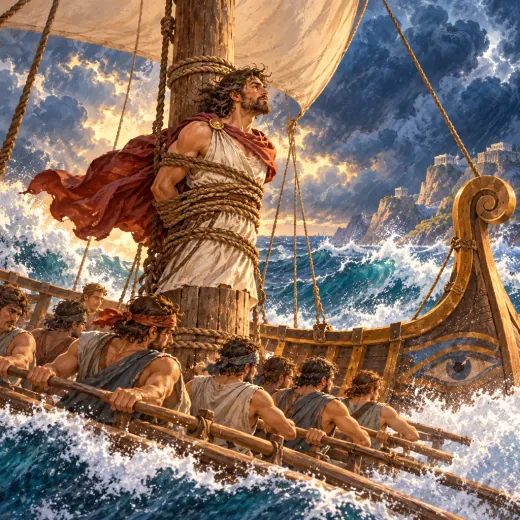
Odysseus
Odysseús, in Greek; Ulysses in Latin
a little scary
Odysseus was the king of the island of Ithaca, famous more for his cunning than for his strength. At the end of the Trojan War, it was he who came up with the trick of the wooden horse full of soldiers. His journey home took ten years: he faced the Cyclops Polyphemus, the sorceress Circe, the Sirens, the monsters Scylla and Charybdis, and he even went down into the kingdom of the dead. Meanwhile, at home, his wife Penelope waited for him, unpicking at night the cloth she wove by day to keep her suitors waiting.
Did you know? From his Greek name comes the word “odyssey”, which we use for a long journey full of trouble.
The story
After ten years of war at Troy, Odysseus wanted only one thing: to go home.
He had a wife waiting for him, Penelope, and a son he did not know yet, Telemachus. He had twelve ships, and his men were tired, dirty and hungry. The sea, however, was in no hurry to let them go.
One evening the fleet landed on an island nobody knew. Goats grazed freely on the rocks, and at the top of a hill there was a great cave, its mouth as black as the mouth of a monster.
“Let’s go in and look,” said Odysseus. “Maybe there’s food. Maybe there’s someone who will take us in.”
He chose twelve companions, the strongest, and took with him a goatskin of sweet, dark wine, a gift from a priest. It was a wine so strong that it had to be mixed with twenty parts of water.
The cave was enormous. Inside were rows of cheeses, buckets full of milk, pens full of lambs. At first none of the companions touched anything: but hunger is a bad travelling companion, and one by one they started to eat.
Towards evening, the ground shook.
Through the entrance came a mountain of flesh and bone. A giant, as tall as a tree, with a single great eye in the middle of his forehead, and behind him his flock of sheep. It was Polyphemus, the Cyclops, son of Poseidon, the god of the sea.
With one hand he rolled a boulder across the entrance, a boulder so big that twenty carts could not have shifted it.
“And who are you?” His voice boomed through the rock. “Pirates? Merchants?”
“We are Greeks,” said Odysseus, and his voice shook a little. “We were on our way home from Troy. We beg you, in the name of Zeus, protector of guests, to welcome us.”
The Cyclops laughed.
“Zeus? What do I care about Zeus?” And he reached out an enormous hand, grabbed two of the companions by the legs, smashed them against the wall and ate them. Then he lay down among his sheep and fell asleep with a full belly.
At the back of the cave, Odysseus could not sleep a wink.
He could kill the giant in his sleep, with his sword. But then who would move that boulder? They would all die, shut inside. He had to think.
The next morning, two more companions ended up in Polyphemus’ stomach. Then the giant went out with his sheep, rolled the boulder back and left Odysseus to think.
In a corner, Odysseus found a stake of olive wood, as long as a ship’s mast. He had it sharpened with his sword, hardened it in the fire and hid it under the straw.
In the evening Polyphemus came back and ate two more companions. Then Odysseus went up to him, holding the goatskin.
“Cyclops, drink this. It’s wine. After a meal of human flesh, it will do you good.”
The giant drank a cup. He asked for another. He drank a third. “This wine is delicious. What’s your name, stranger? I want to give you a present.”
“My name is Nobody,” Odysseus replied. “Nobody: that’s what my mother and my friends call me.”
“Then, Nobody, here is my present: I’ll eat you last!”
He laughed again, a crooked laugh. Then his eye closed, his head dropped onto his shoulder, and he began to snore.
Odysseus and the four companions who were left took the stake and heated it in the embers until it glowed red, and then, all together, with a shout, they drove it into the single eye.
The Cyclops screamed.
It was a scream that shook the whole island. He tore the stake out of his eye and groped about in the dark, calling to his neighbours, the other Cyclopes who lived in the caves. They came and shouted from outside, “Polyphemus! What’s wrong? Who is hurting you?”
“Nobody! Nobody is killing me! Nobody has blinded me!”
“If nobody is hurting you,” the Cyclopes answered, “then it must be a sickness sent by the gods. We can’t help you.” And they went away.
Inside the cave, Odysseus was holding his breath so as not to laugh.
At dawn Polyphemus, feeling his way with his hands, moved the boulder to let his flock out: he felt the back of every sheep, one by one, to be sure that no man escaped. But Odysseus had tied his companions under the bellies of the biggest sheep. He himself clung to the fleece of the largest ram.
The ram went past. The Cyclops touched its back, and felt nothing.
Outside, in the light, Odysseus untied his companions and they ran to the ship. They rowed with all the strength they had. When they were far off, just within shouting distance, Odysseus could not resist.
“Cyclops! If anyone asks who took your eye, tell them it was Odysseus, son of Laertes, king of Ithaca!”
It was the biggest mistake of his life.
Polyphemus, on his knees on the shore, raised his hands to the sky and prayed to his father, Poseidon: “If I am truly your son, make sure this man never gets home. And if he really must get home, let him arrive late, alone, on a foreign ship, and find trouble waiting for him.”
Poseidon listened.
From then on, for ten years, the sea was Odysseus’s enemy. The Sirens called to him from their rocks. Scylla snatched six of his companions with her six heads. Charybdis, the whirlpool, almost swallowed him. Circe turned his men into pigs. A storm wrecked his last ship. Odysseus watched all his companions die, one after another.
In the end he came back to Ithaca alone, on a boat belonging to strangers, dressed as a beggar, and found his house full of enemies. But that is another story.
When the Greeks told stories about Odysseus, they loved him. Not for his strength, because others were stronger, nor for his courage. They loved him because, out of all the heroes, he was the only one who won with his head. But the story of the Cyclops always left a subtle lesson, and perhaps that is exactly why they told it to young people.
Odysseus had beaten the monster. And then, in a moment of vanity, he had wanted the monster to know his name.
Relatives around the world
Listen / Read next
- Music to read by: Cinematic JourneyEpic film-style music, no lyrics, by Ciro Simone IrmiciSpotifyYouTube Music
Sources
- Homer, Odyssey
