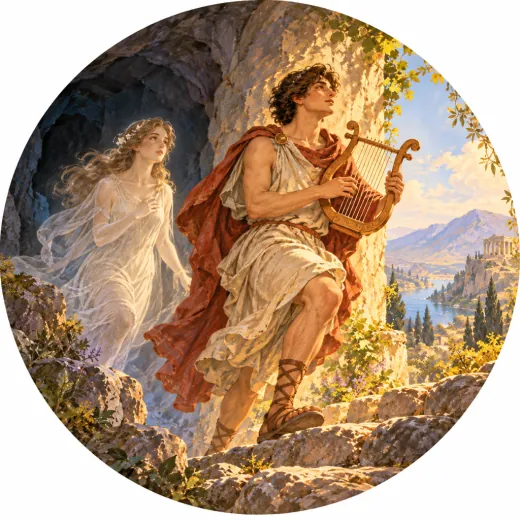
Orpheus and Eurydice
Orpheús and Eurydíkē
a little scary
Orpheus was the greatest musician of all: when he sang with his lyre, animals stopped to listen and even stones moved. When his bride Eurydice died from a snake bite, Orpheus went down into the kingdom of the dead to bring her back. His music moved Hades and Persephone, who let her go on one condition: he must not turn round to look at her until they were out in the light. Right at the threshold, Orpheus feared she was not there, turned round and lost her forever.
Did you know? The oldest opera that has survived complete, “L'Orfeo” by Claudio Monteverdi (1607), tells exactly this story.
The story
In Thrace, where the mountains run down to the sea, there was a young man who could sing.
He did not sing like anyone else. When he plucked the strings of his lyre, the wind stopped blowing so it could listen. The oak trees bent towards him. Lions lay down in the grass, and beside them, without fear, lay the goats. Rivers slowed down. Even the stones, people said, moved ever so slowly, one after another, to get closer to the music.
His name was Orpheus. He was the son of a Muse, and the god Apollo had given him the lyre.
One day, in a meadow, he saw a girl picking flowers. Her name was Eurydice. She had dark hair tied back with a ribbon and a laugh like a little stream. Orpheus stopped singing. For the first time in his life, he could not think of anything to say.
Then he said, simply, “May I play for you?”
They were married soon afterwards. For a whole day, in that valley, not a single bird stopped singing.
On the very day of the wedding, Eurydice was walking with the nymphs in a field near the river. Virgil tells that a shepherd, a man called Aristaeus, saw her and began to chase her; Ovid does not even mention him. She ran, frightened, through the tall grass, and did not see the snake hidden among the blades.
It was just one bite, a small one, on her foot.
The nymphs screamed. Orpheus came running and found her lying in the grass, her face as white as wax. He tried calling her. He tried shaking her. He took her hand, and her hand was already cold.
For days he did not sing. For weeks, in Thrace, the silence was so deep that animals left their dens to search for that voice. Then Orpheus stood up, took his lyre and said to no one, “If the gods above won’t give Eurydice back to me, I’ll go and ask the gods below.”
He found the entrance in a cave at Cape Taenarum, and went down.
The path was steep, dark and full of cold wind. All around him in the darkness moved the Shades of the dead, light as smoke, without faces. He came to the bank of a black river and saw a boat, and an old man with a long beard holding an oar. It was Charon, the ferryman.
“The living do not cross,” said the old man.
Orpheus did not argue. He sat down on the bank and began to play.
I can’t tell you what that music was like. Those who heard it say it sounded like the voice of someone weeping and hoping at the same time. Charon put down his oar. For the first time in centuries, the ferryman forgot to be hard, and he took Orpheus across.
Then, in the darkness ahead of him, appeared Cerberus, the three-headed dog, blocking the gate with his teeth bared. Orpheus kept on playing. The three heads yawned, one after another, and the dog curled up on the threshold like a puppy.
The Furies, the women with snakes for hair, stood still and stared at him. The boulder of Sisyphus stopped rolling. Tantalus, who was dying of thirst in the middle of the water, forgot that he was thirsty.
And the music reached the throne.
Hades, the king of the dead, was sitting beside his wife Persephone, and before he could even speak, he felt something he had not felt for a thousand years: pity.
“Ask me for whatever you want,” he said.
“I want Eurydice,” Orpheus replied. “She died too soon. I’m not asking for her forever. Every man comes back to you one day. Just give me the time to live with her the life that was taken from her.”
Hades looked at Persephone. Persephone, who knew what it means to be far from home, nodded.
“So be it,” said Hades. “Eurydice will follow you. But there is one condition. You will walk in front, and she will walk behind you. You must not turn round. Not even once, until you are outside, in the light of the sun. If you turn round, you will lose her forever.”
“I won’t turn round,” Orpheus swore.
The climb began.
The path was endless. Ahead of him, darkness. Behind him, only silence. No footsteps. No breathing. Orpheus could feel the lyre knocking against his back, and his own heart beating. He climbed, and climbed again. For how long? A day? A lifetime?
At some point, a doubt began to creep in.
What if she isn’t there? What if Hades has tricked me? What if I’m climbing alone, talking to a shadow, while she’s still down there?
Ahead, at the end of the path, he could see a thread of light. The way out. Just a few more steps.
Orpheus felt he could not bear it any longer.
He was one step from the threshold, with one foot already in the sunlight. He turned round.
He saw her.
Eurydice was there, two steps away from him, pale and beautiful, her eyes full of tears. She held out her arms. She said one single word, “Farewell”, so softly that it sounded like a breath. And she was pulled back into the darkness like a leaf sucked into a whirlpool.
Orpheus threw himself after her. He shouted. But this time Charon would not let him cross.
He went back up to the surface alone, with his lyre in his hand. He did not sing again for months. They say he wandered through Thrace, over the mountains, growing thinner and thinner. They say that in the end he died at the hands of women gripped by madness, and that his head, carried along by the river, went on singing all the way to the sea.
But the people who tell this story in Greece love one moment above all. Not the song, not Cerberus, not the throne of Hades. They love that step before the way out. That second in which Orpheus, one step from the light, was afraid.
Because it is everybody’s fear. When you have almost got what you wished for, you realise that you don’t believe it is real.
And you turn round, to check.
Relatives around the world
Listen / Read next
- Music to read by: Cinematic JourneyEpic film-style music, no lyrics, by Ciro Simone IrmiciSpotifyYouTube Music
Sources
- Virgil, Georgics, Book IV
- Ovid, Metamorphoses, Book X
