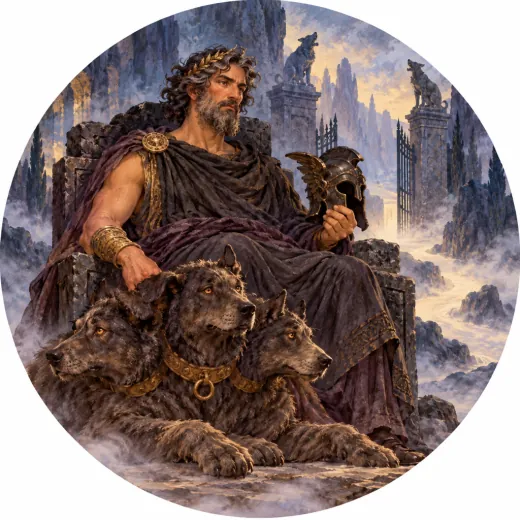
Hades
Háidēs, “the unseen one”
scary
Hades is the brother of Zeus and Poseidon, and when the three shared out the world he was given the kingdom under the earth, where the souls of the dead go. He is neither a devil nor an evil god, but he lets no one leave. To reach him you must cross the river Acheron on the boat of Charon the ferryman, and the three-headed dog Cerberus guards the entrance. Hades owned a helmet that made him invisible, and his name, according to an ancient explanation, means “the one who cannot be seen”.
Did you know? In the Cratylus, Plato explains the name Pluto, one of the names given to Hades, as meaning “the rich one”.
The story
When the three brothers divided up the world, Hades got what lay underneath.
Zeus got the sky, with the clouds and the thunderbolt. Poseidon got the sea. Hades was left with the part nobody asks for: the house of the dead, at the bottom of the earth, where the sun never reaches. He did not protest. He took his place, and since then nobody has ever seen his face.
Because Hades has a helmet that makes you invisible. And he has another reason to stay hidden: the living do not like to look at him.
Once, at Troy, it was Athena who wore that helmet. She pulled it down over her head so that the god of war would not see her while she drove a hero's chariot, and Ares, who was searching for her everywhere, did not see her. All the gods know what wearing that helmet means: disappearing, as if you had never existed.
This is the story of how you get there.
Imagine a soul that has only just left its body. It has no weight any more, no hunger, no need for sleep. All it feels is a pull, like a taut thread tugging it downwards. It walks without noticing, through a grey mist that smells of nothing. Around it, other shadows, hundreds of them, walk in the same direction and do not speak to each other. Some still turn round for an instant, as if trying to remember the smell of bread or the sound of a voice. Then the thread pulls harder, and they move on too.
After a time that cannot be measured, they reach a river.
It is a wide, slow river, of a black that reflects nothing. On the bank stands an old man with a filthy beard and eyes like embers. His name is Charon, and he has a boat. The souls form a queue. He looks at them one by one and chooses some, and turns the others away, and those left on the shore weep without making a sound.
The soul climbs aboard. The boat glides over the black water, and from below comes a murmur, like many distant voices. Nobody speaks. The only sound is the oar.
On the far bank there is a gate.
And in front of the gate, lying in his cave, is a dog.
He is as big as a wagon. He has more than one head, and each head has a bronze voice that booms like the stroke of a gong. His name is Cerberus. When the souls go past, he wags his tail and rubs his muzzle against their hands; he seems almost friendly. But the soul has heard the stories. It knows that this dog has only one job, and it is not welcoming. It is shutting in. Whoever enters that kingdom can be anything at all, except one thing: someone who leaves.
The soul goes past. The dog lets it go. His eyes follow it, warm, until it is in the dark.
Beyond the gate are the halls.
They are enormous halls, carved out of the rock, with ceilings so high you cannot see them. Every step echoes and multiplies. The walls are as smooth as mirrors, but they reflect no faces. The air is still and cold, and smells of wet earth. Far away flows another river, the Styx, on whose waters the gods themselves swear, and an oath sworn that way can never be broken.
Not far away, in the house of Night, live two brothers. One is Sleep, who now and then goes up among the living and makes them sleep. The other is Death, who has a heart of iron and a spirit of bronze that never bends, and who never lets go of anyone he touches.
The soul walks on. The silence presses on its ears. And at a certain point, at the far end, where the hall grows higher and darker, it sees a throne.
On that throne sits Hades.
He has no horns, no tail, none of the trident some people give him. He is a big man, perfectly still, with a dark crown on his head and a gaze that does not bend. His helmet rests on his knee. For a moment, the soul really sees him, sharp and clear, as no living person has ever seen him.
The poets call him by names that sound like compliments: “the receiver of many”, “the lord of all the dead”. None of those names sounds gentle. Because Hades, Homer says, is the most hated of all the gods: not because he is wicked, but because he cannot be persuaded. You can pray to Zeus and get what you ask for. You can beg Poseidon, and maybe. But Hades does not give in. He accepts no gifts. He does not listen to pleading.
Around the throne, in the dark, there are other figures: shadows of kings, of shepherds, of children, of warriors, all of them pale, all of them silent, all with the same empty look of someone who has left something behind and no longer knows what. Nobody laughs, but nobody screams.
The soul trembles, but there is no reason to. Hades does not raise his voice. He does not punish, he does not threaten. He looks at the shadow standing before him and, with a wave of his hand, points it to a place among the others.
That is all it takes. No long sentence, not one word too many, no noise. The soul sits down where it was told, and the silence closes over it like still water. For ever.
Since then, hardly anyone has ever made the journey the other way.
Over the centuries, people learned not to say his name. Not because it was forbidden, but because it is not wise to call someone who never answers. When they really had to speak of him, they gave him other names, kinder ones, longer ones, that did not sound like a summons.
And if one day, walking in the countryside, you feel a tremor under your feet, long and low, do not think straight away of an earthquake. Stop and listen. It might just be an enormous dog turning over in its sleep, deep down in the earth, at the foot of a gate.
A gate that closes. And never opens again.
Relatives around the world
Listen / Read next
- Music to read by: Cinematic JourneyEpic film-style music, no lyrics, by Ciro Simone IrmiciSpotifyYouTube Music
Sources
- Hesiod, Theogony
- Homeric Hymn to Demeter
