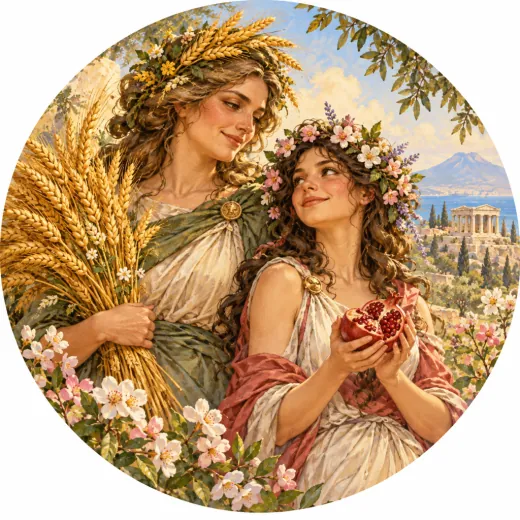
Persephone and Demeter
Persephónē and Dēmḗtēr
a little scary
Demeter was the goddess of grain and harvests, and she had a much-loved daughter, Persephone. One day, while the girl was picking flowers, Hades opened up the earth and carried her off to his kingdom to make her his queen. In despair, Demeter stopped the plants from growing, and hunger came to the earth. So Zeus found a deal: Persephone would spend part of the year with her mother and part with Hades, because down there she had eaten a few pomegranate seeds. When she comes back to her mother, it is spring.
Did you know? According to the poet Ovid, Persephone was taken while she was gathering flowers near Lake Pergusa, in Sicily.
The story
Once upon a time there was a girl who was picking flowers.
Her name was Persephone, and she was the daughter of Demeter, the goddess of grain. That day she was in a meadow with her companions, the daughters of Ocean, and they were all running through the grass looking for roses, violets, lilies and irises. The air was warm, the sky was clear. There was no reason at all to be afraid.
All at once, Persephone saw something unlike anything else.
It was a narcissus. But not just one: a clump of a hundred blooms was rising from the ground, white and gold, with a scent so strong it made your head spin. The earth had made it grow for one purpose only, to lure her, and Persephone, who suspected nothing, wandered away from the others and went over to pick it.
She reached out her hand.
Beneath her, the earth split open with a roar.
Out of the crack came a golden chariot, pulled by immortal horses. Standing in it was a man in a dark cloak: Hades, king of the dead, brother of Zeus. He seized her by the arm, pulled her up onto the chariot and, without a word, whipped the horses on.
Persephone screamed. She screamed her father Zeus's name, and her mother's, and her companions, far away, did not hear. The mountains answered with an echo, the sea with a rumble. But nobody else heard, except two: Hecate, the goddess of torches, in her cave, and the Sun, who sees everything from above.
Then the earth closed again. The meadow stayed just as it was, with the flowers in the basket and the scent of the narcissus in the air.
Demeter heard that echo from far away.
It was as if something had been torn out of her. She pulled the veil from her hair, threw a dark cloak over her shoulders and flew over land and sea like a bird, searching. For nine days she did not eat, did not drink, did not wash. She travelled the world with a burning torch in each hand, calling her daughter at every step. Nobody answered.
On the tenth day she met Hecate. “I heard a scream,” said the goddess. “I didn't see who it was. Let's ask the Sun.”
From high up on his chariot, the Sun spoke plainly. “It was Hades. Zeus himself, his brother, allowed it. Don't take it too hard: he is not an unworthy husband. He is the brother of the king of the gods, and he rules over many.”
Demeter would not listen. Her grief gave her a different shape. She left Olympus and wandered the earth in the form of an old woman, and she sat down at Eleusis, beside a well, like anyone who has lost everything. The daughters of the local king found her, took her home and invited her in. She wanted neither food nor wine. She sat there, motionless, eyes lowered. She did not want to speak to anyone.
They offered her red wine, but she refused it and asked instead for a bowl of barley mixed with water and mint. One of the women, Iambe, with her jokes and her teasing, at last managed to draw a smile from her.
Meanwhile, something in the world was changing.
In her grief, Demeter stopped the seeds from sprouting. The farmers ploughed, the oxen pulled the ploughs, but the earth would not let out a single ear of wheat. The fields stayed bare. Bread disappeared. For a whole year people went hungry, and the old were the first to fade away. The human race was in danger of dying out, and the gods would no longer receive any offerings or sacrifices.
Zeus sent messengers. He sent Iris, he sent the other gods, with gifts and promises. Demeter gave them all the same answer: “I will not go back to Olympus, and I will not let the grain grow, until I see my daughter again.”
So Zeus sent Hermes down to the kingdom of Hades.
Down there in the dark, Persephone had spent all that time sitting without speaking, thinking about the light. Hermes went down and found Hades on his throne, with Persephone beside him, pale and silent, refusing to eat in her grief. Hades listened. He did not argue.
“Very well,” he said. “Let her go back to her mother.”
Then, as Persephone stood up, he secretly held something out to her. “First, take this.”
It was a pomegranate seed, sweet, as red as a ruby. She ate it, frightened, almost without meaning to. It was a small thing, but Hades knew that a single seed was enough to bind whoever ate it to his kingdom.
Hermes brought her back to Eleusis on the golden chariot.
When Demeter saw her, she ran like a maenad. They held each other, and for a while they said nothing.
Then Demeter asked, “My daughter, did you eat anything down there?”
Persephone lowered her eyes. She told her everything, even about the seed.
Demeter was silent for a moment. Then she said quietly, “Then it will not be for ever.”
At that point, Zeus sent Rhea, the mother of the gods, with a message: Persephone would spend two thirds of the year with her mother, and one third with her husband, under the earth. Other poets, like Ovid, say half and half, and tell that there were seven seeds. The “Hymn” speaks of a single seed, and two thirds. But the meaning does not change.
Demeter smiled for the first time in many months. She looked at the countryside, and the countryside bloomed again: the fields were covered with wheat, the trees with leaves, the valleys with flowers. Then she taught the people of Eleusis her rites, and those rites stayed secret for centuries.
But every year, when the time of the agreement is over, Persephone rises from her throne and climbs the long staircase, all the way up to the light. And Demeter, on the other side, waits for her.
When they embrace, it is spring: fields that looked dead turn green within a few weeks, and even the stones seem softer.
When they part, the land grows silent, the leaves fall and the cold settles over the fields. But by now nobody is afraid of winter any more, not even the children watching it from the window. Because everyone knows that she, somewhere, is about to come back.
Relatives around the world
Listen / Read next
- Music to read by: Cinematic JourneyEpic film-style music, no lyrics, by Ciro Simone IrmiciSpotifyYouTube Music
Sources
- Homeric Hymn to Demeter (7th–6th century BC)
- Ovid, Metamorphoses, Book V
