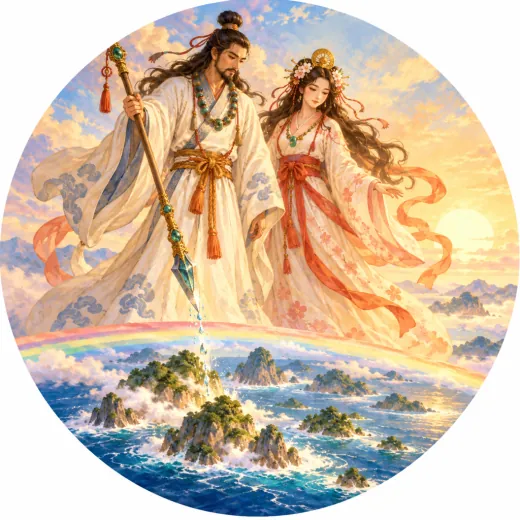
Izanagi and Izanami
イザナギ and イザナミ
a little scary
According to the Kojiki, the oldest book in Japan, in the beginning the earth was like oil floating on water. Two deities, Izanagi and Izanami, stepped onto the bridge of heaven and stirred the sea with a jewelled spear: the drops that fell from its tip formed the first island. Then they created the islands of Japan and many other deities. When Izanami died, Izanagi went to look for her in the land of the dead, but she had ordered him not to look at her, and he disobeyed the order.
Did you know? It resembles the Greek story of Orpheus and Eurydice, even though the two cultures were very far apart: it is only a resemblance.
The story
In the beginning, says the Kojiki, the earth was soft, like oil floating on water, or like a jellyfish drifting wherever the currents took it.
The gods of heaven took pity on it. They called two deities, Izanagi and Izanami, a brother and a sister, and told them, “Make this land solid.” And they gave them a spear decorated with jewels.
The two went down to the Floating Bridge of Heaven, which stood between the sky and the sea. Izanagi reached down with the spear and stirred the salty water. It made a deep gurgling sound, koworo, koworo, like a pot slowly coming to the boil. When he lifted the spear out, a few drops fell from its tip, and the drops thickened and became an island. They named it Onogoro.
They went down onto the island. Izanagi set up a pillar of heaven, and together they built a palace. Then they decided to marry and bring more lands into the world.
First they walked round the pillar, in opposite directions. When they met, Izanami spoke first: “What a handsome young man!” Then Izanagi spoke: “What a lovely young woman!”
But they had got it wrong. Their first child was born without bones, soft as a leech. They put him in a boat made of reeds and let him drift away. The second child was no better. So they climbed up to the gods of heaven, who read the signs in the bones of a deer and said, “It went wrong because the woman spoke first. Go back down and do it again.”
They went back, walked round the pillar once more, and this time Izanagi spoke first. And the islands were born. First Awaji, then Shikoku, then Oki, then Kyushu, then more and more, until there were eight great islands: Japan. And after the islands came the mountains, the winds, the trees, the valleys, and many gods.
Izanami's last child was a god of fire. As he was born, he burned her. Izanami fell ill and died.
Izanagi wept. He threw himself on her body, he crawled round her head and round her feet, and from his tears another god was born. Then he decided to follow her.
The road to Yomi went down under the earth, and the air smelt of moss and ash. At the bottom stood a dark palace with a closed door. Izanagi stopped in front of it. “My beloved wife,” he called, “the land we made is not finished. Come back.”
From the other side her voice answered, low and far away. “What a pity you came so late. I have already eaten at the hearth of Yomi. But it is an honour that you have come all this way. I will go and speak with the gods of Yomi. Wait for me. But do not look at me.”
She went into the palace. Izanagi waited.
He waited a long time, and the silence was so deep that he could hear his own heart beating. There was not a single bird, not even the sound of a shadow moving. In the end he could bear it no longer. He broke a tooth off the comb he wore in his hair and lit it like a torch. Then he went in.
What he saw froze his blood. Izanami was no longer the one he remembered. Her body had become the body of a dead woman, and around her, and on top of her, eight thunder spirits were moving.
Izanagi was afraid. He turned and ran.
“You have shamed me!” her voice screamed behind him. And she sent the hags of Yomi, the ugliest and fastest witches of all, to chase him.
Izanagi ran. Behind him he could hear footsteps, many footsteps, rustling like dry leaves. He tore the crown of black vines from his head and threw it on the ground: at once it became a bunch of grapes. The hags stopped to eat. He ran on, but they set off again. So he broke the comb he wore in his hair and threw it down, and its teeth became bamboo shoots. The hags gobbled those up too.
Then Izanami sent the eight thunder spirits, with fifteen hundred warriors of Yomi. Izanagi drew his sword and swung it behind him without looking back. He reached the foot of the slope that leads up to the world of the living, and there he found a peach tree. He picked three peaches and waited. When his enemies were close, he threw them, and every one of them fled. Behind him the uproar stopped all at once.
“You have helped me,” he told the peaches. “Now help all the people in the world of the living who find themselves in trouble.” And he gave them a name: Ōkamuzumi, “great god of the fruit”.
Last of all came Izanami herself. Izanagi took a boulder that a thousand men could not have moved and dragged it across until it blocked the slope. The boulder settled with a dull thud, and the silence that followed was the longest Izanagi could remember. The two of them stood on opposite sides, with the boulder between them, and their voices barely passed through the stone.
“My beloved husband,” she said, “if you do this, every day I will make a thousand people of your land die.”
“My beloved wife,” he answered, “if you do this, every day I will make fifteen hundred people be born.”
And so, says the Kojiki, every day a thousand people die and fifteen hundred are born.
Izanagi went back to the world of the living. “I have been to a horrible, unclean place,” he said. “I must wash.” He went to the mouth of a river, at Tachibana, took off his clothes and purified himself in the water. He threw away his staff, his belt, his bag, his clothes and the bands on his arms. From each of those things, as soon as it touched the ground, a god was born, and the river water carried the uncleanness away.
At last he washed his left eye. From it was born Amaterasu, the goddess of the sun. He washed his right eye, and Tsukuyomi, the god of the moon, was born. He washed his nose, and Susanoo, the god of storms, was born.
“I have had child after child,” said Izanagi, “and at the very end I have three noble children.”
Then Izanagi took off his necklace of jewels and gave it to Amaterasu: “Rule the High Plain of Heaven.” To Tsukuyomi he gave the kingdom of the night. To Susanoo, the sea.
A living tradition, told with respect: how we tell myths.
Relatives around the world
Listen / Read next
- Music to read by: Cinematic JourneyEpic film-style music, no lyrics, by Ciro Simone IrmiciSpotifyYouTube Music
Sources
- Kojiki (712)
- Nihon Shoki (720)
