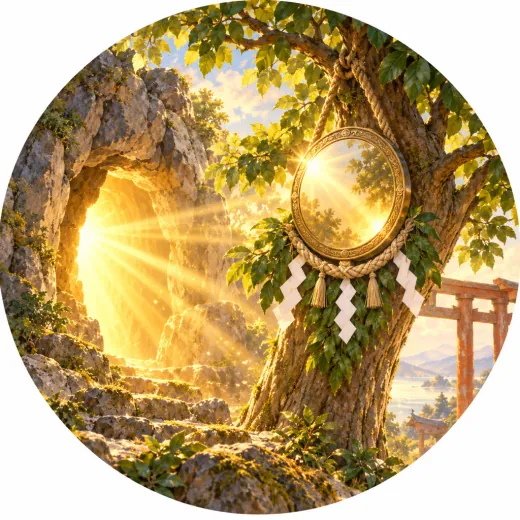
Amaterasu
天照, “shining in heaven”
not scary at all
Amaterasu is the deity of the sun, one of the most revered in Shinto. The Kojiki tells that, hurt by the misdeeds of her brother Susanoo, she shut herself away in a cave, and the whole world fell into darkness. The other deities did not know how to bring her out. Then a goddess began to dance in such a funny way that everyone burst out laughing. Curious to know what was so amusing, Amaterasu opened the rock door a little, saw her own light reflected in a mirror, and light returned to the world.
Did you know? Her main shrine, at Ise, has been rebuilt from scratch every twenty years for more than a thousand years, always the same, next to the old one.
The story
There was a time when the sun could decide not to come out.
Her name was Amaterasu, and she was not a ball of fire: she was a goddess, with a character of her own and with brothers, and she lived with the other gods on the High Plain of Heaven. Every morning she rose above the horizon and the world lit up. The rice fields turned gold, the rivers began to sparkle, children opened their eyes. Nobody thanked her. After all, do you thank the air you breathe?
She had a brother, Susanoo, the god of storms and of the sea. He had come up to heaven to say goodbye to her before setting off into exile, and instead of leaving he had stayed. That was Susanoo: wherever he went, the peace and quiet ended.
It started with mischief. He broke down the banks of his sister's rice fields. He filled in the channels that carried the water. He made a mess of the hall where the first harvest of the year was offered to the gods. Every time, Amaterasu stood up for him. “He didn't mean any harm,” she would say. “He just lost his temper.”
Then Susanoo did something that nobody could excuse. In the hall where the weavers made the gods' clothes, he made a hole in the roof and threw something terrifying inside. The women screamed and ran, and one of them, in her hurry, hurt herself on her shuttle and died.
Amaterasu did not answer back. She did not shout, she did not punish anyone. She did something much worse: she went away.
She went into a cave of rock, at the far end of heaven, and closed the entrance with an enormous stone.
The darkness fell all at once.
It was not the darkness of evening, the kind that slowly fills up with stars. It was total darkness, without end, over heaven and over earth. The evil spirits, who never dared show themselves in the light, came out in swarms, as noisy as flies in midsummer. The rice stopped growing. The cold crept down over the villages, and nobody could tell any more whether it had been night for a day or for a month. Animals lost their way. The gods tripped over one another and wondered who had switched off the world.
They gathered on the bank of the river of heaven, in the dark, feeling their way. There were a great many of them: the Kojiki says eight hundred myriads, which is a way of saying “all of them”. They talked, they argued, they interrupted each other. “We have to get her out.” “But how?” Praying had not worked. Threats were out of the question: you cannot demand anything of a goddess who holds up the sun.
The most patient of them all was Omoikane, the god who did the thinking for everyone else. He stayed silent for a long moment. Then he said, “If she won't listen to us, perhaps she will listen to something else.”
And he put together a plan, piece by piece.
First of all they gathered the roosters, the birds that sing at the end of the night, and made them crow in front of the cave, one after another, so that Amaterasu would remember that morning exists. Then they made a mirror, polished until it could reflect a whole face, and necklaces of curved jewels. They uprooted a sacred tree, hung the mirror, the jewels and long strips of cloth on it, and planted it in front of the stone door. Finally the strongest god, Tajikarao, went and hid beside the boulder, holding his breath.
Only one thing was missing. That was the goddess Uzume's job.
Uzume tied up her sleeves with twigs, put on a crown of leaves and picked up a bunch of bamboo. She turned a big tub upside down in front of the cave, climbed on top and began to stamp her feet. The wood boomed like a drum. Then she began to dance. She jumped, she spun, she pulled faces, she made up steps that nobody had ever seen before and that, to be honest, made no sense at all.
For a moment the gods just stood and watched in the faint glimmer. Then someone snorted. Then someone else clapped a hand over their mouth. Then they all burst out laughing together, roaring, crying with laughter, and their laughter was so loud that the High Plain of Heaven shook.
Inside the cave, Amaterasu heard it.
She kept still. She listened again. How long had she been in there, alone, with her back against the cold rock, thinking about how she had been wronged? She no longer knew. But that sound was strange. She had hidden, the world was dark, there should have been weeping. And instead, outside, they were laughing.
She moved the stone aside just enough for one eye.
“Why are you laughing?” she asked. “I am shut in here, and everything is dark. Why are you dancing?”
“Because a goddess brighter than you has arrived,” answered Uzume, without stopping her jumping.
At that moment two gods lifted the mirror and held it up in front of her eyes.
Amaterasu saw a shining face, and she did not recognise it. Who is that? she thought. She took one step outside to get a better look.
Just one step, but it was enough.
Tajikarao came out of the shadows, grabbed her hand and pulled her out of the cave. Behind her, another god quickly stretched out a rope of sacred straw and said, “You cannot go back any further than this.”
Light poured over heaven and earth. The mountains reappeared, then the rivers, then the fields. The evil spirits vanished back to wherever they had always been. Somebody in the meadow started laughing all over again.
There was no mercy for Susanoo. The gods made him pay a huge fine in gifts, they cut off his beard and his nails, and they sent him away from heaven.
Much later, the Nihon shoki tells us, Amaterasu sent her grandson Ninigi down to earth to rule it, and she gave him the mirror from that night. “Look at it as if you were looking at me,” she told him. “Keep it close to you when you sleep and when you eat.”
Ever since, they say, the mirror has been kept at Ise, in Amaterasu's shrine. Every twenty years the Japanese rebuild the shrine from scratch, exactly the same, next to the old one, as if each time they wanted to remember that light can be lost and found again.
The sun had come back without a battle and without a prayer. What brought her out was a laugh. And a little bit of curiosity.
A living tradition, told with respect: how we tell myths.
Relatives around the world
Listen / Read next
- Music to read by: Cinematic JourneyEpic film-style music, no lyrics, by Ciro Simone IrmiciSpotifyYouTube Music
Sources
- Kojiki (712)
