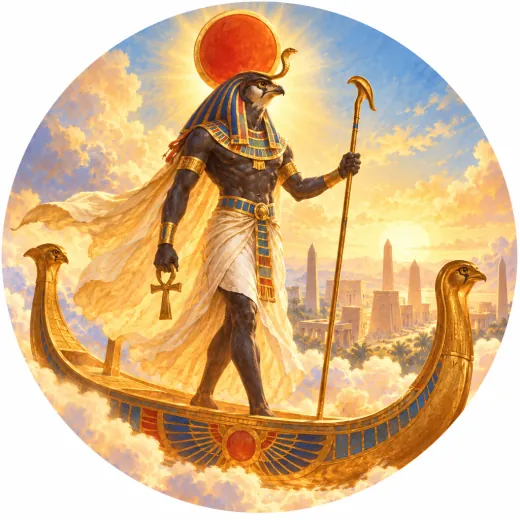
Ra
Rꜥ, the Sun
not scary at all
Ra was the god of the sun and, for the ancient Egyptians, the king of all the gods. He was often shown with a man's body and a falcon's head, with a sun disc above his head. Every day he crossed the sky in a boat, bringing light; every night his boat entered the underworld, where he had to get past a thousand dangers in order to be reborn in the morning. When the sun rose, the Egyptians knew that Ra had won once again.
Did you know? The obelisk in Piazza del Popolo, in Rome, comes from Heliopolis, the city of the sun: the emperor Augustus had it brought to Italy.
The story
Every evening, in Heliopolis, the sun died.
Heliopolis was the city of the sun: the place where, the Egyptians believed, everything had begun, and where the temples of Ra had been gazing at the horizon for longer than anyone could remember. Everyone saw it. The sun slid towards the horizon, red as an ember, and vanished behind the western desert. The sky went dark, and the light drew back from the rooftops, from the banks of the Nile, from the fields. And every evening, in Heliopolis, the priests of Ra stayed awake, watching the darkness. They knew something the rest of the world preferred to forget: nobody had promised that the dawn would come back.
Because Ra did not die. He went in.
Ra was the king of the gods: he was painted with the body of a man, the head of a falcon and a red disc above his head. By day he crossed the sky in a boat, and the light was his passing. At every sunset, the boat went down into a kingdom the Egyptians called the Duat, the world below. It was a hidden river, as long as the night. The Book of the Amduat, painted on the walls of the kings' tombs, tells it hour by hour: twelve hours, twelve gates, twelve regions, each with its own guardians and its own traps. Ra had to cross every one of them, one after another, without stopping, to come out on the other side. Strange beings lived in every region: serpents, gods with the heads of animals, souls who had been waiting for who knows how long. Some were friends. Others were not friends at all.
He did not travel alone. On the boat with him was a crew of gods, each with a job to do: one steered, one kept watch, one spoke the right words at the gates. Because in the Duat strength is not enough. The gates open only for someone who knows the name of the one who guards them.
In the first hours the water was dark and silent. On the banks lay the dead, many of them, stretched out in the shadows. They had been sleeping for a long time, without light. Then the boat passed, and its light brushed over them like a breath of warm wind. They opened their eyes. They raised their arms. Some spoke, others wept for joy. “Ra is here,” they whispered. “Ra has come to us.” For a moment, in the kingdom without a sun, it was day. Then the boat moved away, the banks fell back into darkness, and the dead lay down again to wait for the next night.
Halfway through the journey the river grew so narrow and dry that the boat could no longer sail: it had to be dragged across the sand, through a land without water, where Ra's light seemed as small as a lamp in a cave. It was the longest hour. No one on board said a word. Ra stood looking ahead. He knew that somewhere in front of him the sand came to an end and the river began again. All he had to do was not stop.
No one on the banks thanked him. No one up above knew that a journey was taking place.
At the sixth hour, at the deepest point of the night, the strangest thing of all happened. Ra met Osiris, the lord of the dead, and for a moment the two of them became one. The sun entered the body of the dead god, and set off again from there with new strength. It was the centre of the world below, the point where the light touched bottom. From there on, every hour would be a climb.
But straight after, in the seventh hour, came the danger.
Out of the black water rose Apophis, the serpent. He was as long as the river itself, as huge as a mountain, and he wanted only one thing: to stop the boat. If the boat stopped, the sun would not rise again, and the world would stay dark for ever. Apophis hissed, and the sound ran across the water like an icy wind. He coiled himself round the bow and opened his jaws wide.
The gods on the boat did not step back. No one screamed. No one ran. Each of them did what they knew how to do, as on every night, as on all the nights before, with steady hands and low voices, because in the Duat one wrong word can cost you the whole journey. They bound him with their spells, struck him with their spears and drove him back. The serpent sank back into the waves, wounded, and the boat moved on. They had not killed him: Apophis came back every night, and every night he had to be beaten all over again.
The hours went by. The gates opened one after another. In the last one, the boat entered the body of an enormous serpent and came out the other end, and Ra was no longer the same: he had been reborn, small like a young sun, ready to rise.
In Heliopolis, meanwhile, the priests were waiting.
It was the hour when the eastern sky is no longer black and not yet light, when even the birds fall silent to listen for whether something is happening. A grey thread along the horizon. Then a pink thread. Then a rim of gold.
And the sun rose.
The priests raised their arms, the people in the streets stopped where they were, and everyone shouted the same thing: Ra had won again.
The Egyptians never took it for granted. The Pyramid Texts, carved in the burial chambers of the most ancient kings, say that the pharaoh too, after his death, had to rise to the sky and take his place on the boat of the sun, beside Ra, to make that journey every night. It was not only an honour. It was a duty. He too would have to help keep the serpent away.
So when they watched the sun go down, the Egyptians did not feel only sadness. They felt that somewhere beneath their feet a boat had just set out across a dark river, and that on board was someone keeping the night at bay.
Every morning, when the sun appeared, they knew that the night just gone had been one of those nights when everything could have gone wrong, and nothing had. And they waited for the morning the way you wait for a friend who has promised to come back.
Relatives around the world
Listen / Read next
- Music to read by: Cinematic JourneyEpic film-style music, no lyrics, by Ciro Simone IrmiciSpotifyYouTube Music
Sources
- Pyramid Texts (about 2400 BC)
- Book of the Amduat (New Kingdom)
