Apophis
ꜥꜣpp, the serpent of chaos
scary
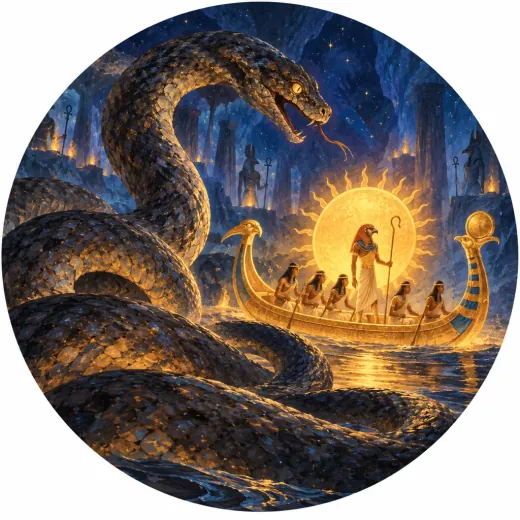
Apophis was a gigantic serpent, the enemy of Ra and of everything orderly. Every night, as the sun's boat passed through the underworld, Apophis lay in wait to swallow it and stop the light forever. Every night the gods fought him and drove him back, and in the morning the sun rose again. To help Ra, the priests wrote the serpent's name on a figure, trampled it, stabbed it with a flint knife and burned it.
Did you know? There is an asteroid called Apophis that will pass very close to the Earth in 2029, without any danger: it will be visible to the naked eye.
The story
Every evening, the sun died.
The Egyptians knew it. When the last light vanished behind the western hills, Ra went down into another world, a world beneath the earth, which they called the Duat. He did not go down alone. He travelled in a boat, the boat of the sun, and with him were the gods who defended him: Thoth with his words, Isis with her magic, and Seth, the strongest of them all, who stood at the prow with his spear in his hand.
The boat sailed for twelve hours. Twelve hours, twelve regions, one after another. At night Ra had the head of a ram, and his light was low and warm, like the glow of an ember. He crossed black rivers and passed by dead people who were waking up, sleepers who raised their heads as Ra went by, and in every region the sun's light entered the dark for a moment and left it a little brighter. The dead bowed. For as long as the boat stayed in front of them, the Duat was alive.
But there was an enemy.
He had no army. He had no kingdom. He had only one thing, and it was enough.
He was a serpent.
His name was Apophis, and he lived in the dark depths of the world, where there was no order. He was long, immensely long, and his coils disappeared into the fog. His eyes were two slits. He never slept. He wanted nothing: not gold, not power. He only wanted everything to end. For the boat to stop, for the sun not to rise, for the world to go back to the shapeless silence it had come from.
So he waited.
Every night, at a place in the river where the current slowed and the water grew shallow and thick, like a sandbank, the serpent lay across the channel. He stayed perfectly still, grey as the sand, until he felt the boat coming.
On board, nobody spoke.
All you could hear was the river rubbing against the hull, nothing else. On the banks, the songs of the dead died away one after another. The fog began to rise, low at first, then higher. The gods stared ahead, motionless. Ra stared ahead too. His light, for the first time that whole night, was trembling.
Then the boat slowed down.
The river seemed to shrink away, as if someone were drinking it. People said the serpent tried to stop the boat by drinking the water of the river. The sandy bottom crunched beneath the boat. The prow touched something soft and cold, and in front of them all a head rose up, enormous, emerging from the fog little by little.
The eyes of Apophis opened.
That gaze, people said, was a spell. Whoever met it could no longer move. Their arms grew heavy, and words would not come out of their mouths. Someone on board swayed. That was the moment when the boat truly risked stopping for ever, in the middle of the dark, with the serpent's jaws gaping in front of it.
But a voice rose from the boat.
It was Seth. He didn't shout, because there was no need. He spoke in the deep voice of someone who knows he is not afraid, and a light shot from his spear. Beside him, Thoth began to speak the right spells, one after another, the ones that bind an enemy with his own words. Isis answered with her magic. And around Ra's cabin, to protect it, coiled the serpent Mehen, who was also of serpent blood but stood on the side of the light.
Apophis hissed.
The fog churned. Little by little, the river began to rise again. The serpent writhed, drew back, showed his pale belly and slid away into the black water, until his head was no longer a head but only a shadow on the bottom.
The boat moved off again. Once more you could hear the water running against the hull, and that sound, small as it was, seemed like music. Nobody on board said a word. Ra raised a hand, and one by one the gods went back to their places.
It was not over. Apophis never truly dies: he knows he will be back. The gods knew it, and Ra knew it. That is why the journey began again every night, and every night the same battle was fought, in the same place, with the same words.
And up on the surface, someone was helping them.
In a temple in Thebes, as the sky turned grey, a young priest walked up to a table with a papyrus on it. It was the coldest hour, the one just before dawn. On the papyrus was written the name of Apophis, in green ink, next to a drawing of a serpent. The priest looked at it for a long time.
Then he began to read. Slowly, in a clear voice, the spells of The Book of Overthrowing Apophis.
He spat on the name. He trampled the figure with his left foot. He stabbed it with a flint knife. He threw it into the fire and watched until nothing was left but ash. It was slow, patient work, and the young priest did it with a little fear and a great deal of respect, because he believed that his words, that night, really did reach the river under the earth.
In the Duat, the boat was about to pass through the last gate.
Ahead of it, a crack opened. Then a pale streak. Then a light, rising from behind the horizon and tearing the fog apart with a golden hand.
Ra was alive. He had come out of the dark once again, as he had every morning since the world began.
On earth, in their houses, people opened their windows without knowing whom they should thank. Children woke up. Birds began to sing. The Nile turned silver, and the walls of the temples turned red.
Nobody knew that, beneath their feet, a grey serpent had gone back to hide in the shadows.
But the gods knew. And so did the young priest, who put out his oil lamp and rubbed his eyes.
That evening the sun would die again.
And the serpent would start waiting again.
Relatives around the world
Listen / Read next
- Music to read by: Cinematic JourneyEpic film-style music, no lyrics, by Ciro Simone IrmiciSpotifyYouTube Music
Sources
- Book of Apophis, Bremner-Rhind Papyrus (4th century BC)
- Book of the Amduat
