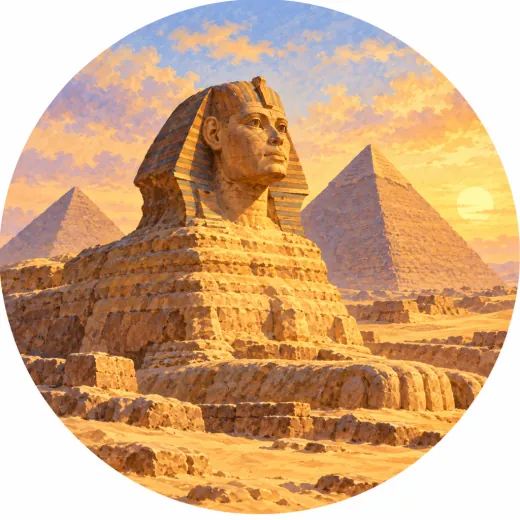
The Sphinx
the lion with a human face
not scary at all
In Egypt the sphinx was a lion with the head of a pharaoh, a symbol of strength and protection. The most famous of all, the Great Sphinx of Giza, is carved straight out of the rock and has watched over the pyramids for more than 4,500 years. A stone slab between its paws tells of a dream: a prince fell asleep in its shade, and the Sphinx promised to make him king if he freed it from the sand that covered it. It is said that the prince did so; what is certain is that he became the pharaoh Thutmose IV.
Did you know? The sphinx of the Greek myths is different: a winged female monster who set riddles for travellers and was beaten by Oedipus.
The story
At midday, in the desert of Giza, even the lizards hide.
The sun beats straight down on the sand, the air shimmers above the dunes, and the sky is white with light. Nothing moves. It is the hour when even people who have always lived in the desert look for a corner of shade and wait for it to pass.
That day, in the middle of all that white, a chariot was racing along.
On it rode a young prince, Thutmose, the son of the king of Egypt. He had gone out hunting gazelles and lions, as princes did, with two servants behind him. He was out of breath, his hands were burned by the reins, and he wanted only one thing: to sit down somewhere and close his eyes. But all around there was not a tree, not a rock, nothing at all.
Then, ahead of him, he saw something.
A head was rising out of the sand. A gigantic head, carved in stone, with the face of a king, a calm expression and its gaze turned to the east, towards the place where the sun rises. Further down, among the dunes, you could just make out the body of a lion, lying down, but almost completely buried. It was the Sphinx. It had been carved straight out of the rock, and little by little the sand had climbed up to its chest, and it was still climbing.
Thutmose stopped the horses and stood looking at it. He felt small, the way he had felt as a boy when he first saw the pyramids nearby, as big as mountains.
“Let's stop here,” he told the servants.
He got down from the chariot and sat in the shade of the head. Under that stone there was a coolness he had not felt all day. The servants moved away to let him rest, and he leaned his back against the warm rock and felt his eyelids grow heavy. The wind barely brushed the sand, with a faint rustle, like someone breathing softly. He fell asleep.
From a distance, the two servants watched him sleep and did not dare wake him. One of them took off his cloak and spread it over the prince's knees, to keep the flies off him. The other sat by the horses and made sure they did not wander off. For a while nothing happened. Then the wind stopped blowing altogether, and over Giza fell one of those silences in which you can hear your own heart.
In the dream, the Sphinx spoke.
Not with the voice of a monster, but with the voice of a father speaking to his son. “Look at me, Thutmose, my son,” it said. “I am your father, the god of many names: Horemakhet, Khepri, Ra, Atum. I will give you the kingdom on earth, at the head of the living. You will wear the white crown and the red crown on the throne of Geb. The land will be yours in all its length, and gifts will come to you from every country.”
Thutmose listened, his heart pounding.
“But look at the state I am in,” the Sphinx went on. “My body is suffering. The sand of the desert I lie on is covering me. I have waited for you a long time. I know that you are my son and my protector. Come. I am with you. Do what my heart desires.”
Then the voice fell silent, and the dream dissolved like salt in water.
Thutmose woke with a start, his forehead wet. The servants hurried over and called him twice, “My lord, my lord,” and he did not answer. The sun was still high, the sand still white, and in front of him were the same stone and the same silence. But he was not the same any more. He stood up and laid his hand on the Sphinx's paw, which was warm like the side of a sleeping animal. He understood that this had not been a dream like any other.
He promised. It did not take many words: the Sphinx was not waiting for words. It was enough for his hand to rest there a moment, on the stone.
It is said that in the days that followed the workers came, dozens of them, in neat lines, with baskets and shovels. They started at the top, at the head, then worked down towards the shoulders, and day after day the sand drew back like a wave returning to the sea. With every basket carried away, a little more of the lion appeared: the chest, the flanks, the long, peaceful paws resting on the ground. At first the workers laboured in silence, almost in awe. Then, seeing the whole body, they began to speak in low voices, as if in a temple.
When the last shovelful had been cleared, the Sphinx was free. It gazed at the dawn as it always had, but now with its whole body.
And Thutmose became pharaoh.
He never forgot that day. He had a stele carved, tall and smooth, and set between the Sphinx's paws, so that anyone passing could read what had happened there at midday, when he was just a tired boy looking for shade. He put in the dream, the name of the god, the words of the promise. The stele is still there, with its rows of hieroglyphs. Towards the end the stone has crumbled, and the last lines can no longer be read, as if time had wanted to keep the ending for itself.
The name the stele gave the god meant, more or less, “Horus in the horizon”: a god who stands where the sky touches the earth, and watches from there. Meanwhile the Sphinx goes on gazing to the east. It has watched pharaohs pass, and armies, caravans and travellers from every land. It has seen the sand come back, again and again, to cover its paws. It has never been in a hurry. It waits, motionless, for the sun to rise in front of it every morning, in a sky that turns to gold behind it at once.
The Egyptians knew who it was. Not a monster, not a statue: a god with the body of a lion and the face of a king, who has stood there watching over the pyramids for more than four and a half thousand years. And who, to anyone brave enough to sit in its shade at midday, may still have something to say.
Relatives around the world
Listen / Read next
- Music to read by: Cinematic JourneyEpic film-style music, no lyrics, by Ciro Simone IrmiciSpotifyYouTube Music
Sources
- Dream Stele of Thutmose IV (about 1400 BC)
- Herodotus, Histories, Book II
