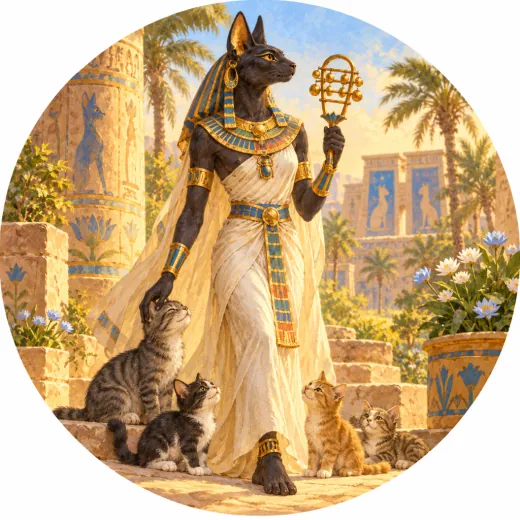
Bastet
Bꜣstt, in Egyptian
not scary at all
Bastet was the cat-headed goddess who protected the home and families, but also music and celebrations. According to scholars today, at first she was shown as a fierce lioness; later she became gentler and gentler, like a house cat. In her city, Bubastis, a great festival was held every year with music, dancing and crowds of people arriving by boat along the Nile. Cats were sacred to her: in Egypt they were deeply respected and were even mummified.
Did you know? The Greek historian Herodotus tells that when a cat died, the family shaved off their eyebrows as a sign of mourning.
The story
The cat died a few days before the great festival, old and grey, in the spot where the sun came in through the window.
It was the girl who found him. She sat down on the floor beside him, and for a while she said nothing. Then she went to fetch her mother.
Her mother looked at the cat without a flicker. She went over to the water bucket and picked up a bronze razor.
“Come here,” she said. “We'll do it all together.”
In Egypt, when a cat died in a house, everyone who lived there shaved off their eyebrows. It was the sign of mourning. It wasn't just for children or just for old people: it was for the whole family. And for a while, people went about with faces that looked a bit odd, a bit surprised, and nobody laughed.
The girl let them shave her eyebrows, keeping very still, with her hands clasped in her lap. When she looked at herself in the water of the bucket, with that bare face, she also saw her father's and mother's eyes, all with the same startled look. Then she didn't know whether to laugh or cry, and she did both.
“Now we'll take him to Bastet,” said her father.
They wrapped the cat in a linen cloth, carefully, the way you would a person. The festival of Bastet was close, and her father said there could be no better time to take him there. A cousin of the neighbours had a boat. The next morning, at dawn, they loaded the bundle and the food, and set off down the river.
Bubastis was a city in the Nile Delta, and dead cats from all over the country were taken there to be embalmed and buried in sacred places. It was the city of Bastet, the goddess with the head of a cat. Scholars today say that at first she was a lioness, powerful and fierce, and that over time she grew gentler and gentler, like the cats that live in people's houses. The Egyptians would have told the girl that Bastet was Bastet, and that cats knew her.
The journey was long, but it wasn't sad, because they were not alone.
As the days went by, the boats on the river grew more and more numerous. Too many to count. Full of men and women, old people and children, they all moved in the same direction, one behind another, packed together like leaves on a pond. And music came from the boats: flutes, castanets, tambourines, singing. Some women played castanets, some men played flutes, and everyone else clapped and sang.
Every time the boat passed a town, the music changed. They drew close to the bank, without touching it, and the women stood up and shouted jokes at the women of the town, who shouted jokes back from the bank, laughing. Nobody took offence. It was the game of the festival.
The girl sat in the boat with the bundle in her lap and listened. Then a woman next to her asked, “Have you got a cat in there?”
“Yes.”
“So have I,” said the woman, and pointed to another one, further along, in a basket. “We're all going to the same place.”
And for the first time in days, the girl felt a little less alone.
When they reached Bubastis it was evening. Over the years the city had been raised higher with the earth dug out of the canals. The temple had not: it had stayed low, in the middle, and you looked down on it from every street, like the bottom of a bowl. Water surrounded it on every side, and the only way in was along a path, beside great trees that gave shade. Inside stood the statue of the goddess.
All around them people were drinking and singing, and lanterns swayed on the boats. During the festival at Bubastis, more wine is drunk than in all the rest of the year. The local people said there were seven hundred thousand of them, men and women, not counting the children, and the girl thought there were as many as the grains of sand on the riverbank.
But she didn't let herself get swept along. With the bundle in her arms, she followed her father to a low house, where some silent men were receiving the dead cats. The priests looked at them one by one. When it was her turn, her father put a hand on her shoulder.
“It's your turn now.”
She handed over the bundle. A man took it in his arms, just as gently as she had.
“He'll be buried here, in Bubastis. In his own city.”
“And then?”
“And then he'll be fine,” said the man.
In Egypt, nobody ever harmed cats. Anyone who killed one, even by accident, was in serious trouble. They say that when a fire broke out in a house, people didn't rush to put it out: they stood in a ring, keeping watch over the cats. But the cats, who knows why, ran straight into the flames. And afterwards the Egyptians grieved for days, as if for a real death in the family. A person could spend hours watching a cat asleep on a wall, thinking that as long as there are cats, the world isn't completely lost.
The girl didn't know these things, but she knew that her cat had been a good cat. Every evening he had curled up at the foot of her bed, and every morning he had said hello in his own way, rubbing against her ankles.
That night there was music everywhere, even outside the city. The girl lay down on the sand and looked at the stars. Beside her, her father was singing softly, and a sweet smell of smoke drifted up from the temple.
“Dad,” she said. “Will my eyebrows grow back?”
“Of course.”
“Then it's all right.”
She fell asleep like that, amid the noise of the festival, a little sad and enormously tired, while all around her, on the warm stone of the temple, the cats of Bubastis stretched out in the dark, at peace.
As if they knew that everything was as it should be.
Relatives around the world
Listen / Read next
- Music to read by: Cinematic JourneyEpic film-style music, no lyrics, by Ciro Simone IrmiciSpotifyYouTube Music
- And in our homes: the catBestiepedia, guides for people who live with a pet
Sources
- Herodotus, Histories, Book II
- Pyramid Texts
