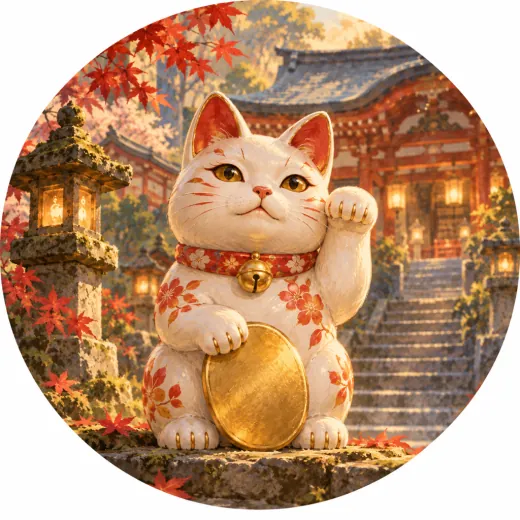
Maneki-neko
招き猫, “the beckoning cat”
not scary at all
In Japanese shop windows there is often a little ceramic cat with one paw raised, as if waving: it is the maneki-neko, the beckoning cat. One of the legends about its origin tells of a lord caught in a thunderstorm near a poor temple in a village outside Edo, old Tokyo. A cat in the doorway seemed to beckon him in with its paw. He went over, and at that very moment lightning struck the spot where he had been standing. Out of gratitude, the lord helped the temple, which became rich.
Did you know? It is said that a raised left paw calls in customers and a raised right paw calls in money, but this is a modern custom and in other shops it is the other way round.
The story
A long time ago, outside the walls of the city of Edo, there was a temple so poor that even the mice had moved out.
The roof leaked. The garden was full of weeds. In the kitchen, every evening, the monk who lived there boiled a rice soup so thin that it looked more like water than food. He had no worshippers and no gifts, and when he rang the bell, the only answer was the echo.
But the monk did have company.
His name was Tama, and he was a cat. Not a special cat: short pale fur, slightly tattered ears, a dark patch on his face. He had turned up one winter evening, as thin as a twig, and the monk, who had nothing to give him, had given him half his soup. From that day on he had never left.
In the evenings the monk sat on the veranda with his bowl in his hands and talked to the cat.
“Look at us, Tama. The two of us eat whatever there is. It isn't much. But it's all ours.”
Tama closed his eyes and purred. He seemed to understand.
Once the monk said to him, laughing, “If you were a magic cat, Tama, you could bring us a little luck.” The cat did not answer, of course. But his tail twitched once, slowly, as if to say: we'll see.
One summer afternoon, a hunting party passed through the nearby forest.
A lord on horseback, surrounded by men with hawks on their arms, was riding back towards the city. His name was Ii Naotaka, and he was the lord of Hikone: a powerful man, used to being obeyed. He had spent the whole morning in the woods, and the sky, which had been clear only a little while before, had filled with black clouds.
Suddenly the wind rose. The leaves whirled. Thunder rolled over the trees.
“Quick!” shouted one of his men. “We must find shelter!”
They stopped under a big tree, close to a stone wall. The rain began to pour down in buckets. The horses whinnied. Up in the sky, the thunder crashed closer and closer.
And that was when the lord saw it.
On top of the wall sat a cat. White, with a dark patch on its face. It was looking him straight in the eye. And as the lord stared back, the cat raised a paw and moved it, back and forth, back and forth, in a strange little gesture, as if it were calling him.
“What is it doing?” asked the lord.
“I don't know, my lord,” said a servant. “It looks as if it wants you to come over.”
Naotaka paused for a moment to think. It seemed ridiculous. But there was something in that gaze that made him want to listen. The sky flashed white.
“Let's go and see,” he said.
He left the tree. He strode across the meadow, the rain drumming on his shoulders, and reached the gate of the temple, where the cat was waiting for him. The others followed, a little puzzled.
They did not even have time to step inside.
Behind them came a flash and a roar so loud that the stones shook. The lord turned round. The tree they had been sheltering under had split in two, and it was burning. Right in the spot where, a moment earlier, he had been standing.
Nobody spoke. All they could hear was the crackle of the fire and the rain putting it out.
Naotaka looked at the cat. The cat, perfectly calm, was washing a paw.
The monk had heard the noise and appeared on the veranda in his threadbare robe. When he saw the lord and all his men standing there, soaked to the skin, he bowed so low that he almost touched the ground.
“I'm so sorry,” he stammered. “I have nothing here to offer you…”
“It doesn't matter,” said the lord. His voice had changed; it was softer. “Your cat has saved my life.”
They asked him for a little tea, and the monk made some with the very last leaves he had. They sat on the veranda and watched the storm pass. Drops fell from the roof into the cat's bowl, and nobody minded. The lord, who was used to golden halls, thought he had never drunk such good tea. He talked with the monk for a long time, and discovered that he was a wise man who knew a great deal about poetry and prayer, and that he was poor only because, until that day, nobody had ever come looking for him.
When the rain stopped, the lord climbed back onto his horse.
“I will come back,” he said.
And he did. Again and again. In time he had the roof repaired, the garden cleared, and rice and firewood and cloth brought to the temple. He decided that this temple would become the resting place of his ancestors, and that his family would protect it for ever. The little temple outside the walls filled with worshippers. Today it is called Gōtoku-ji, and it became rich and famous.
Tama, meanwhile, was still there. He spent his days enjoying the sun on the veranda, eating real fish instead of rice water, and every now and then the monk would look at him and shake his head, amused.
“So you really were a magic cat,” he would say.
The cat, of course, did not answer.
When Tama died, the monk and the lord's family gave him a proper burial. They built him a tomb in the temple garden, with a small headstone. Later, someone had the idea of making a little statue of the cat with its paw raised, in memory of the moment it had called a man over and saved his life.
People liked the statue. So another was made, and then another. Today, at the temple, hundreds of little white cats, all with one paw raised, fill the shelves. Anyone who has a wish takes one home, and when the wish comes true, brings it back.
That is why, in the windows of Japanese shops, on the counters of little restaurants, next to the tills in cafés, there is a cat waving one paw. The people who look at it don't know. But every time that little paw goes back and forth, amid the chatter of customers and the clink of coins, someone is still saying: come in, come in, there's a place for you.
The cat, of course, does not answer.
A living tradition, told with respect: how we tell myths.
Relatives around the world
Listen / Read next
- Music to read by: Cinematic JourneyEpic film-style music, no lyrics, by Ciro Simone IrmiciSpotifyYouTube Music
Sources
- tradition of the Gōtoku-ji temple, Tokyo (Edo period)
- Michael Dylan Foster, The Book of Yōkai (2015)
