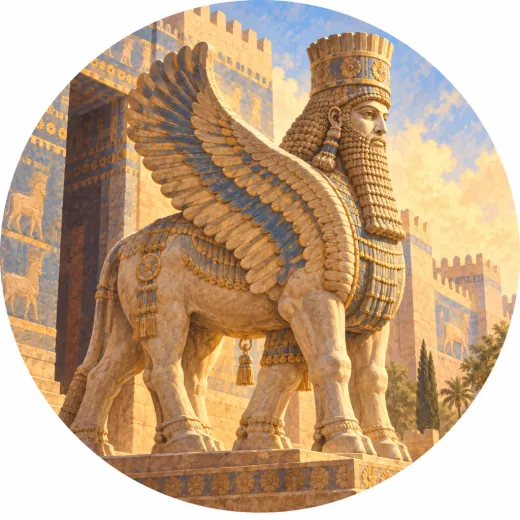
The Lamassu
lamassu, in Akkadian
not scary at all
The lamassu were protective creatures with the body of a bull or a lion, great eagle's wings and a man's head with a long curly beard and a tall crown. The Assyrian kings had gigantic pairs of them carved, more than four metres high, on either side of the gates of palaces and cities: their job was to keep evil away. Seen from the side they have five legs: so, from the front, they seem to stand still, and from the side they seem to be walking.
Did you know? Some original lamassu can be seen at the British Museum in London and at the Louvre in Paris.
The story
The messenger had been travelling for thirty-two days, and he was carrying a letter he could not read.
He came from a mountain kingdom beyond the border, where kings lived in fortresses of rough stone and trusted nothing but swords. His lord had sent him to the most powerful king in the world, to ask for peace. “If they let you in,” he had told him, “look at everything. Then come back and tell me what you saw.”
After a month on the road, one morning, from the top of a hill, he saw the city.
It was new. The walls were the colour of honey and shone as if someone had just washed them. All around, in the fields, hundreds of men were digging and carrying stones. King Sargon had wanted a capital all of his own, with a name all of his own: the Fortress of Sargon. Inside those walls there was a palace, and in front of the palace there was a gate.
The messenger got down from his horse, because his legs would not hold him. He could hear the noise of hammers, of wheels, of workers singing; the air smelled of hot dust and cut stone. And yet, at that spot in front of the gate, it seemed to him that everything had gone quieter and further away.
On either side of the entrance, enormous, stood two creatures.
They had the body of a bull, as big as a house, and on their backs two great folded eagle's wings. But the head was the head of a man. A head with a long curly beard, arranged in perfect rows, and on top a horned crown, like the crowns of the gods. Their stone eyes looked straight ahead. They were taller than two men, one standing on the other's shoulders, and when the messenger lifted his head to look them in the face, he had the feeling they were looking back.
“Don't be afraid,” said a voice.
The messenger jumped. It was only a guard, sitting in the shade of the wall with a jug of water. He was old and thin, and he had certainly seen him arrive and tremble.
“It happens to everyone,” he went on. “When messengers from the north see the lamassu for the first time, some kneel, some run away. One started praying in a language nobody understood. But they are here for you.”
“For us?”
“For anyone who comes in with good intentions. They are the guardians. The king had them carved to keep evil away: enemies, sickness, demons, anything that wants to come in and do harm. Anyone with a bad idea in his head knows it when he walks between them.”
The messenger swallowed. He looked at his hand, which was gripping the letter. He had a good idea in his head, and he felt calmer.
“How did they make them?” he asked.
“Each one is a single block of stone, cut out of the quarry and dragged here with ropes and logs by hundreds of men. Then the stonecutters worked on them for months. Look at them carefully, lad. Stand here, in front.”
The messenger stood in front. The two creatures looked at him: motionless, solemn, their front legs straight and side by side. They seemed to have stood still forever, like two mountains.
“Now come round to the side, and walk along by the wall.”
The messenger hesitated. At home the gates of the fortresses were made of wood, with a bar and two guards, and nobody had ever thought of carving a guardian out of rock. “And what if an enemy comes anyway?” he asked.
“Then he finds himself facing these two before he faces us,” the old man replied. “Anyone who comes with a sword in his hand has to pass through here, between these wings. We'll see how long it takes him to decide whether to keep going.”
The messenger walked along the bull's flank. And at a certain point he had a strange feeling: the creature was moving. Its legs were stepping forward, with the slow stride of someone walking out of a doorway. The messenger stopped. He looked again. He counted the legs.
“It has five,” he whispered.
“Five,” said the old man, and laughed for the first time. “Seen from the front, it stands still and keeps guard. Seen from the side, it walks and comes towards you. Whoever carved it knew that nobody ever stays in the same spot. This way the guardian watches everyone: those who arrive and those who pass by.”
Then he pointed to the wings. On the stone, in fine rows, the feathers had been carved one by one. Lower down, between the legs, there were tight lines of writing shaped like nails.
“What does it say?”
“The king's name, and why he built the gate. I can't read it. But I know that the words are there to keep the stone alive.”
The messenger touched the bull's side. The stone was smooth, cool and a little damp. He thought he could feel, under his hand, a very slow heartbeat.
Then the soldiers called him, and he went in. He walked between the two creatures with the letter in his hand and his head held high, and the gate welcomed him without a word.
The years went by. King Sargon died in battle, far from home, and his son decided to found another capital, at Nineveh. The new city, with its honey-coloured walls, was left empty. The desert wind brought sand, the roofs fell in, the streets disappeared.
But at the gates, still standing, the lamassu stayed at their posts. Little by little the earth covered them, up to their shoulders, up to their beards, up to their crowns. And they went on guarding the entrance to a palace that was no longer there.
More than two thousand five hundred years later, someone dug and found them again. The wings were still upright, the beards still in perfect rows, the eyes still open. Some of them went off to museums: today you can see them in London, at the British Museum, and in Paris, at the Louvre. They stand on either side of great halls, one on this side and one on that, just as in Sargon's day.
If you go to visit them, do what the messenger did. Stand in front of them and watch them standing still. Then step to the side, and watch them walk.
Relatives around the world
Listen / Read next
- Music to read by: Cinematic JourneyEpic film-style music, no lyrics, by Ciro Simone IrmiciSpotifyYouTube Music
Sources
- British Museum, Lamassu from the palace of Ashurnasirpal II
- inscriptions from the palaces of Sargon II at Khorsabad (8th century BC)
