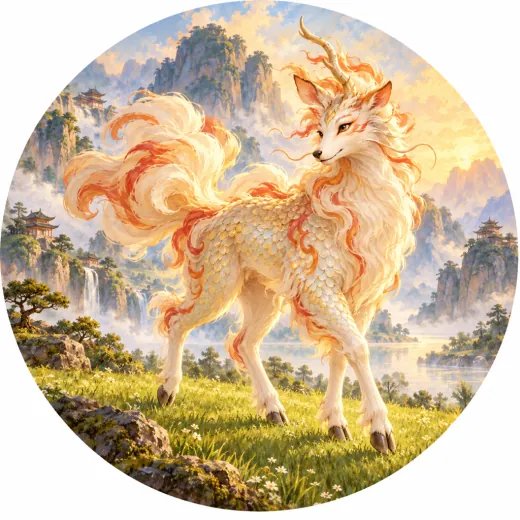
Qilin
麒麟, in Chinese
not scary at all
The qilin is an extremely gentle creature, with a deer's body, an ox's tail and a horn (in later images also scales and horse's hooves). It is so kind that it walks without trampling the grass or crushing even a single insect. It appears only rarely, when a great sage or a just ruler is about to be born or to die. A legend tells that a qilin appeared to Confucius's mother before he was born, leaving her a jade tablet.
Did you know? In 1414 a giraffe brought from Africa to the Chinese court was welcomed as a living qilin: the giraffe is still called “kirin” in Japanese and “girin” in Korean.
The story
That evening, the mother of Confucius was walking alone along a path through the hills.
Her name was Yan Zhengzai, and she was not rich. She had prayed for a long time for heaven to grant her a son, and now that the wait was almost over she could not keep still at home. The sun was going down, and the air smelled of cut grass. She walked as far as a clearing where the path opened out, sat down on a stone to rest, and closed her eyes.
When she opened them again, there was an animal in front of her.
She had never seen anything like it. Its body was a deer's, slender and light chestnut in colour, with an ox's tail that swung gently. On its forehead it carried a single horn, rounded at the tip and covered in soft skin, as if it had been made never to hurt anyone. It walked in a strange way: every step was measured and delicate, and where it set down its hooves, the grass did not bend.
Yan Zhengzai did not move. She had heard of this animal (the old people called it the qilin), but she had thought it belonged in books. The books said that the qilin was one of the four miraculous creatures, together with the dragon, the phoenix and the turtle. They said it almost never let itself be seen, and that you met it only when something great was about to happen.
The qilin stopped in front of her. It lowered its head, opened its mouth and let a jade tablet fall into her lap.
The jade was cool. On its surface there was writing, in fine, clear characters. The woman held it up to her eyes. The writing said that the son about to be born would be a great sage, and that although no king would ever give him a crown, his name would last longer than every throne.
Yan Zhengzai looked up, not knowing what to say. Then, to thank the animal, she did something simple. She untied an embroidered ribbon from her robe, a ribbon she had made with her own hands, and tied it carefully around the horn.
The qilin stayed with her for two nights, in the clearing, in silence. It did not eat. It did not drink. It let her stroke it. At dawn on the third day it got up, turned round one last time and walked away among the trees, and the red ribbon followed it like a small flame until it disappeared.
The son was born. They named him Kong Qiu, and the world would remember him as Confucius. His mother kept the jade, and told the story of the qilin to only a few. The boy grew up quiet and watchful, and when he played he liked to set little vessels out in a row, the way it is done in ceremonies.
Many years went by.
Confucius grew up, studied, taught. He travelled from state to state trying to persuade the princes to rule with justice, and hardly anyone listened to him. When he came back to Lu he was already old, with spotted hands and a bent back. He had gathered many pupils around him. He spent his days writing the annals of his country, one year after another, each event in a few dry lines.
One spring day, in the fourteenth year of Duke Ai of Lu, there was a great hunt in the west, on a plain outside the city. The clatter of chariots and dogs frightened the woods, and something leapt out of the bushes.
It was an animal the hunters did not know.
It had a deer's body, a single horn, an ox's tail. It was thin and frightened. It was trying to escape and did not know where to go. The men looked at one another. Nobody could say what kind of beast it was. One said it was bad luck. Another said it should be killed before it brought disaster. In the end a charioteer of the Shusun family caught it, and they carried it off without knowing what they had in their hands.
Someone ran to Confucius.
“Master, we've caught a strange beast. Come and see it.”
The old man put down his brush. He got up with difficulty and followed them. When he arrived, he crossed the courtyard, parted the crowd with one hand, and stopped.
In front of him was the qilin.
He recognised it at once, the way you recognise the face of someone you have never forgotten. The animal looked at him. Perhaps it recognised him too: they say that on its horn there was still a faded red thread, from a ribbon of many years before. But this is a detail every storyteller remembers a little differently.
“It is a qilin,” said Confucius. His voice shook.
The hunters said nothing.
“It comes only when there is a just king,” he went on. “It comes to announce something. And today it has come at a time when there is no just king, when there is nobody who knows how to recognise it, and they have caught it the way you catch a deer.”
He raised his sleeve to cover his face. When he lowered it, the sleeve was wet with tears. The Gongyang says that the master wept until his robe was soaked.
“Who has it come for?” he whispered. “Who has it come for, and why now?”
Nobody had the courage to answer.
That evening Confucius went back to his desk. He picked up his brush again. He wrote a single line, as short as all the others: In spring, in the fourteenth year, during a hunt in the west, a qilin was captured. Then he put down the brush. The annals he was writing end there. He never wrote another word of that book.
The Gongyang gives him, in those days, just one sentence: that his road had come to an end.
But the name of Confucius has lasted. What was written on the jade, in a clearing among the hills, came true: no king gave him a crown, and for more than two thousand years kings have studied his books.
And the qilin, they say, has shown itself even less since then. It is not waiting for a sage to be born, or for a sage to die. It is waiting for the world to learn to recognise it.
Relatives around the world
Listen / Read next
- Music to read by: Cinematic JourneyEpic film-style music, no lyrics, by Ciro Simone IrmiciSpotifyYouTube Music
Sources
- Liji, Book of Rites
- Wang Jia, Shiyi Ji (4th century)
