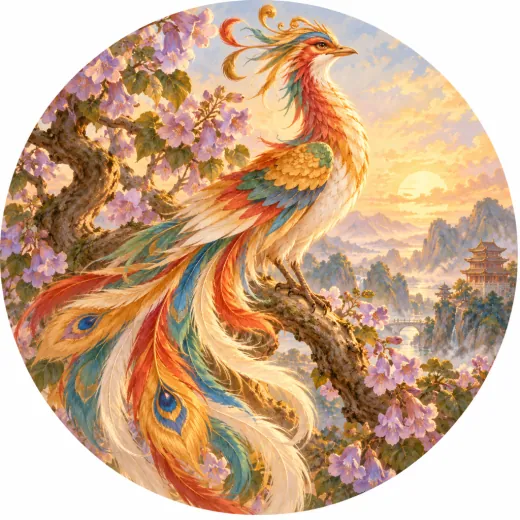
Fenghuang
鳳凰, in Chinese
not scary at all
The fenghuang is a marvellous bird with feathers of five colours and a long, flowing tail. It has nothing to do with the Greek phoenix that is reborn from its ashes, even though it is often called the Chinese phoenix: according to Chinese tradition it appears only in times of peace and good government, and disappears when dark times come. It perches only on paulownia trees, eats only bamboo seeds and drinks only from the purest springs. For centuries it was the symbol of the empress, just as the dragon was the symbol of the emperor.
Did you know? At traditional Chinese weddings the dragon and the phoenix are often seen together: they stand for a happy couple.
The story
Grandfather always said that you don't go looking for the fenghuang. You wait for it, and even waiting isn't enough.
She was little when she first heard him say it, during a lean winter, the kind when the rice runs out before spring. There had been hard years in the valley. People quarrelled over water, quarrelled over the edges of their fields, and in the evenings nobody was keen to open the door to a traveller. Grandfather, sitting by the brazier with his hands twisted by the cold, gazed at the embers and told stories.
“Once, a long time ago, the wise Confucius went far from home, because none of the lords would listen to him. And one day he sighed and said: the fenghuang comes no more. The river shows its signs no more. It is all over for me.”
“What is the fenghuang?” asked the little girl.
“A bird.” Grandfather smiled. “But not like the sparrows that steal the grain. It has feathers of five colours, and on its body there are markings that, if you look closely, are words. On its head, virtue; on its wings, justice; on its back, propriety; on its breast, humanity; on its belly, loyalty. It has a long tail that ripples like a ribbon. And nobody has ever seen it eat from someone else's field: it eats only bamboo seeds, drinks only from the purest springs, and will settle on no tree except the paulownia.”
“And where does it live?”
“On a faraway mountain called Danxue. But what the old books care about most is when it comes. The fenghuang shows itself only when the world is at peace. It sings by itself, it dances by itself, and when it appears, they say, the land is in order and the people live in harmony. When times turn bad, it disappears.”
The little girl looked outside. It was raining. On the roof of a house nearby, a crow was shaking the water from its feathers.
“Then it will never come,” she said.
“Perhaps not.” Grandfather shrugged. “But when it doesn't come, it's very convenient to blame the sky.”
The next morning he took her behind the house, where there was a patch of ground full of stones. With an old knife and frozen hands, they dug a hole. Grandfather took a paulownia seedling out of his pocket, pulled up who knows where, and planted it.
“This tree will grow fast,” he said. “It won't be the fenghuang that settles on it, not this year. But you need a tree, if you want to keep the door open.”
That spring they planted bamboo too, along the wall, where the wind was weakest. Grandfather cleared the little spring that trickled out of the rock and that nobody looked after any more. He took out the rotten leaves, moved a stone, and a thread of clear water began to flow again.
The neighbours watched and shook their heads. “Who are you doing it for?” they asked. “For a bird that doesn't exist?”
Grandfather didn't answer. But over the years a strange thing happened, the kind of thing nobody decides: people passing by would stop at the spring. Someone brought a stone to make a step. Someone offered to help with the fence. Then, when another winter came that hurt, a family that still had a little rice shared it with the family next door, and nobody made a song about it, because it seemed the natural thing to do.
One summer evening a traveller with worn-out shoes stopped and asked for a drink. He drank at the spring for a long time, then looked at the houses with no bolts on their doors and said quietly, “I have passed through many villages, and in none of them did I find the door open.” The girl didn't know what to say. She gave him a bowl of soup, and he set off again at dawn, lighter than before.
The paulownia grew tall. Grandfather grew smaller. One autumn morning he sat down under the tree to watch the leaves, and he did not get up again.
The girl, who was no longer a little girl, stayed. She went on keeping the spring clean. She went on planting bamboo, one every year. Sometimes, on the worst days, she caught herself thinking that her grandfather had been wrong, and that you can spend a whole life waiting for a bird that lives somewhere else.
Then, one day at the end of spring, her courtyard filled with a different kind of silence.
It was not the silence of fear. It was the silence in a hall when someone everyone respects walks in. The birds had stopped singing, one by one, as if they understood. Even the dogs on the far side of the stream fell quiet.
She looked up.
On the paulownia, at the very top, a bird had landed, larger than any bird anyone had ever seen. Its feathers did not have one colour: they had five, and they shifted with the light, red melting into yellow, yellow into green, and then blue, and a white like snow against the sun. Its long tail hung down like a banner, brushing the lowest branches. On its breast, among the feathers, were fine markings that she could have sworn she knew how to read.
The bird looked at her. Then it opened its beak and sang.
It was a sound unlike any music she had ever heard, and yet it made her think of all music. People came out of the houses, one at a time, in silence, still holding their ladles and hoes. Nobody spoke. A woman put her hand over her mouth. A man took off his hat.
The fenghuang spread its wings and danced.
It stayed all that day, and all that night, and a while longer. It drank at the clean spring. It pecked the seeds from the bamboo she had planted years before. Then, one morning, it was gone.
Nobody cried, because it had not left out of disappointment. It had left the way a kind guest leaves, with the house in good order.
And the woman, her hair grey by now, went out behind the house, dug a hole where the wind was weakest, and planted another bamboo.
Because good times, she had understood, are not something that arrives. They are something that somebody keeps open.
Relatives around the world
Listen / Read next
- Music to read by: Cinematic JourneyEpic film-style music, no lyrics, by Ciro Simone IrmiciSpotifyYouTube Music
Sources
- Shanhaijing, Classic of Mountains and Seas
- Confucius, Analects, Book IX
