Pegasus
Pḗgasos, in Greek
not scary at all
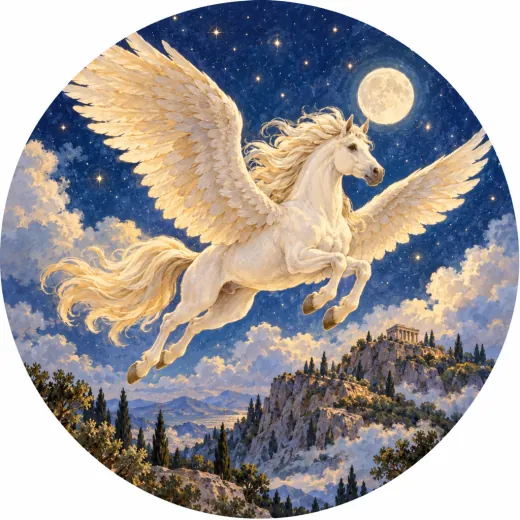
Pegasus is the white horse with wings, born from the neck of Medusa when Perseus defeated her. He was wild and no one could ride him, until the hero Bellerophon tamed him, according to the poet Pindar, with the help of a golden bridle given to him by the goddess Athena. Together they defeated the Chimera, a fire-breathing monster. When Pegasus struck Mount Helicon with his hoof, a spring burst out, the Hippocrene, dear to the Muses and to poets. The Greeks said that in the end Zeus turned him into a constellation.
Did you know? The constellation of Pegasus is easy to see on autumn evenings: four stars form a great square.
The story
Pegasus' first breath was a neigh, and it stopped the waves.
He had only just been born, and he was already on his feet. A monster had brought him into the world: at the edges of the world, near the springs of Ocean, Perseus had cut off Medusa's head, and from her neck, like a seed from a fruit, two children had sprung. One was Chrysaor, a giant with a golden sword. The other was a white horse with wings.
Hesiod tells us he was named Pegasus because he was born near the springs of the Ocean. In Greek, springs are called pegai. But he had no use for a name. He had just opened his wings, and the sky was in front of him.
He took off. For a while he went nowhere at all: he flew round in circles above the waves, drunk on air. Then he flew upwards, higher and higher, all the way to the home of the gods. Zeus saw him coming. He took him into his stables, and from then on Pegasus carried the thunderbolts of the father of the gods from one sky to another, like a messenger no one can stop.
But there were days when he came down to earth.
Once he landed on Mount Helicon, in Boeotia, where the nine Muses lived, the goddesses of song and poetry. He was tired and restless and wanted to stamp. He struck the rock with his hoof, just once.
The mountain shook. The stone cracked, and water came out of the hole. Clear, cold water that gushed and foamed as if it could not wait to be born. It was a spring. Later, people called it Hippocrene, the Horse's Spring.
Ovid tells us that when the news spread, even Athena came down, the goddess the Romans called Minerva. She wanted to see with her own eyes the spring born from a hoof. “I didn't believe it,” she told the Muses. “A horse born from a monster's blood, and now a spring for poets.” One of the nine took her by the hand and led her through the trees to the rock, still dark and wet. Athena bent over the water and gazed at it for a long time. They say that whoever drinks from it becomes a poet. Pegasus, meanwhile, was already far away.
For years no one could get near him. No horse gallops like a horse that can fly. No rope can hold a horse that can slice through the clouds.
Then, in a Greek city, Corinth, there appeared a young hero called Bellerophon.
He wanted to tame Pegasus. He had heard that the horse came to drink at one of the city's springs, the spring of Pirene, every morning at dawn. He waited for days, but the horse would not let him come close. So he asked a seer for advice, and the seer told him to sleep in the temple of Athena.
Bellerophon lay down on the altar in the silence of the night. He dreamed of a tall goddess with grey eyes, holding something out to him. When he woke, there beside him on the stone lay a golden bridle.
He ran to the spring. Pegasus was there, white in the morning light, drinking. He raised his head and looked at him. Bellerophon did not move. He lifted the bridle, slowly, so that it shone.
The horse stared at it. Then, to his surprise, he lowered his head. He let the bridle slip over his nose, as if he had been waiting for it all along. Bellerophon climbed onto his back, and the world dropped away from under his legs.
Up they went. He clung to the mane with both hands, and below him he saw Corinth shrink to the size of a coin, then the coast, then the sea, with islands like scattered leaves. The wind took his breath away and filled his eyes. He was frightened, and he was laughing. Pegasus did not gallop: he swam through the air with wide, slow wingbeats, and with every beat the clouds parted like curtains. For the first time, Bellerophon understood what it meant to have no walls around him. That evening they landed on a hill, and the horse let him stroke his neck, still warm, smelling of wind and hay.
The King of Lycia, Iobates, had welcomed Bellerophon with honour, and only after nine days of feasting had he opened a letter the hero carried with him. In it, another king asked him to have Bellerophon killed. Iobates did not want to dirty his own hands, so instead he gave him a task that seemed impossible: to kill the Chimera. It was a monster with the head of a lion, the body of a goat and the tail of a serpent, and its breath burned like a furnace. No one who had faced it had ever come back. The shepherds of Lycia had stopped taking their flocks up to the high pastures, and at night a red glow could be seen in the mountains.
Bellerophon did not fight it on the ground. He flew above it, out of reach of the fire, and after circling for a long time he struck it from above. Hesiod says the Chimera was killed by Pegasus and the hero together. For once, a monster could not touch anyone.
It was the best day of their lives. And perhaps that was why Bellerophon began to think he was a god.
Because a man who has flown above the clouds will, sooner or later, want to fly higher still. One morning he urged Pegasus upwards, towards the gates of Olympus, where no mortal has ever been allowed. Higher and higher they climbed, until Pegasus reared. He would go no further. The horse knew what the hero had forgotten: up there, boundaries are meant to be respected.
Bellerophon slipped. He fell. He fell a long way, and was left alone, far from both men and gods, to wander for the rest of his life.
Pegasus flew on upwards, alone, all the way home. He went back to Zeus's stables and carried his thunderbolts once more.
The Greeks said that, in the end, Zeus placed him among the stars. Even today, on autumn evenings, you can look for him in the sky: four stars make a great square, the horse's body, and from one corner stretches a trail of light, his neck.
If you look up and wait for your eyes to get used to the dark, you can see him too.
He is still flying.
Relatives around the world
Listen / Read next
- Music to read by: Cinematic JourneyEpic film-style music, no lyrics, by Ciro Simone IrmiciSpotifyYouTube Music
Sources
- Hesiod, Theogony
- Ovid, Metamorphoses, Book V
