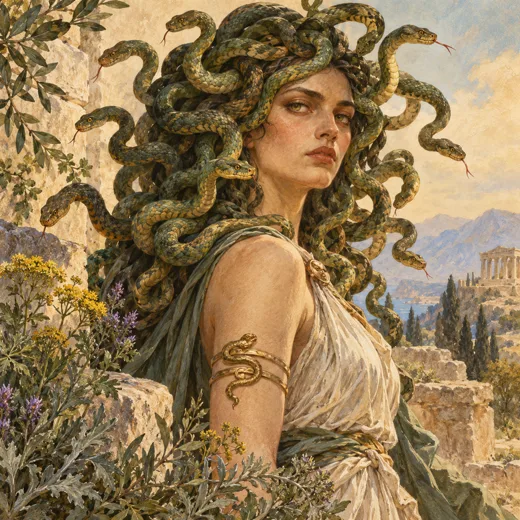
Medusa
Médousa, in Ancient Greek
scary
She was one of the three Gorgons, with snakes instead of hair: anyone who looked her in the eyes was turned to stone. The hero Perseus faced her by looking only at her reflection in his shiny shield. The myth says that Pegasus, the winged horse, was born from her neck. Perseus later used her head to save Princess Andromeda from a sea monster, and in the end he gave it to the goddess Athena, who placed it in the centre of her shield.
Did you know? In the oldest versions she was a monster from birth; in the version of the Roman poet Ovid she was a girl transformed by a goddess.
The story
At the edges of the world, where the sea ends and the dark begins, there was an island with no birds.
No seagulls, no swallows, not even a cricket in the grass. Only statues.
Statues of warriors with their swords raised. Statues of shepherds holding their crooks. A statue of a dog curled up, of a woman covering her face with her arms, of a little boy who had been running and had stopped halfway through a step. All grey, all covered in moss, all with their mouths open, as if they had been about to scream and had run out of time.
Three sisters lived on the island: the Gorgons. Two of them were immortal. The third, Medusa, was not. And Medusa was the one nobody must ever look at.
Ovid, the poet, says that she had once been the most beautiful girl in Greece, with hair so splendid that travellers stopped in the road to see her. Then something happened in Athena's temple, and the goddess had punished her, terribly: her hair turned into snakes. Other stories, older ones, say she was a monster from the day she was born. Nobody knows which is true. On that shore, in the silence, it made no difference.
Anyone who met her eyes turned to stone.
One day, a young man landed on that beach.
His name was Perseus. The king of a faraway island had given him a task that sounded like a death sentence: “Bring me the head of Medusa.” Perseus was young, but he was not alone. Athena, the goddess of intelligence, was helping him, and so was Hermes, the messenger of the gods.
The journey was long. First he found the Graeae, three old sisters who had been born with white hair already, and who shared a single eye and a single tooth between them. They passed them from hand to hand, and for a moment, as they passed them, all three were blind. Perseus waited for that moment, snatched the eye and said quietly, “You’ll have it back when you tell me where the nymphs live.” The old women shrieked, threatened, begged. Then they talked.
The nymphs gave him three gifts. A pair of sandals with wings, for flying. A magic bag, strong enough to hold anything at all. And a helmet that made whoever wore it invisible: it was the helmet of Hades, the lord of the dead. Athena lent him a bronze shield so polished that it could be used as a mirror. Hermes handed him a sickle that would never break.
“Never look at her,” Athena told him. “Not for a single instant. Not even if she calls you.”
Perseus flew for a day and a night. When he reached the sky above the island, he felt the silence rising up towards him.
Below him the sea was black and smooth, without a single wave, as if even the water were afraid to move. The air smelled of wet stone. The sun gave no warmth.
He landed without a sound. He walked among the statues with the shield held in front of his chest and his eyes fixed on the bronze, where everything looked small and upside down, as in a pond. He saw the warrior with the sword. He saw the dog. He saw the little boy. He felt like stopping to say sorry to each one of them.
At the far end of the island, in the shadow of a cave, something was moving slowly.
It was a hiss. No, it was a thousand hisses, thin ones, all woven together. In the shield appeared a figure lying on the ground, asleep, with her head resting on one arm. And on her head, something alive: hundreds of snakes, slow ones, coiling and uncoiling with every breath she took.
Perseus did not breathe. He could hear his blood pounding in his ears, so loudly he was afraid it would wake her. He put on the helmet and vanished. He took one step, then another, still looking only at the shield. He raised the sickle. The reflection trembled.
It is said that at that moment Athena’s hand came to rest on his, to guide it.
A single blow, clean, without a cry. Then silence, a silence even greater than before.
When Perseus opened the bag and pushed the head inside, without looking at it, the snakes were still hissing. And from the severed neck, the myth says, came two creatures no one had ever seen: a white horse with wings, who was called Pegasus, and a giant with a golden sword, who was called Chrysaor. The monster, as she died, left two children to the world.
But the worst was not over.
A scream split the sky: the two Gorgon sisters had woken up. They smelled the blood. They flew over the island on golden wings, with bronze hands and breath that smelled of iron, searching for the killer. With the helmet on his head, Perseus was invisible: but not to their noses, and not to their ears, which could hear the rustle of his sandals. He felt them behind him, closer and closer. He raced across the sky, through the clouds, his heart in his mouth, while the bag weighed on him like a boulder.
The sisters chased him for a whole day, screaming. Then, at evening, a cloud hid him. And the noise faded away over the sea.
Perseus used that head one more time, against Phineus and his warriors, who wanted to snatch away the princess Andromeda, just saved from a sea monster: they all turned to stone in front of those lifeless eyes. Then he gave it to Athena, who fixed it in the middle of her shield, to protect the whole of Greece.
For centuries, painters put her on the walls of temples, on coins, on armour: a round face, tongue sticking out, eyes wide open. To frighten anyone who wanted to do harm.
And on the island with no birds, they say, the statues are still there, grey and covered in moss.
They are waiting for someone to look them in the face, to tell each of them what their name was, to remind them what the sun was like.
But if one day you happen to find yourself in a place like that, where no bird sings, do what Perseus did.
Never look straight at it.
Look in the reflection.
Relatives around the world
Listen / Read next
- Music to read by: Cinematic JourneyEpic film-style music, no lyrics, by Ciro Simone IrmiciSpotifyYouTube Music
Sources
- Hesiod, Theogony
- Ovid, Metamorphoses, Book IV
