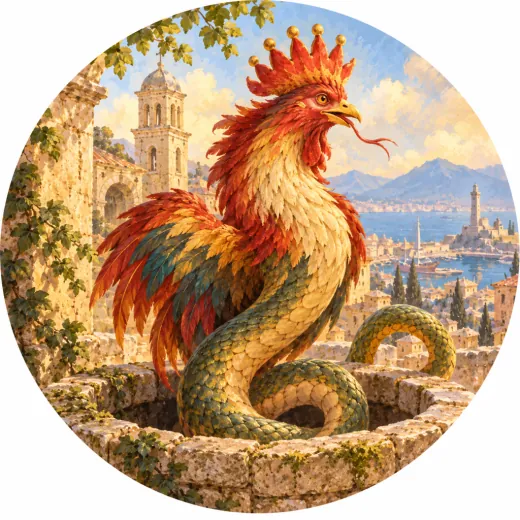
The Basilisk of Genoa
basilisk, from the Greek for “little king”
scary
The basilisk is a monster from medieval bestiaries: half rooster and half snake, with a crown-shaped crest, able to make people ill with its breath. In Genoa people said one was hiding in a well, and that everyone living nearby fell sick. Bishop Syrus, who later became the city's patron saint, went to the well and with his prayers forced the monster out and away; in some versions it ended up in the sea. The scene is carved and painted in several Genoese churches.
Did you know? At the corner of Via San Siro and Via di Fossatello there is still a plaque marking the well of the legend.
The story
In the bestiaries of the Middle Ages, those books full of real and invented animals, there was one creature that was more frightening than all the others: the basilisk.
It was drawn with the body of a serpent and the head of a cockerel, with a little crest on its forehead in the shape of a crown. That is why its name, in Greek, means "little king". It was said that its gaze alone, or its breath, was enough to kill whoever met it. It was the king of serpents, and where it passed, the grass withered.
In Genoa, according to the legend, a basilisk once really did arrive.
It did not come from the sea, or from the mountains. It hid in a well. A well like many others, in the middle of the city, in a narrow area of alleys, where people went to draw water. The monster went down there, into the damp darkness, and crouched.
Trouble began. Its breath rose from the well and spread through the district, like a poisonous smell. The children had fevers. The old people fell ill. Animals dropped to the ground. People did not understand what was happening. Then one man, braver than the others, leaned over the rim of the well, and saw two burning eyes looking at him from the bottom.
The news went round the city. Nobody dared go near any more. There was no water. The sickness grew.
It was then that someone thought of the bishop.
His name was Syrus. He was the bishop of Genoa, a man born in his own city and loved by everyone, who had guided the community for about thirty years. He died, they say, on a 29 June, perhaps in the year 381. For this reason some place him in the fourth century, others later. But his fame as a saint had begun even before his death.
Syrus listened. He took no weapons. He called no soldiers. He said only that for three days the city would pray and do penance. Three days of silence, of fasting, of prayers. The triduum.
When the three days had passed, the bishop went to the well.
He had a bucket brought. He tied it to a rope. And in front of a crowd holding its breath, he lowered it into the well, down, down into the darkness, until it touched something.
Then he spoke to the monster. He ordered it to get into the bucket.
Silence. The rope went taut. Something heavy had moved. Syrus began to pull up, slowly. The men in the crowd pressed together. The women closed their eyes. When the bucket appeared at the rim, inside it was the basilisk, motionless, with its eyes lowered.
The bishop spoke to it again. He ordered it to go to the sea and vanish for ever.
The monster obeyed. It climbed down from the bucket, crawled along the streets between two wings of crowd that stepped aside, and threw itself into the water. The waves swallowed it. Nobody ever saw it again.
The well became clean again. The sick recovered. Genoa went on with its life of port and trade, of ships and alleys.
Some say this story is not really about a monster. It is about something else, a battle of ideas. Syrus is said to have fought against Arianism, a heresy that divided Christians. The basilisk, according to this reading, is a way of telling that struggle. But it is only a probability. Nobody has ever proved it.
What we do know is that the scene was carved. In Genoa, in vico San Pietro della Porta, according to some sources (others place it at the corner of Via San Siro and Via di Fossatello), there is a marble plaque from 1580. It shows a holy bishop subduing a serpent. Beside it, a mysterious inscription: CCCCLXXX. Four hundred and eighty. Nobody knows what it means.
People who pass by usually do not look up.
But if you do, and you stop to look at that worn old marble, you can almost hear the water at the bottom of the well, and the sound of a rope coming up.
Relatives around the world
In the trails
Listen / Read next
- Music to read by: Cinematic JourneyEpic film-style music, no lyrics, by Ciro Simone IrmiciSpotifyYouTube Music
- The words of the dialect: GenoeseNonnese, the dictionary of Italian dialects
