San Fruttuoso and the Dragon
the bay beneath the Portofino headland · Liguria
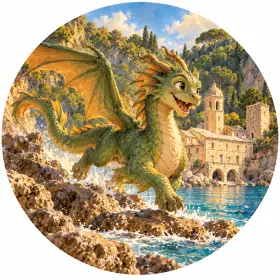
According to tradition, Prosper, bishop of Tarragona, was fleeing by sea from Spain, invaded by the Arabs, carrying the relics of Saint Fructuosus. In a dream the martyr told him where to stop: a lonely bay beneath the mountain, with a spring of fresh water. There, in the eighth century, the first church was born. Some also tell of a dragon that lived in the bay and was defeated, but the abbey's official pages do not mention it. The abbey really exists, hidden in a bay of the Portofino headland, and today it is cared for by FAI, the Italian heritage trust.
Did you know? No road reaches the abbey of San Fruttuoso: you can only get there on foot or by boat.
Sources: FAI, Fondo per l'Ambiente Italiano, «Abbazia di San Fruttuoso»; Città Metropolitana di Genova, «Complesso abbaziale San Fruttuoso di Capodimonte»
The Bàsura of the Grotte di Toirano
“bàsura”, witch in Ligurian · Liguria
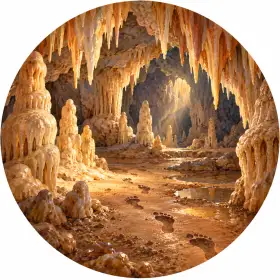
In Ligurian “bàsura” means witch, and the most famous cave of Toirano is called the Witch's Cave. People said a witch lived inside: the wind going in and out of the cracks made strange whistles and sighs. Nobody ever wrote down a real story about the witch, though. What is inside is even more surprising: in 1950 some explorers found hundreds of footprints, handprints and knee prints left by people who lived about 14,000 years ago.
Did you know? A 2019 study found that the prints include those of children about 3 and 6 years old.
Sources: Ministero della Cultura, «Grotte di Toirano»; Romano e altri, «A multidisciplinary approach to a unique palaeolithic human ichnological record from Italy (Bàsura Cave)», eLife (2019)
The Basilisk of Genoa
basilisk, from the Greek for “little king” · Liguria
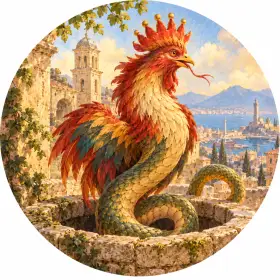
The basilisk is a monster from medieval bestiaries: half rooster and half snake, with a crown-shaped crest, able to make people ill with its breath. In Genoa people said one was hiding in a well, and that everyone living nearby fell sick. Bishop Syrus, who later became the city's patron saint, went to the well and with his prayers forced the monster out and away; in some versions it ended up in the sea. The scene is carved and painted in several Genoese churches.
Did you know? At the corner of Via San Siro and Via di Fossatello there is still a plaque marking the well of the legend.
Sources: Paolo Giardelli, studio sulle tradizioni popolari liguri, Atti della Società Ligure di Storia Patria (2004); Catalogo generale dei Beni Culturali, «S. Siro scaccia il basilisco»
The Witches of Triora
the “village of witches” · Liguria
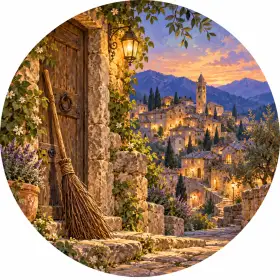
Triora is a stone village high above the Argentina valley. Between 1587 and 1589, after two years of bad harvests, some women were accused of having brought hunger with magic. They were put on trial and treated harshly, until the authorities of Genoa stopped the trial. Today we know they were innocent: the harvests failed because of the weather, and poverty did the rest. Beside the true story, a legend grew of the “bàsure” meeting at night to dance in a lonely house outside the village, the Cabotina.
Did you know? Triora has an Ethnographic and Witchcraft Museum that tells the story of the trial and of mountain life in those centuries.
Sources: Michele Rosi, «Le streghe di Triora in Liguria. Processi di stregoneria e relative quistioni giurisdizionali nella seconda metà del secolo XVI», Roma, Tipografia delle Mantellate (1898), edizione Liber Liber; Comune di Triora, Museo Etnografico e della Stregoneria, «La stregoneria»
The Madonna Bianca of Portovenere
the painting that came from the sea · Liguria
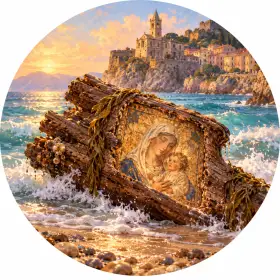
Tradition says that in 1204 a cedar log drifted from the sea to the shore of Portovenere, and inside it was a painting of the Madonna. Over the years the painting grew dark and was set aside. In 1399, during a plague, a man praying before it saw it turn bright and luminous again: today everyone calls it the Madonna Bianca (the White Madonna). It is said that after that day the sickness ended. The painting and the piece of log are still kept in the church of San Lorenzo.
Did you know? Every 17 August Portovenere lights up with thousands of small candles for the procession of the Madonna Bianca.
Sources: Catalogo generale dei Beni Culturali, «Madonna Bianca»; Discover Portovenere (sito turistico locale), «La festa della Madonna Bianca»