Colapesce
“Cola Pisci”, Nicholas the fish · Sicily
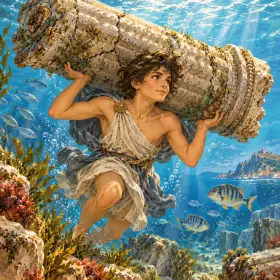
Nicholas was a boy from Messina who spent more time in the sea than on land, so much that he became half fish. The king put him to the test: he made him bring back a golden cup thrown into the sea, then a crown, then a ring, deeper and deeper each time. On his last dive Nicholas discovered that Sicily rests on three columns and that one of them was cracked by the fire of Etna: so he decided to stay down there and hold it up, to keep the island from sinking. In the oldest versions, he simply never comes back up.
Did you know? When there is an earthquake, people say Colapesce has shifted to rest his shoulder.
Sources: Giuseppe Pitrè, «Studi di leggende popolari in Sicilia» (1904); Italo Calvino, «Fiabe italiane», Einaudi (1956)
The Pupi and Orlando
“l’Opra dî pupi”, in Sicilian · Sicily
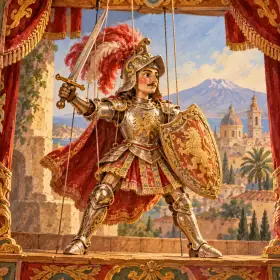
In Sicilian puppet theatres, wooden marionettes in shining armour tell the deeds of Charlemagne's paladins: Orlando, the strongest of all, his cousin Rinaldo, the traitor Gano of Maganza, the battles against the Saracens and the love for beautiful Angelica. The stories come from chivalric poems such as Ariosto's “Orlando Furioso”. The puppeteers moved the pupi with iron rods, the main one running through the head, often improvised the lines, and one story could go on in instalments, night after night, for months.
Did you know? The Opera dei Pupi was proclaimed by UNESCO in 2001 and inscribed in 2008 on the Representative List of the Intangible Cultural Heritage.
Sources: Ministero della Cultura, Ufficio UNESCO, «Opera dei Pupi, teatro siciliano dei pupi»; Ludovico Ariosto, «Orlando furioso» (1532)
The Donne di Fora
“donni di fora”, the ladies from outside · Sicily
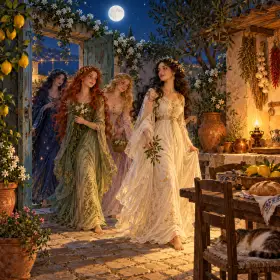
In Sicily people told of creatures, half fairies and half witches, who went round houses at night, thirty-three creatures led by a Great Mother: the donne di fora. Out of respect people called them “the Beautiful Ladies”. If they found the house tidy and were welcomed kindly, they brought luck; if they were offended, they caused trouble. People also believed that some women left their sleeping bodies at night to join them. Traces of these beliefs remain in the records of the Inquisition too.
Did you know? The great scholar Giuseppe Pitrè, in the nineteenth century, collected from people's own voices many popular Sicilian stories like these.
Sources: Giuseppe Pitrè, «Usi e costumi, credenze e pregiudizi del popolo siciliano», vol. IV (1889); Claudia Geremia, «Religions» (2024), articolo sulle donne di fora nei documenti dell'Inquisizione
Arethusa and Alpheus
the spring of Syracuse · Sicily
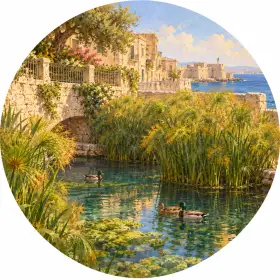
Arethusa was a nymph who followed the goddess Artemis through the woods of Greece. One day, while she was bathing in a river, the god of that river, Alpheus, fell in love with her and began to follow her, but she wanted nothing to do with him. To help her, Artemis hid her in a cloud; the nymph, in her anguish, dissolved into water, and the goddess opened the earth so that she could flow under the sea, all the way to the island of Ortygia, in Sicily. But Alpheus did not give up: he too crossed the sea beneath the waves to join his waters with those of the spring. Ovid tells the story.
Did you know? The Arethusa Spring, a few metres from the sea, now has brackish water because of seepage from the sea, and its basin is rich in papyrus.
Sources: Ovidio, «Metamorfosi», libro V; ENIT, italia.it, «Fonte Aretusa»
Polyphemus the Cyclops and Etna
“Polyphemos”, in Greek · Sicily
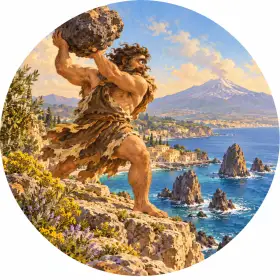
According to a tradition later than Homer, the Cyclopes, giants with a single eye, lived in the caves of Etna. In the Odyssey, Ulysses and his companions are trapped in the cave of one of them, Polyphemus. Ulysses says his name is “Nobody”, blinds him and escapes hidden under the bellies of the sheep. Furious, Polyphemus hurls huge boulders at the ship: according to tradition they are the sea stacks off Aci Trezza. Ovid also tells of his unrequited love for the nymph Galatea.
Did you know? When Polyphemus shouted “Nobody has blinded me!”, the other Cyclopes thought it was an evil sent by the gods and advised him to pray to his father, instead of helping him.
Sources: Omero, «Odissea», libro IX; Ovidio, «Metamorfosi», libro XIII; ENIT, italia.it, «Riviera dei Ciclopi»