The Uomo Cervo of Castelnuovo al Volturno
the Stag Man, “Gl'Cierv” · Molise
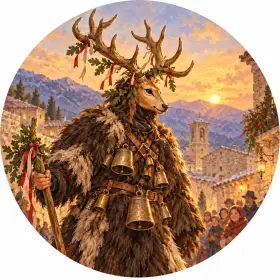
On the last Sunday of Carnival, at sunset, the Uomo Cervo (the Stag Man) comes into the square: a man covered in furs, with a mask and a great branching rack of antlers on his head, who runs among the crowd and stirs everyone up. He is the wild force of nature. With him come the Cerva (the Hind) and Martino, a figure dressed in white who tries to catch him. At the end the hunter arrives and the stag falls. But soon after he gets up again: it is nature that dies in winter and is reborn in spring.
Did you know? The association that keeps the rite alive calls it an “ancestral tradition”, with no firm dates: nobody can say exactly how old it is.
Sources: Alessandro Testa, «Il carnevale dell'uomo-animale. Le dimensioni storiche e socio-culturali di una festa appenninica», Napoli, Loffredo (2014); Associazione Il Cervo APS, «Gl'Cierv. La storia»
The Mysteries of Campobasso
the “ingegni” that make people fly · Molise
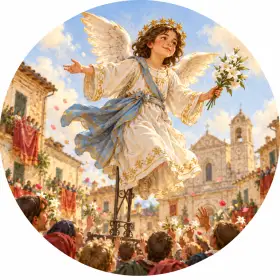
More than a legend, it is a wonder repeated every year. For the feast of Corpus Domini the “Misteri” parade through Campobasso: thirteen iron machines called ingegni, carrying real people, mostly children. The machines are metal structures with complex and daring stage sets, and the figures seem to hang in mid-air, as if flying above the crowd. The machines were invented in the mid-eighteenth century by a Campobasso sculptor, Paolo Saverio Di Zinno, and since then they have been carried through the streets.
Did you know? According to the FAI heritage trust, the Mysteries have paraded for more than 260 years, since the mid-eighteenth century.
Sources: FAI, I Luoghi del Cuore, «Museo dei Misteri, Campobasso»; Dora Catalano, «Bollettino d'Arte», Ministero della Cultura (2011)
The Devil of Tufara
“lu Diavule” · Molise
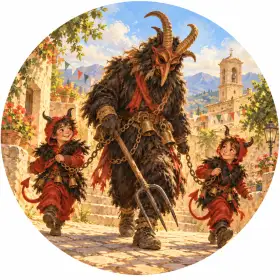
On the last day of Carnival, in Tufara, the devil runs through the streets of the village. He is a man dressed in black goatskins, with a frightening mask and a pitchfork in his hand. He is held in chains by some goblins, who drag him along and now and then let him loose among the people. With him walk figures dressed in white with floured faces, representing Death. It is the struggle between good and evil, and the passage from winter to spring: at the end it is the Carnival puppet that is tried and sentenced, and then thrown down from the cliff.
Did you know? According to those who tell its story, the costume of the Devil of Tufara was once made of seven goatskins.
Sources: Associazione Culturale Antica Maschera «Il Diavolo» di Tufara, «Il Rito»; Rete Italiana di Cultura Popolare, «Il Diavolo di Tufara» (2022)
The 'Ndocciata of Agnone
the “'ndocce”, the torches · Molise
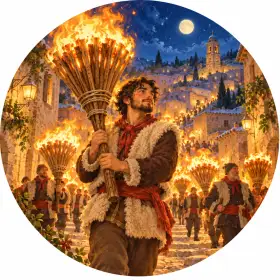
On Christmas Eve, in Agnone, a river of fire flows down the streets. It is made of many “'ndocce”, big fan-shaped torches of fir wood, each with many flames, carried on the shoulders of the people of the town's districts. Where this custom comes from nobody knows for sure. Many think of ancient fire rites for the longest night of the year; over time the torches became the light of Christmas, the light farmers used to walk down to church.
Did you know? A single 'ndoccia can have up to twenty flames burning at once.
Sources: Lo Scarpone, rivista del Club Alpino Italiano, Gian Luca Gasca, «'Ndocciata di Agnone: la magia del fuoco che illumina il Molise» (2025); Touring Club Italiano (associazione per il turismo), «La 'Ndocciata di Agnone»
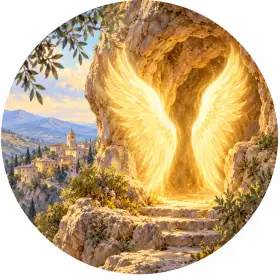
Saint Michael and the Cave of Sant'Angelo in Grotte
the archangel's cave · Molise
Above the village of Sant'Angelo in Grotte a cave opens in the rock. The cave is dedicated to the archangel Michael, and his cult here began after the apparitions on the Gargano, where his most famous sanctuary still stands. The village itself takes its name from the cave and from the angel it is dedicated to. The cave is still a place of devotion, and it is part of a long chain of places dedicated to Saint Michael along the Apennines.
Did you know? According to the Pro Loco, the first traces of worship in this cave date from around the year 800, about twelve hundred years ago.
Sources: Pro Loco Sant'Angelo in Grotte, «Grotta di San Michele Arcangelo»; ENIT, italia.it (portale turistico nazionale), «Sant'Angelo in Grotte»; Showcaves.com (sito sulle grotte turistiche), «Grotta di San Michele (Molise)»