The Mazzariol
Mazaròl or Mazzaruò, in Venetian and Ladin dialects · Veneto
The Mazzariol is a little man dressed in red who lives in the woods around Belluno. Anyone who accidentally steps on one of his footprints loses the path and walks in circles, confused, until the elf decides to let them go. A famous story, told mainly in nearby Primiero, says that he kidnapped a girl, Ninetta, and that she learnt from him how to make cheese, butter and tosela, and when she went home she taught it all to her village.
Did you know? In the Ansiei valley people say the red glow on the rock at sunset is the jacket of the Mazzaruò, trapped up there.
Sources: Zanichelli, «Lettere in movimento», «Una leggenda italiana: il Mazzaruò della valle dell'Ansiei»; Babytrekking, «La leggenda del Mazaròl a Malga Juribello»
The Anguane of the Buso
“el Buso dele Anguane”, the cave of the Anguane · Veneto
Between Crespadoro and Durlo, in the valleys near Vicenza, a cave opens in a rock face, called “el Buso dele Anguane”. Old people said that the Anguane, water women, lived there. In the stories about them, sometimes they teach men their trades, other times they draw men to them, and nobody ever knows how it will end. Their stories were told during the “filò”, winter evenings spent in warm cowsheds while it snowed outside. They are cousins of the Anguane of Trentino and the Agane of Friuli.
Did you know? The “filò” was a winter evening when whole families gathered in the cowshed, warmed by the animals, to spin wool and tell stories.
Sources: Vicenza è, turismo della provincia di Vicenza, «Magic Tour»; Sharry.land, «El Buso dele Anguane»
Romeo and Juliet in Verona
the story of the two lovers of Verona · Veneto
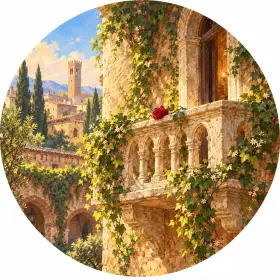
Two young people from Verona fall in love, but they belong to two enemy families, the Montagues and the Capulets. They marry in secret, then a series of misunderstandings tears them apart and the story ends badly for both. It is not an old legend passed down by word of mouth: a similar tale already appears in Masuccio Salernitano (1476, set in Siena), but it was Luigi da Porto, from Vicenza, around 1530, who first set it in Verona; then William Shakespeare made it famous all over the world. Yet Verona has made it its own: there is a “Juliet's house” with a balcony and a statue, visited every year by huge numbers of people.
Did you know? Every year thousands of letters addressed to Juliet arrive in Verona, and a group of volunteers answers every one of them.
Sources: Luigi da Porto, «Historia novellamente ritrovata di due nobili amanti» (circa 1530); William Shakespeare, «Romeo and Juliet» (1597)
The Legend of Lago di Misurina
Lake Misurina: Princess Misurina and King Sorapiss · Veneto
King Sorapiss had only one daughter, Misurina, who was very spoilt. One day she heard that a fairy of Mount Cristallo owned a magic mirror able to read thoughts, and she wanted it at any cost. The fairy agreed to give it on one condition: the king had to turn into a mountain. Out of love for his daughter, Sorapiss accepted. But while her father was turning to rock, Misurina, happy at the thought of playing on the new mountain, looked down, felt dizzy and fell from the summit. The mountain-king wept so much that his tears formed two streams, which joined further down: the lake was born.
Did you know? The lake bears the princess's name, and the big mountain nearby, Sorapiss, bears her father's.
Sources: Karl Felix Wolff, «Dolomitensagen» (1913); SiViaggia (sito di viaggi), «La leggenda del Lago di Misurina»
Saint Mark and the Lion of Venice
“Pax tibi Marce”, peace be with you, Mark · Veneto
According to tradition, Mark the Evangelist was travelling when he stopped on an island in the lagoon. In a dream an angel appeared and told him: “Peace be with you, Mark: one day your body will rest here.” Many centuries later, in 828, some Venetian merchants “stole” the saint's body in Alexandria in Egypt and brought it to Venice: this is a historical fact. The dream was told afterwards, to explain why the saint had to rest right there. Since then the winged lion with an open book has been the symbol of the city.
Did you know? The lion of Saint Mark almost always holds a book, and on the book is written “Pax tibi Marce, evangelista meus”: “Peace be with you, Mark, my evangelist”.
Sources: Archivio di Stato di Rovigo, «I leoni di San Marco», materiale didattico (2021); Ministero della Cultura, Gallerie dell'Accademia di Venezia, «L'opera del giorno: Cima da Conegliano»