The Rocca del Drago of Roghudi
“Rokka du Traku”, in the Greek of Calabria · Calabria
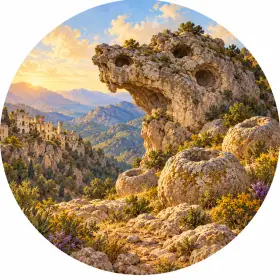
Near the abandoned village of Roghudi Vecchio, in the Aspromonte mountains, a winding road passes two places with strange names: the Rocca del Drago (the Dragon Rock) and the Caldaie del Latte (the Milk Cauldrons), rocks wrapped in myths and mysteries. In village tales the Rock looks like a dragon's head; it is said that the dragon guarded a treasure and that people offered it milk to keep it calm, but these details are not confirmed by the sources consulted. The rocks really exist and their shape is the work of wind and rain.
Did you know? In that area people still speak Grecanico, a Greek dialect that arrived in Calabria many centuries ago.
Sources: ENIT, italia.it, «Bova, Pentedattilo, Roghudi Vecchio»; SiViaggia, «Gli 8 borghi più belli del Parco dell'Aspromonte»
Scylla and Charybdis
“Skylla” and “Charybdis”, in Greek · Calabria
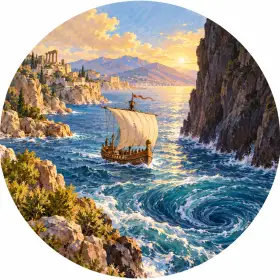
In the Odyssey, Ulysses has to sail through a very dangerous strait. On one side is Scylla, a monster with six heads on long necks that snatch sailors from their ships; on the other is Charybdis, a whirlpool that swallows the sea three times a day. The sorceress Circe advises him to keep closer to Scylla. The poet Ovid tells that Scylla had once been a beautiful nymph, turned into a monster by a jealous Circe. Tradition places Scylla on the Calabrian cliff and Charybdis on the Sicilian shore.
Did you know? The Italian saying “between Scylla and Charybdis”, meaning between two dangers, comes straight from the Odyssey.
Sources: Omero, «Odissea», libro XII; Ovidio, «Metamorfosi», libri XIII e XIV
The Fata Morgana
the sorceress of the cities in the sky · Calabria
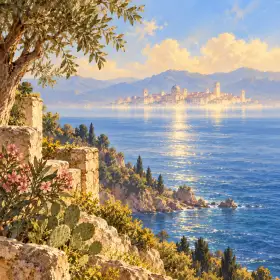
Morgana is the sorceress of the King Arthur stories. According to the scholar Arturo Graf, the tales of Arthur reached Sicily with the Normans in the eleventh century, and so her name became linked to the Strait of Messina. In Reggio the visions that sometimes appear on the water are called “Morgana”: castles, towers, arches and pillars that are not there. The first to give the phenomenon this name was the chronicler Marc'Antonio Politi, in 1617. The true part is spectacular: it is a mirage, and you can really see it.
Did you know? “Fata morgana” has become the scientific name of a kind of mirage studied all over the world: when the air above the sea has layers at different temperatures, distant coasts look like floating cities.
Sources: Andrew T. Young, San Diego State University, «Fata Morgana mirages»; Consiglio regionale della Calabria, «Fata Morgana»
The Treasure of Alaric in the Busento
the tomb beneath the river · Calabria
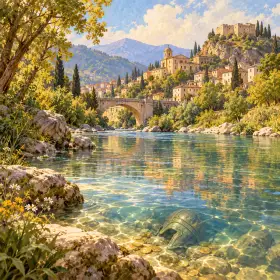
Alaric, king of the Visigoths, sacked Rome in 410 and then went south, planning to cross to Africa. He fell ill and died near Cosenza: this is history. The historian Jordanes tells that his warriors diverted the river Busento, buried the king in the riverbed together with great riches, and then let the water back in, so that nobody could ever find the tomb. The legend adds an immense treasure, the plunder of Rome, and the king buried in armour on his horse.
Did you know? Alaric's tomb has never been found, even though people have been looking for almost three hundred years, most recently in 2015 with ground radar and drones.
Sources: Giordane, «Getica», capitolo XXX (VI secolo); Treccani, Enciclopedia Italiana (1929), «Alarico I»
Saint Francis of Paola and the Cloak
the crossing of the Strait · Calabria
Francis was a friar from Paola who wanted to cross the Strait to Sicily with his companions. On the beach of Catona he asked a boatman for a ride, but the boatman wanted to be paid, and Francis had no money. So the friar knelt to pray, spread his cloak on the water, climbed onto it with his companions (one or two, depending on the version) and, using his staff as a mast and a corner of the cloak as a sail, reached the other shore. That is why he is venerated as the patron of seafaring people.
Did you know? Francis of Paola is the patron saint of Calabria, and the scene of the cloak on the Strait is painted in many churches in southern Italy.
Sources: Catalogo generale dei Beni Culturali, «San Francesco di Paola attraversa lo stretto di Messina col suo mantello»; Ministero della Cultura, Biblioteche, «Profilo di San Francesco di Paola»