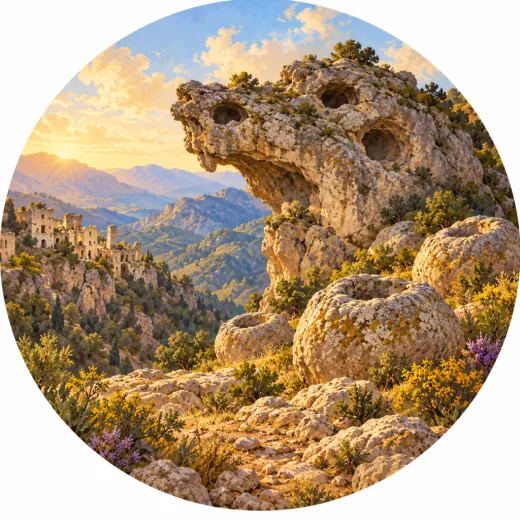
The Rocca del Drago of Roghudi
“Rokka du Traku”, in the Greek of Calabria
a little scary
Near the abandoned village of Roghudi Vecchio, in the Aspromonte mountains, a winding road passes two places with strange names: the Rocca del Drago (the Dragon Rock) and the Caldaie del Latte (the Milk Cauldrons), rocks wrapped in myths and mysteries. In village tales the Rock looks like a dragon's head; it is said that the dragon guarded a treasure and that people offered it milk to keep it calm, but these details are not confirmed by the sources consulted. The rocks really exist and their shape is the work of wind and rain.
Did you know? In that area people still speak Grecanico, a Greek dialect that arrived in Calabria many centuries ago.
The story
On the Aspromonte, at the southernmost point of Calabria, there is a village where nobody lives any more.
It is called Roghudi Vecchio. It stands on a ridge of rock, sheer above a stony river, the Amendolea torrent, which in summer is almost dry and in winter becomes a fury. The houses are in tight rows along the slope, one above the other, linked by flights of steps and by alleys that climb and drop. The village grows from top to bottom, adapting to the shape of the rock, as if it had come out of the mountain itself.
To reach it you must take a winding road, with bends that climb through the woods. Then, suddenly, the village appears. Silent. Empty. With windows without glass and doors flung open.
Once there were shepherds. People who lived on sheep and goats, who with transhumance spent the winter down below and the summer in the mountains. They were part of a particular community, the Grecanici: people who in that area still speak a Greek dialect, which came to Calabria many, many centuries ago.
Then, in the 1970s, came the floods. Violent. The river water came down from the mountains and the houses began to give way. The families were evacuated, one after another, and went to live elsewhere, in a new village built lower down. Roghudi Vecchio remained as it is today: a place without inhabitants, with its streets still standing.
And yet the village is not a sad place. It is a silent place. Those who pass through usually speak in low voices.
And along the road that leads to Roghudi Vecchio there are two strange things.
The first is called Rocca del Drako. It is the Greek name of this area: "drako", the same word from which "dragon" comes. It is a great rock, jutting from the side of the mountain. It is said that its shape, with its dark hollows, recalls the head of a dragon.
The second is the Caldaie del Latte, the Milk Cauldrons. They too are rock formations, large and round. Their name brings to mind great pots, the kind in which shepherds heat milk to make cheese.
The sources I read say only this: they are geological formations "wrapped in myths and mysteries". They do not tell the myth. They are names, and that is all.
But in the tradition that is passed down, and which we report here with caution, because we could not verify it, a story is told. They say a dragon lived in that rock, and that the dragon guarded a treasure. They say that the inhabitants, to keep him calm, and not to make him angry, offered him milk now and then. And some tell that the great round rocks, close by, were the cauldrons where that milk was prepared.
But there is more than one version. In another, the dragon is blind, or has three eyes, and terrorises the village from beneath the rock, and to calm him the people fill the cauldrons with milk; and some link the treasure not to the dragon but to the village.
It is a simple story, and a very beautiful one. A story that explains, in the language of long ago, two rocks whose origin nobody knew.
The scholars of the earth, of course, know how they were formed. They were carved by wind and rain, over millions of years, with the patience of those who are in no hurry.
Today the area can be visited with the official guides of the Aspromonte Park. You walk slowly, listen to the silence, look at the rocks. And you wonder whether one of those shapes does not really resemble a muzzle, an eye, a slow breath.
In case of doubt, those who pass that way, to be safe, lower their voices.
Relatives around the world
In the trails
Listen / Read next
- Music to read by: Cinematic JourneyEpic film-style music, no lyrics, by Ciro Simone IrmiciSpotifyYouTube Music
