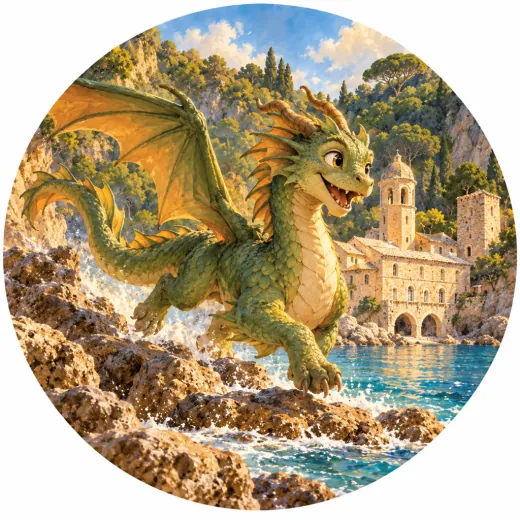
San Fruttuoso and the Dragon
the bay beneath the Portofino headland
a little scary
According to tradition, Prosper, bishop of Tarragona, was fleeing by sea from Spain, invaded by the Arabs, carrying the relics of Saint Fructuosus. In a dream the martyr told him where to stop: a lonely bay beneath the mountain, with a spring of fresh water. There, in the eighth century, the first church was born. Some also tell of a dragon that lived in the bay and was defeated, but the abbey's official pages do not mention it. The abbey really exists, hidden in a bay of the Portofino headland, and today it is cared for by FAI, the Italian heritage trust.
Did you know? No road reaches the abbey of San Fruttuoso: you can only get there on foot or by boat.
The story
On the coast of Liguria, between Camogli and Portofino, there is a place where the road ends.
There is no car park, no motorway exit, no concrete path. There is only the sea, and a mountain that drops steeply to the water. To reach San Fruttuoso you have to walk along paths among the pines, or take a boat and follow the coast. Then, at some point, the woods open, and below you a small bay appears with clear water, and at the end an abbey of stone, with a tower, that seems to have come out of a dream.
And it is from a dream that its story begins.
Tradition tells it, and it goes back more than a thousand years.
In the Europe of those days, Italy was not safe. In Spain, the Arabs had come from the sea, and many Christians were fleeing. Among them was a bishop of Tarragona, a man called Prosper. He carried something precious with him: the relics of Saint Fructuosus, a martyr who had been bishop before him.
Prosper boarded a boat. He had to save those relics, to find a place to hide them, where Christians could keep them without fear. But where? The sea was wide. The coasts were many. And the bishop did not know which way to go.
He sailed for days. Then, one night, he fell asleep. And in his sleep he saw the saint.
Fructuosus, the martyr, spoke to him. He told him that he would not have to choose. The saint himself would show him the place. And in the dream he showed him a bay beneath a mountain, hidden behind a headland.
The bishop woke. He followed that vision. He sailed along the coast of Italy, entered the gulf, and found exactly what he had seen: a small cove surrounded by rocks, between the sea and the mountain. It was isolated. Nobody would look for it. And there was something else precious: a spring of fresh water, flowing a few steps from the beach.
Prosper understood. This was the place.
So, in the eighth century, in that bay, the first church was founded. Later, in the tenth, it became a Benedictine monastery. In the thirteenth century, the Doria, the great family of Genoese seafarers, chose it as the place to bury their dead. Even today, in the abbey, you can see their tombs: white marble and grey stone, with two-coloured arches. Over the centuries, the building passed from monastery to residence, then to the parish of a small fishing village.
In 1551 Pope Julius III entrusted the patronage to Admiral Andrea Doria, and his heirs, in 1562, built the tower that overlooks the bay. It was meant to defend the place from pirates. The sea, which had brought the saint, also brought raiders.
But there is a part of the story that FAI, in its pages on the abbey, does not tell. It does go round, though, in other guides and articles. They say that when Prosper arrived in that bay he did not find it empty. They say that a dragon lived in the valley, a fierce beast, which frightened anyone who came near. In these versions the dragon is usually defeated, with the help of an angel or of the monks. Nobody, of course, has ever been able to verify it. Perhaps it is a way of saying that the place was wild. Perhaps it is the memory of something ancient.
What we do know, instead, is that in 1983 two heirs of the Doria, Frank and Orietta Pogson Doria Pamphilj, donated the abbey to the FAI, the Italian Environment Fund, which restored it. In 2017, after decades of work, the spring was returned as well, the very one that, perhaps, had convinced Prosper.
If you go to San Fruttuoso, remember to look under the water too. There, on the floor of the bay, stands a statue of Christ, with its arms raised towards the surface. It is called the Christ of the Abyss. Divers go down to touch it. The light filters through the waves, and the statue seems to watch over the boats.
It is hard not to think that this has always been a bay of saints.
Relatives around the world
In the trails
Listen / Read next
- Music to read by: Cinematic JourneyEpic film-style music, no lyrics, by Ciro Simone IrmiciSpotifyYouTube Music
- The words of the dialect: GenoeseNonnese, the dictionary of Italian dialects
