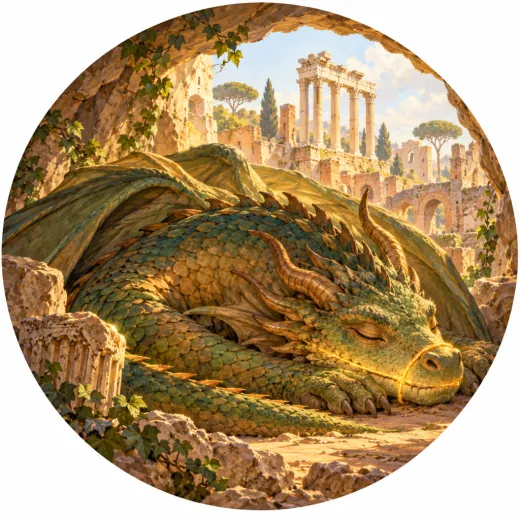
The Dragon of Saint Sylvester
the dragon beneath the Palatine
a little scary
An old legend tells that on the Palatine, in a cave near a stagnant lake, lived a dragon whose poisonous breath made passers-by ill. The priests of the old gods challenged Pope Sylvester: if his God was real, let him stop the monster. Sylvester went down into the cave unarmed, with only a crucifix: the dragon grew tame and the pope tied it up with a thread from his own robe. Then he led it before the Romans, who killed it. Sylvester really was pope, at the time of the emperor Constantine: the dragon is the symbol of a changing world.
Did you know? Saint Sylvester's feast day is 31 December: that is why in Italy New Year's Eve is called “San Silvestro”.
The story
There is a pope, in the history of Rome, who never faced an army and never built an empire. And yet his name is tied to the last night of the year and, in legends, to a dragon.
His name was Sylvester.
He really was a pope. He lived in the days of Constantine, the emperor who was the first to stop persecuting Christians, and he stayed on the throne of Peter for twenty-one years, from 314 to 335. He died on 31 December of that year, and this is why Saint Sylvester's night is the last of the year. Historians, to tell the truth, say that he counted for little. It was Constantine who ran the affairs of the Church. But people, over the centuries, wanted to remember him differently. They had him perform the deeds of a hero.
The finest of them is the one about the dragon.
In those times, in Rome, something strange was happening. Whoever passed near the Palatine, the hill of the palaces, suddenly fell dead, without a wound. Nobody understood why. The doctors shook their heads. Then someone, one day, discovered the reason. In a cave, down at the foot of the slope, beside a still, greenish lake, there lived a dragon.
It did nothing in particular. It attacked nobody. It simply breathed. But its breath was poison. A pestilential vapour that spread through the air and killed anyone it touched.
The Romans, frightened, went to the priests of the old gods. They asked for help. The priests, who in those days were beginning to lose followers to the Christians, had an idea. They set Sylvester a challenge.
"If your God is so powerful," they said, "prove it. Free the city from the dragon, and we will believe."
Sylvester did not hesitate. He took no weapons. He called no soldiers. He brought with him a small crucifix, and nothing else. As he went down towards the cave, people followed from far away, holding their breath. Nobody thought he would come back.
Arriving in front of the cave, the pope stopped. He called on the Virgin for help. Then he went in.
In the half-light, the dragon rose. Huge, dark, with blazing eyes. It breathed. A cloud of vapour came out of its mouth.
And the dragon stopped.
Before the crucifix, before the unarmed man, the beast grew calm. It bowed its head. It crouched like a dog before its master.
Sylvester pulled a thread from his robe, a simple thread, and tied it round the dragon's neck. Then he walked out of the cave, pulling that thread like a lead, with the dragon following meekly behind.
The Romans, seeing this, were left speechless. A pope with a thread in his hand, and behind him the monster that had killed so many people, gentle as a lamb.
We do not really know what they were thinking. But the legend says that the crowd, still full of fear and anger, rushed at the dragon and killed it.
The pagan priests, who had watched, kept their word. They converted. The dragon's body was dragged through the streets to the Roman Forum, and buried beneath the temple of the Dioscuri, Castor and Pollux. Sylvester had a church built close by, Santa Maria Liberatrice, to remember the liberation.
So the tradition tells it.
Another story, also legendary, concerns the emperor Constantine. It is said that he fell ill with a terrible disease, leprosy, and that the pagan priests advised a dreadful remedy: to bathe in the blood of three thousand children. Constantine, faced with the weeping mothers, refused. In a dream Peter and Paul appeared to him, and told him to seek out Sylvester. The emperor found him, hiding on Mount Soracte. The pope baptised him, and the emperor was healed.
Historians say it did not happen like this. Constantine's baptism took place much later, at Nicomedia, at the hands of another bishop.
But it matters little. The dragon, here, is a symbol. It is the old world coming to an end. It is fear melting away before a man who carries no sword.
And every 31 December, while the Romans count the seconds to greet the new year, an unarmed pope, with a thread in his hand, goes on walking in the dark, carrying away the poison.
Relatives around the world
In the trails
Listen / Read next
- Music to read by: Cinematic JourneyEpic film-style music, no lyrics, by Ciro Simone IrmiciSpotifyYouTube Music
- The words of the dialect: RomanNonnese, the dictionary of Italian dialects
Sources
- Iacopo da Varazze, «Legenda Aurea» (XIII secolo), capitolo su San Silvestro
- National Gallery di Londra, «Glossario: San Silvestro»
