Lu Scazzamurrieddu
the house elf of the Salento · Apulia
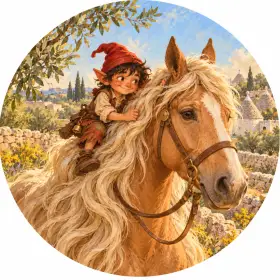
He is the little house elf of Apulia, about as tall as a cat, with shiny black eyes and a red cap always on his head. At night he bangs the pots, moves the chairs, plaits the horses' manes and sits on the chest of whoever is sleeping. All his power lies in the cap: if at dawn you manage to snatch it, he will promise to stop his pranks to get it back. But he is cunning, and often takes it back with a trick before keeping his promise.
Did you know? In the Salento his name changes almost from one village to the next: Laurieddhu near Lecce, Uru further north, Monacieddhru or Scazzamurreddhu further south.
Sources: NostroFiglio.it, «Salento, la leggenda de lu Municeddhu»; raccolte del folklore salentino
Pizzomunno and Cristalda
“tip of the world”, the name of the sea stack · Apulia
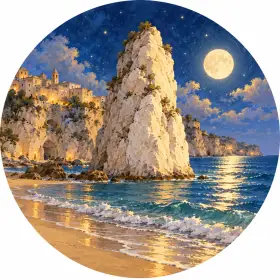
Pizzomunno was a very handsome fisherman in love with Cristalda. The jealous sirens carried Cristalda off to the bottom of the sea; in other versions she died, swept away by a wave. Pizzomunno stayed on the beach waiting for her until he turned to stone: he is the great white monolith on the beach of Vieste. In another version the sirens themselves turned him to stone. Every hundred years, they say, Cristalda rises from the sea and the two lovers are together for a single night.
Did you know? The Pizzomunno monolith is about 25 metres tall, as high as an eight-storey building.
Sources: ENIT, italia.it, «Pizzomunno»; SiViaggia, «Questo scoglio di Vieste ha ispirato la leggenda di Cristalda e Pizzomunno»
Tarantism and the Taranta
“taranta”, the spider, and the “tarantate” · Apulia
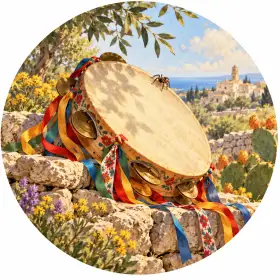
In the Salento, until a few decades ago, people believed that the bite of a spider, the taranta, made women in particular unwell between June and August: tiredness, sadness, restlessness. The cure was music. Players of tambourine, violin and accordion came, and the “tarantata” danced the pizzica, sometimes for days, until the illness went away. Then she went to Galatina, to the chapel of Saint Paul, to pray for healing. In 1959 the anthropologist Ernesto de Martino explained that the taranta was a symbolic animal: behind the bite lay real suffering.
Did you know? To cure the tarantate, the players tried one melody after another: the rhythm of the pizzica or the tarantella, but also slow tunes.
Sources: Ernesto de Martino, «La terra del rimorso. Contributo a una storia religiosa del Sud», Il Saggiatore (1961); Treccani, Enciclopedia on line, «Tarantismo»
Saint Nicholas and the Three Boys
“Santu Nicola”, in the Bari dialect · Apulia
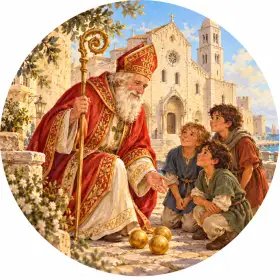
Nicholas was bishop of Myra, in present-day Turkey, in the fourth century. A medieval legend tells that during a famine a wicked innkeeper made three boys who had stopped at his inn disappear, shutting them in a barrel. The bishop, passing by, discovered everything, prayed, and the three boys came out of the barrel safe and sound. That is why Saint Nicholas is the protector of children. In 1087 some sailors from Bari carried his relics from Myra to their city: this is a historical fact.
Did you know? Another of his legends, the bags of gold secretly given to three poor girls, made him the bringer of gifts: Father Christmas comes from Saint Nicholas.
Sources: Iacopo da Varazze, «Legenda Aurea» (XIII secolo), capitolo su San Nicola; Catalogo generale dei Beni Culturali, «San Nicola resuscita tre fanciulli»
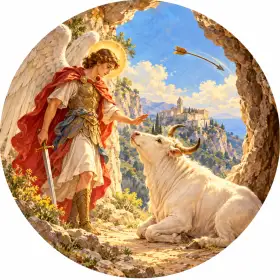
Saint Michael and the Bull of the Gargano
the cave of Monte Sant'Angelo · Apulia
According to tradition, at the end of the fifth century a rich lord lost the finest bull of his herd and found it in a cave on the Gargano. Angry, he shot an arrow at it, but the arrow turned back and struck him. The bishop of the nearby town ordered three days of prayer, and then the archangel Michael appeared to him in a dream: that cave was his. Since then it has been a church that, it is said, the archangel had already consecrated with his presence. Today the cave is the shrine of Monte Sant'Angelo.
Did you know? The shrine of Monte Sant'Angelo has been a UNESCO World Heritage Site since 2011, together with other places of the Lombards in Italy.
Sources: Comune di Monte Sant'Angelo, «Il Santuario di San Michele Arcangelo»; Iacopo da Varazze, «Legenda Aurea» (XIII secolo), capitolo su San Michele