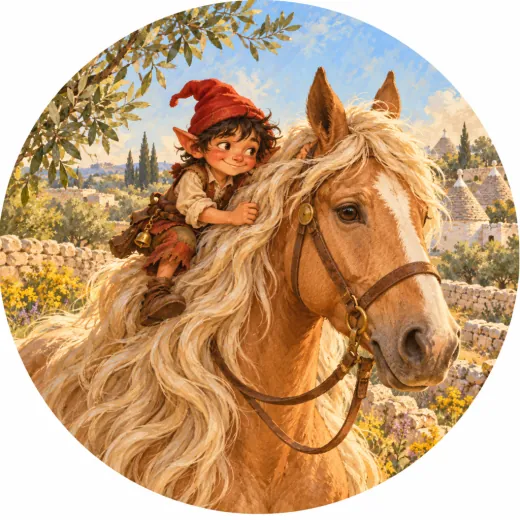
Lu Scazzamurrieddu
the house elf of the Salento
a little scary
He is the little house elf of Apulia, about as tall as a cat, with shiny black eyes and a red cap always on his head. At night he bangs the pots, moves the chairs, plaits the horses' manes and sits on the chest of whoever is sleeping. All his power lies in the cap: if at dawn you manage to snatch it, he will promise to stop his pranks to get it back. But he is cunning, and often takes it back with a trick before keeping his promise.
Did you know? In the Salento his name changes almost from one village to the next: Laurieddhu near Lecce, Uru further north, Monacieddhru or Scazzamurreddhu further south.
The story
You must know one thing first of all: in the old houses of the Salento you are never alone.
There are the grandparents, there are the cats, there is the sound of the wind in the olive trees. And there is him. Lu Scazzamurrieddu.
He is about as tall as a cat, forty centimetres, not one more. He has eyes black, black, shiny as two freshly washed olives, and a head all covered in hair. And on his head, always, day and night, he wears a red cap. Fire red, chilli red, a red you can see from far away even in the dark. He wears it with more pride than a king with his crown.
Nobody knows where he comes from. Some say he is a little monk, the kind nobody ever saw in a monastery. Others, that he is a cunning soul who refused to leave the house where he was born. Your grandmother, perhaps, would tell you that he is simply "one of the household", like the fireplace or the bread chest, and that you must be polite to him.
Because lu Scazzamurrieddu has a character. In fact, he has three.
When you treat him well, he is a friend. A cheerful friend, chatty, a little crazy. But when you ignore him, or worse, do him a discourtesy... ah, then there is trouble! Because he is very, very touchy. And above all he is a great prankster.
Imagine the scene. It is the middle of the night. The house sleeps. The moon comes in through the window and draws a white stripe on the floor. The old clock goes tick, tock, tick, tock.
And suddenly: BONG!
A pot falls in the kitchen. Then another. Clang, clang, clang! It sounds like an orchestra of scrap iron, with a conductor and all. You wake with a start. "Who is it? Who is there?" Silence. You tiptoe towards the kitchen, your heart beating hard... and you find all the pots in a row on the floor, in order of size, from the smallest to the largest, neatly lined up. As if someone had held a race. And on the edge of the table, for an instant, you seem to see something red vanishing behind the dresser. And to hear a little giggle.
You go back to bed. You barely have time to fall asleep when... scrape, scrape, scrape. It is the chairs. They move by themselves, one at a time, scraping across the floor. And then more giggles.
Because lu Scazzamurrieddu, at night, enjoys himself. He moves the chairs. He hides the shoes. He ties knots in the sheets. He puts salt in the sugar and sugar in the salt. And if there is a horse in the house, or a little donkey in the stable, in the morning you find its mane all plaited into long, lovely braids, as if it had spent the night at the hairdresser's. With little bows and all.
And sometimes, but only sometimes, when he really has nothing to do, he climbs onto the bed, jumps onto the chest of the sleeper and sits there, comfortable, cross-legged, looking at the ceiling. In your sleep you feel a strange weight, like a fat cat sleeping on top of you. You try to move and you cannot. You open your eyes: there is nothing. But the weight stays, and you could swear you heard someone say softly: "What a lovely evening, eh?"
And yet, all this has a secret. A secret that the grandmothers of the Salento knew well.
The power of lu Scazzamurrieddu is not in his hands, not in his voice, not even in his pranks. It is all in his red cap.
If someone manages to snatch it from his head, lu Scazzamurrieddu loses all his powers: he stops playing tricks, making a racket, pulling pranks. And he starts praying again, begging, pleading. He runs around you, hops, despairs: "Give it back! Give it back! Give me my cap!"
But careful, because the trick is not easy.
At night you cannot. At night it is his kingdom, he is very quick, he escapes everyone. By day he vanishes, and you cannot find him even with a lantern. The only moment when you can try is dawn. That moment when the night is ending and the day has not yet arrived, and lu Scazzamurrieddu, tired after a long night of pranks, begins to get distracted.
They tell of a boy, Pippi, who one night decided to try. He lay in bed, pretended to sleep, and waited. He kept his eyes half closed, his breath short. He heard the pots. He heard the chairs. He even felt the weight on his chest. And he did not move. He did not move even when a little voice whispered to him: "Sleeping, eh? Sleep well, good boy..."
Then, when the sky began to turn grey behind the window, when the cock was about to crow, Pippi stretched out his arm, quick as lightning. A swipe. And in his fist, soft and warm, he felt something. The cap!
"Ow, ow, ow, ow!" shrieked lu Scazzamurrieddu, jumping off the bed. "My cap! Give me back my cap!"
"First you promise to stop playing tricks," said Pippi, barely holding back a laugh.
"I promise! I promise!"
"And that you will not tie knots in my sheets any more."
"I promise, I promise!"
"And that you will not sit on my chest any more."
Lu Scazzamurrieddu looked at him with those little black eyes, very sad. "But... but that was my favourite spot..."
Pippi gave him back the cap, because he had a good heart. Lu Scazzamurrieddu pulled it onto his head with both hands, adjusted it carefully, and changed at once: his eyes sparkled, his back straightened, his smile came back.
"You promised, eh," said Pippi.
"Of course I promised!" said lu Scazzamurrieddu. "I promised not to play tricks on you any more. But I did not promise anything about your brother!"
And with a wild laugh he leapt out of the window and vanished into the first sun of the morning. The next day, as you can imagine, Pippi's brother found all his shoes hanging from the ceiling.
Because that is how lu Scazzamurrieddu is made. Cunning as a fox, mischievous as a cat, a liar like a merchant. But also, if you know how to take him, a bit like family.
And that is why, even today, in certain houses of the Salento, before going to bed, the grandmothers leave on the table a biscuit, a drop of wine, a piece of bread. They tell nobody. They pretend nothing is happening. But in the morning, perhaps, it has gone.
Because lu Scazzamurrieddu, as everyone knows, is always hungry. And to those who treat him well, in his own way, he behaves well.
Or at least he tries.
Relatives around the world
In the trails
Listen / Read next
- Music to read by: Cinematic JourneyEpic film-style music, no lyrics, by Ciro Simone IrmiciSpotifyYouTube Music
- The words of the dialect: ApulianNonnese, the dictionary of Italian dialects
Sources
- NostroFiglio.it, «Salento, la leggenda de lu Municeddhu»
- raccolte del folklore salentino
