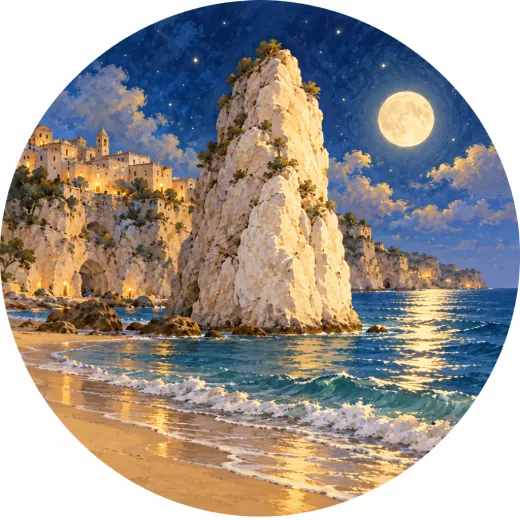
Pizzomunno and Cristalda
“tip of the world”, the name of the sea stack
not scary at all
Pizzomunno was a very handsome fisherman in love with Cristalda. The jealous sirens carried Cristalda off to the bottom of the sea; in other versions she died, swept away by a wave. Pizzomunno stayed on the beach waiting for her until he turned to stone: he is the great white monolith on the beach of Vieste. In another version the sirens themselves turned him to stone. Every hundred years, they say, Cristalda rises from the sea and the two lovers are together for a single night.
Did you know? The Pizzomunno monolith is about 25 metres tall, as high as an eight-storey building.
The story
If you go to Vieste, on the Gargano, where the coast is white as milk and the sea is the colour of glass, you notice something strange as soon as you reach the beach.
There is a rock. An enormous white rock, as tall as an eight-storey building, planted a few steps from the water. It does not look like a rock the sea has carved. It looks like someone waiting.
And that is exactly how they tell it in Vieste.
His name was Pizzomunno, they say, and he was a young fisherman. One of those who get up when the sky is still black, who know every wave by name, who come back with hands full of salt and scales. He was handsome, and strong, and in his eyes he had that light that people have who are often alone with the sea.
And one day, on the beach, he met Cristalda.
How they looked at each other the first time, nobody knows. But from that day they never left each other. They spent the evenings sitting on the sand, watching the sun go down behind the coast, and they talked about nothing, and laughed at everything. They say he brought her shells, and she put them in her hair. They say that when they were together even the wind stopped to listen.
The sea, though, does not love loves that are too happy.
In the waters of Vieste, the old people tell, lived sirens. Beautiful, jealous creatures, with voices that reached the shore, at night, like music that takes away sleep. One evening, in the dark, they saw it. That boy and that girl who loved each other so, without looking at anything else. And they could not bear it.
Because this is the saddest part: nobody knows for certain what they did.
In one version, one night the sirens lured Cristalda into the sea with their song, and dragged her down into the deep, where nobody saw her again. In another, it was a sudden wave, big and cruel, that carried her off while the two were on the beach. And in a third it is said that Cristalda was a siren, who loved a man of the land, and that it was her jealous sisters who punished him.
However it went, the result was the same.
Pizzomunno was left alone. He ran along the shore, shouting her name. He dived in, and searched, and searched again, until his arms had no more strength. Then he went back to the beach, and sat where they had sat so many times, and waited.
He waited all night. He waited the next day, and the one after. He did not eat, he did not sleep, he did not want to move. He only looked at the water, hoping to see a head appear among the waves.
His grief, at a certain point, became so great that his body could not bear it. And slowly, little by little, the young man grew hard, white, motionless. He turned to stone. A great white stone, with its face turned to the sea. In other versions, it was the sirens who turned him to stone.
That is why, they say in Vieste, the rock always looks towards the water. Because it is waiting.
And there is one thing, in the legend, that consoles a little.
They say the spell is not for ever. That once every hundred years, on a summer night, when the sea is calm and the moon is high, Cristalda rises from the waves. That she comes out of the water, and walks on the sand, and draws near the rock. And that at that moment the stone becomes a man again, for one night only.
One whole night, to tell each other everything they could not say in a hundred years. To walk once more along the shore, to sit on the sand, to watch the sea together. One night only. Then, at dawn, she returns to the waves, and he returns to stone, and for another hundred years the waiting begins again.
Some say the night is the fifteenth of August, the Ferragosto holiday, others an August dawn. Nobody knows for certain when the next one will be.
That is why, even today, on summer evenings, on the beach of Pizzomunno there are always lovers. They sit at the foot of the rock, hold hands, watch the moon reflected on the white stone. They make no noise.
Because you never know. Perhaps this is the right night. And nobody would want to disturb two who have waited for each other so long.
Relatives around the world
In the trails
Listen / Read next
- Music to read by: Cinematic JourneyEpic film-style music, no lyrics, by Ciro Simone IrmiciSpotifyYouTube Music
- The words of the dialect: ApulianNonnese, the dictionary of Italian dialects
