The Masche
“masca”, witch in Piedmontese · Piedmont
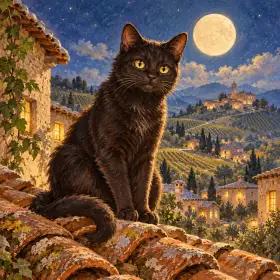
On winter evenings, in the cowsheds of the Langhe hills, people told stories of masche: neighbours who looked like everyone else by day and at night turned into cats (in the Stura valley also into sheep that followed travellers) to play tricks. Their power was believed never to disappear by itself: it could only be passed to another person, when the masca wanted to die. Beside the tale there is a true and sad story: in the fifteenth century some innocent women were put on trial as masche, for example at Levone in 1474.
Did you know? The word “masca” already appears in the Edict of Rothari, of 643, although its origin remains uncertain.
Sources: Donato Bosca e Bruno Murialdo, «Masche»; Langhe.net, «Masche, tra mito e realtà»
The Babàu
babàu, perhaps from a dog’s bark: “bau bau” · Piedmont
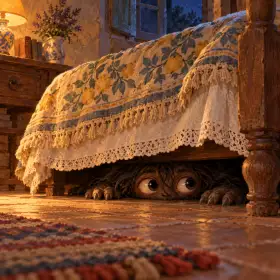
The babàu has no particular face, and maybe that is exactly what makes it work so well. It was the monster grown-ups named to make children behave: “if you don’t sleep, the babàu will come”. It has no real story, but it has relatives: the bogeyman and the ogre. The origin of the name is uncertain: the most widespread explanation is that it imitates a dog's “bow-wow”, and the word is also attested in Languedoc.
Did you know? In Italian “babau” is also said of a person who inspires fear and has a reputation for being terrible.
Sources: Istituto dell'Enciclopedia Italiana, Vocabolario Treccani, voce «babau»
The Ponte del Diavolo of Lanzo
the Devil's Bridge, also called Ponte del Roch · Piedmont
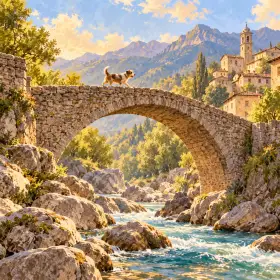
The people of Lanzo had tried twice to build a bridge over the river Stura, and twice the river had carried it away. Then the devil turned up: he would build an indestructible one, in exchange for the soul of the first living creature to cross it. The bridge was built, but the townsfolk sent a little dog across first. Furious at being tricked, the devil stamped his paws violently on the rocks all around, and that is how the “giants' kettles” were born. The real bridge, the Ponte del Diavolo (the Devil's Bridge), dates from 1378 and is still standing.
Did you know? According to another tradition, the giants' kettles are the big pots in which the devil cooked to feed his helpers while the bridge was being built.
Sources: Ente di gestione delle aree protette dei Parchi Reali, «Riserva naturale del Ponte del Diavolo»; MuseiOnline (portale privato su musei e monumenti), «Ponte del Roch»
The Legend of the Sacra di San Michele
and of “beautiful Alda” · Piedmont
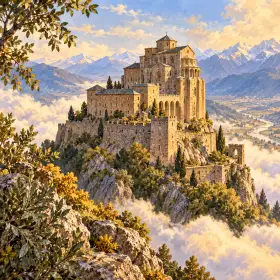
Around the year 1000, an abbey that seems to float in the sky was built on top of Mount Pirchiriano. One legend says the hermit John Vincent had a vision of the archangel Michael, who ordered him to build a sanctuary up here, later consecrated by the angels. The most famous story is that of beautiful Alda, a girl who, chased by soldiers, leapt from the tower and was set down safe and sound by the angels. But nobody believed her, and to prove the truth she threw herself down again: that time nobody saved her and she died on the rocks.
Did you know? The Sacra di San Michele inspired Umberto Eco's abbey in the novel “The Name of the Rose”.
Sources: ENIT, italia.it, «La Sacra di San Michele in Val di Susa»; Consiglio regionale del Piemonte, «Tascabile n. 88»
The Ciciu of Villar
“ciciu”, puppets in Piedmontese · Piedmont
Above Villar San Costanzo there is a wood full of earth pillars with a boulder on top, like giant stone mushrooms. Legend says that Saint Constantius, a Roman soldier of the Theban Legion martyred during the persecutions, was being chased by other soldiers: he turned round and cursed them, and they turned to stone. In another version the pillars are witches turned to stone. The real explanation is just as beautiful: the boulder on top works as an umbrella and protects the earth below from the rain, which washes away everything around it.
Did you know? When the boulder on top falls off, the pillar loses its “umbrella” and slowly melts away in the rain.
Sources: Ente di gestione delle Aree protette delle Alpi Marittime, Riserva naturale dei Ciciu del Villar, «Storia e leggenda»; Ente di gestione delle Aree protette delle Alpi Marittime, Riserva naturale dei Ciciu del Villar, «Natura»