The Masche
“masca”, witch in Piedmontese
scary
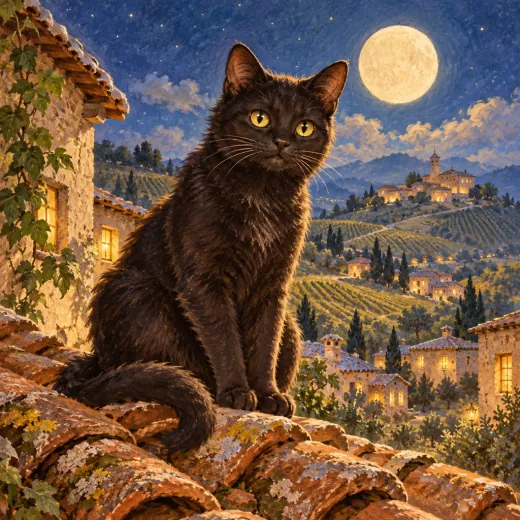
On winter evenings, in the cowsheds of the Langhe hills, people told stories of masche: neighbours who looked like everyone else by day and at night turned into cats (in the Stura valley also into sheep that followed travellers) to play tricks. Their power was believed never to disappear by itself: it could only be passed to another person, when the masca wanted to die. Beside the tale there is a true and sad story: in the fifteenth century some innocent women were put on trial as masche, for example at Levone in 1474.
Did you know? The word “masca” already appears in the Edict of Rothari, of 643, although its origin remains uncertain.
The story
On winter evenings in the Langhe, darkness falls at five. Outside there is fog that covers the vineyards and even your feet. Inside, in the stable, there is the warmth of the cows, the lantern, the hay dust glittering.
They were called vijà. The evening gatherings. People went there after supper, wrapped in shawls and jackets, and sat down next to each other. The oldest took the best places. And when the right moment came, one of them would clear his throat and say:
"I'll tell you about the masche."
The children huddled closer.
The masche, they said, were witches. Not the ones in books, with long noses and pointed hats. They were people of the village, and by day you could not tell them apart. It might be your next-door neighbour, greeting you from her doorway. It might be the woman who bought eggs at the market.
But at night they were no longer that.
At night they could change shape. The old man said that many became cats. That is why, in some houses, a cat on the threshold was not welcome. In a valley further south, the Stura valley, they told of sheep: a white sheep, alone, that followed you along the road in the evening, and you did not remember meeting it. It walked behind you, at a distance. Then, at a bend, it vanished.
"Why do they do it?" someone always asked.
"To get revenge for a wrong," the old man answered. "A masca never forgets."
And after a silence: "Or on a whim."
When something strange happened, a misfortune nobody could explain, they said it was a mascheria. The cow that gave no more milk. The bread that would not rise. The child who suddenly fell ill. Someone, surely, must have done it. And in the village, looking around, they searched for who.
So people defended themselves. Salt was scattered on the threshold. Children's little clothes were never left hanging outside at night, because a masca might touch them. Houses were protected with hemp threads, but spun by girls who had never used a spindle before: they had to be the first threads, the purest. And in church, during Mass, it was said the priest could recognise a masca among the people, just by looking at her.
But what made the children huddle closest were the books.
"There are books," said the old man, lowering his voice, "called books of command. Full of formulas. Of words that call up spirits, good ones and bad ones. They say the devil himself wrote them."
In the stable, an animal stirred. Nobody laughed.
"Whoever has one cannot throw it away. Nor burn it, nor bury it. The only way to be rid of it is to give it to someone else. And whoever receives it becomes a masca in turn."
"Then it's a trap," said a child.
"A chain," said the old man.
Outside, for a moment, the wind made the door move.
Everyone looked towards the door. On the threshold, almost invisible in the shadow, there was a cat, and it was looking at them. Just an ordinary cat. Then it turned and vanished into the dark.
The stable stayed quiet for a long time. Then someone laughed, and another laughed, and everyone began to breathe again.
The old man, though, did not laugh. He waited for silence and said something that was said less often at the gatherings.
That not the whole village believed in the masche, but the whole village was afraid of them. And that fear, sometimes, did greater harm than the masche.
He told of Micillina. They say she was from Barolo and, married to a farmer, went to live in Pocapaglia. She looked a little different from the other women, and had a manner the village did not like. When a baby girl was born with a hump, and on another day there was an accident, someone said her name. Then another said it. Even her husband began to treat her badly. She fled into the woods, and it was said of her that she had made a pact with the devil.
The judges of the Inquisition came. In the end Micillina was condemned, and her fate was sealed on the hill that, since then, has been called the Bric d'la Masca in Pocapaglia. That means the Witch's Hill.
"Was she really a masca?" asked the child.
The old man was silent for a while.
"I don't know. But I know that in those times it didn't take much to become one."
And this, unlike the books and the cats, is not a story. In the summer of 1474, in Levone, in the Canavese, four women were tried on a charge of witchcraft. Two were condemned. The papers of that trial are still kept today in Turin, in the State Archive.
Those women had no black cloaks, no devil's books. They were women of the village.
Historians remember it with care, and with respect: the masche, in the tales, were a fright for the stable. But beside the fright there was something real, and sad, that happened to real people.
In the Langhe today, nobody holds the evening gathering in the stables any more. Few of the old people who remember those stories are left. When they tell them, though, they still lower their voices. Not because of the masche.
Relatives around the world
In the trails
The word in dialect
Listen / Read next
- Music to read by: Cinematic JourneyEpic film-style music, no lyrics, by Ciro Simone IrmiciSpotifyYouTube Music
Sources
- Donato Bosca e Bruno Murialdo, «Masche»
- Langhe.net, «Masche, tra mito e realtà»
