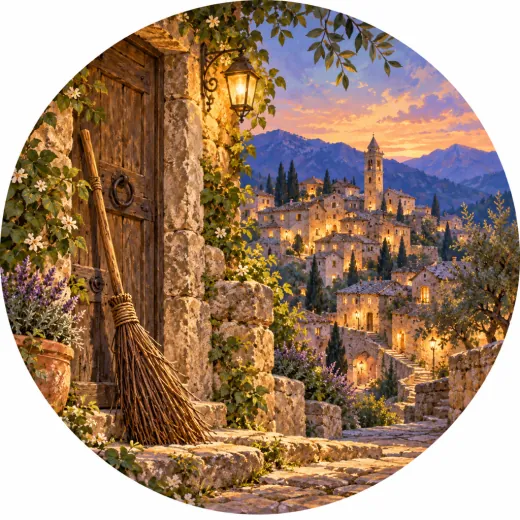
The Witches of Triora
the “village of witches”
scary
Triora is a stone village high above the Argentina valley. Between 1587 and 1589, after two years of bad harvests, some women were accused of having brought hunger with magic. They were put on trial and treated harshly, until the authorities of Genoa stopped the trial. Today we know they were innocent: the harvests failed because of the weather, and poverty did the rest. Beside the true story, a legend grew of the “bàsure” meeting at night to dance in a lonely house outside the village, the Cabotina.
Did you know? Triora has an Ethnographic and Witchcraft Museum that tells the story of the trial and of mountain life in those centuries.
The story
Triora is a village of stone, high above a narrow valley in Liguria, where the houses lean on one another as if to keep warm. The streets are alleys, the doorways arched, the walls high and dark. Today many call it "the village of the witches". But behind that name there is no fairy tale. There is a true story, and it hurts.
At Triora, for two years, the wheat had grown poorly. Two years running the harvests had gone badly, and by 1587 hunger had come. In a mountain village, where every mouth to feed counts, that means hunger.
People looked for an explanation. And they found it where hard explanations were often found in those days: in a curse. Someone must have worked a spell. Someone must have ruined the fields. The Community, gathered in parliament, decided to ask the authorities for help, both the civil and the religious ones.
The men of power arrived from Genoa. An inquisitor of the Republic of Genoa came. So did the one from the diocese of Albenga, Girolamo dal Pozzo, whom those who have studied those years describe as a hunter of people. And a Genoese commissioner came, Giulio Scribani, who was supposed to bring clarity. Instead he did more. He extended the investigations beyond Triora. And he went beyond his remit, dealing with matters that belonged to the Church.
Who was accused?
About thirty people. Women, mostly. Girls. Even a little boy. They had not been caught doing anything. They were simply people whom the Community found strange, "eccentric" compared with the others: people whom the Community, for some reason, did not feel to be like the rest.
They were arrested. They were questioned. They were tortured.
I will not write the details. It is enough to know that there was nothing just in what happened. Isotta Stella, a woman from a well-off family, died from the torture. Another, whose name we do not even know, threw herself from a window that gave onto the church square, rather than endure any more. Franchetta Borelli, also from a comfortable family, was ransomed by a relative and managed to escape. They recaptured her. They tortured her at length. The record of that interrogation survives, and it is one of the harshest documents of the whole trial. They say that she, even in that state, held firm in her mind, and did not say what they wanted to hear.
While all this was happening, in Genoa something began to stir.
The Father Inquisitor of Genoa, who represented the Inquisition of Rome, had some of the accused transferred to the city, taking them away from the fury of the village. A Genoese jurist, Serafino Petrozzi, began to doubt the way Commissioner Scribani was conducting matters, even though he confirmed some of the sentences. In 1588 even the representatives of the Community of Triora, those who had asked for the investigation, began to ask for moderation. They had realised how far it had gone.
In the end, the doge of Genoa, Davide Vacca, wrote to the religious authorities asking to stop the trial.
In 1589 the trial ended. The prisoners in Genoa, perhaps, were freed. Giulio Scribani, who had directed the investigations, was excommunicated; later he was absolved.
And the burnings? Scribani asked for some women to be burned at the stake, but that sentence was never carried out. We do not even know the exact number of the victims.
Today we know something that nobody wanted to admit then: they were innocent. The harvests failed because of the climate, the cold, the rain. There was no magic. There were only frightened people who looked for someone to blame among the weakest.
At Triora, now, there is a museum. It is called the Ethnographic and Witchcraft Museum. It tells of life in those centuries, the toil of the mountains, and the trial. Many people come, and many, as they leave, no longer feel like laughing.
Because the word "witches", when you say it in front of those alleys, is not a carnival word.
It is a word that must remind us how easy it is to be wrong. And what it costs.
Relatives around the world
In the trails
Listen / Read next
- Music to read by: Cinematic JourneyEpic film-style music, no lyrics, by Ciro Simone IrmiciSpotifyYouTube Music
- The words of the dialect: GenoeseNonnese, the dictionary of Italian dialects
