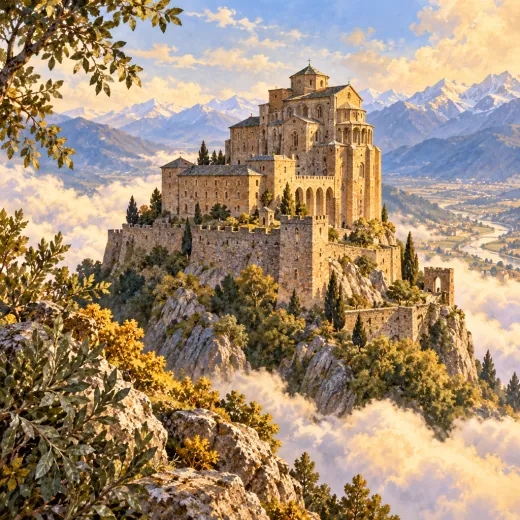
The Legend of the Sacra di San Michele
and of “beautiful Alda”
a little scary
Around the year 1000, an abbey that seems to float in the sky was built on top of Mount Pirchiriano. One legend says the hermit John Vincent had a vision of the archangel Michael, who ordered him to build a sanctuary up here, later consecrated by the angels. The most famous story is that of beautiful Alda, a girl who, chased by soldiers, leapt from the tower and was set down safe and sound by the angels. But nobody believed her, and to prove the truth she threw herself down again: that time nobody saved her and she died on the rocks.
Did you know? The Sacra di San Michele inspired Umberto Eco's abbey in the novel “The Name of the Rose”.
The story
To reach the Sacra, you have to climb. There is no other way.
The road leaves the valley and winds up Mount Pirchiriano, a mountain just under a thousand metres high, right where the Susa Valley opens onto the plain. The Lombards had built their defensive walls at this spot, to bar the way to anyone coming from the other side of the Alps. When you reach the top, the wind already tastes different, and above the rock you see a building that seems to grow out of the mountain: the abbey, with its towering arches, stretching towards the sky.
They say it all began with a hermit. His name was Giovanni Vincenzo, and he had been archbishop of Ravenna before retiring to live up there, alone, among the stones. One night he had a vision. The archangel Michael, the one with the sword, ordered him to build a sanctuary on the mountain top. He built it. And when it was finished, they say, it was the angels who consecrated it. That is why the oldest chapel is dedicated to the Angels, and from that chapel the place took the name Sacra, the Holy One.
Over the centuries, above the first chapel, a Romanesque and Gothic church grew, on the highest point of the mountain, and soon afterwards a New Monastery, with cells, kitchens, a refectory, workshops and a library. Benedictine monks lived there until 1622. Then the place stood empty for a long time, until in 1836 the Rosminian fathers came back.
But there is another story, the one the young people of the valley tell in low voices. The story of the tower.
On the north side of the abbey, where the rock falls almost sheer, there is the tower they call the Bell'Alda, the beautiful Alda.
We do not know what year it was. Nobody tells it. We know only that one evening a girl named Alda was running up the slope, and that behind her, only a few steps away, there were soldiers.
She could hear them. She could hear the iron clinking, the heavy steps on the stone, the voices calling to one another in the dark. Her breath was short and her throat burned. She went into the abbey through a door that someone had left open, crossed a corridor, climbed a narrow stair, then another. She did not know where she was going. She knew only that below there was no way out any more.
She reached the top of the tower.
In front of her there was only air. Far below, the valley, already dark, the roofs of the villages like crumbs, the silver thread of the river. Behind her, on the stairs, the footsteps were getting closer.
Alda turned. Then she looked at the emptiness. On the edge of the tower the wind lifted the hair from her forehead, and for an instant she seemed a light thing, something that might even fly.
"Madonna," she whispered. "Madonna, help me."
And she threw herself.
She fell, and the wind filled her ears. For a moment she heard nothing: not the iron, not the steps, not her fear. Then, inside that silence, she heard something else. A rustle, like great wings opening. And, instead of crashing against the rock, she felt herself held up, gently, by hands she could not see.
The angels set her on the ground the way you lay down a feather. She was safe and sound, without a scratch.
The next day the news spread through the whole valley. Alda told what had happened to her: the tower, the prayer, the wings. She spoke softly, her eyes still wide. But nobody believed her.
"You fell, but not from there," they told her. "Nobody comes back from that tower to tell of it."
"I swear to you it happened like this."
They laughed in her face, or worse, they looked at her with gentle pity. Alda felt something hard growing inside her, a kind of anger, not against anyone in particular. She only wanted them to believe her. And she thought there was a simple way to make them.
She went back to the tower.
This time the people followed her. There were the curious, the monks, a few travellers who had stopped along the road, all with their faces turned upward. Alda climbed to the top, slowly, step by step, and when she stood on the edge she turned towards them. She looked small from down there, her dress stirred by the wind.
"Look," she said, or perhaps she only thought it.
And she threw herself again.
This time there was no rustle of wings. No hand to hold her up. Only the wind, and the rocks below, and a great silence that closed over the valley.
The people stood watching without moving. Then the monks came down, slowly, and began to pray.
This is the legend, as they still tell it today to those who climb to the sanctuary. In the nineteenth century Massimo D'Azeglio remembered it too, in his memoirs, and called it the tragic flight of the Bell'Alda, who threw herself twice from the highest tower.
Today the tower is still there, on the north side. The wind is just the same. And in the novel by a writer, Umberto Eco, the same abbey becomes the place where mysteries, libraries and murders hide, although that is another story.
Whoever climbs all the way up there, at sunset, and looks down from the tower, often says nothing. The valley is all gold, and very far away.
Then, usually, they take a step back.
Relatives around the world
Listen / Read next
- Music to read by: Cinematic JourneyEpic film-style music, no lyrics, by Ciro Simone IrmiciSpotifyYouTube Music
