Tarantasio, the Dragon of Lake Gerundo
Tarantasio, also called Tarànto · Lombardy
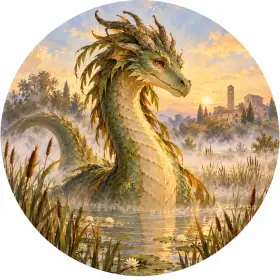
In the Middle Ages, between the rivers Adda and Serio, there was a wide area of still water and marshes that tradition calls Lake Gerundo. Down there, people said, lived the dragon Tarantasio, whose stinking breath made the villagers ill. Who defeated it? Every town has its own answer: a saint, the emperor Barbarossa, the first of the Visconti family. In another version the dragon died when the lake was drained. The dragon's breath was probably the malaria of the marshes, which disappeared with the land drainage.
Did you know? Until the time of Napoleon some churches kept “dragon's ribs”, which the sources describe as remains of prehistoric animals.
Sources: Il Giorno, «Tarantasio, il mitico drago del lago Gerundo»; Panorama, «La leggenda del drago che viveva nel cuore della Lombardia»
The Colonna del Diavolo of Sant'Ambrogio
“la colòna del diavol”, the Devil’s Column in Milanese · Lombardy
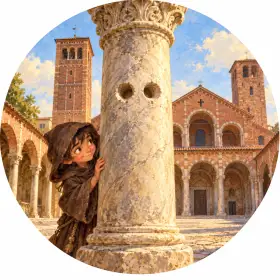
In front of the basilica of Sant'Ambrogio in Milan stands a Roman column, the Colonna del Diavolo (the Devil's Column), with two holes side by side. Legend says the devil clashed with Ambrose, the city's bishop, and in the fight drove his horns into the marble, leaving those two holes. In another version he tried to run the saint through with his horns, missed, and got stuck in the column. Some also say a smell of sulphur sometimes comes out of the holes.
Did you know? The two holes may once have held iron fittings or chains, yet many Milanese, walking past, poke their fingers into them out of curiosity or for luck.
Sources: Regione Lombardia, Lombardia Beni Culturali, «La colonna del diavolo» (stampa); ENIT, italia.it, «Basilica di Sant'Ambrogio»
The Dama Bianca of Padernello
Biancamaria Martinengo · Lombardy
In the plain near Brescia there is a castle surrounded by a moat full of water: the castle of Padernello, home of the Martinengo counts. The legend tells of Biancamaria, the count's daughter, a shy girl who loved nature. One summer evening, sitting among the battlements, she saw the fireflies, believed she could join them and fell. Since then, they say, a figure dressed in white crosses the great hall holding a golden book that keeps a secret.
Did you know? According to the legend the Dama Bianca (the White Lady) appears only once every ten years, always on the night of 20 July.
Sources: Fondazione Castello di Padernello, «Conosci il castello» (con «La leggenda della Dama Bianca»); Regione Lombardia, in-lombardia.it, «Padernello Castle»
Theodelinda and the Dove of Monza
“Modo” and “Etiam”, meaning “here” and “yes” in Latin · Lombardy
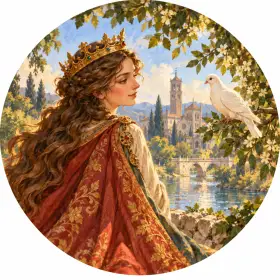
Theodelinda was a real queen of the Lombards, daughter of a duke of the Bavarians, who lived around the year 600. She was looking for the right place to build a church, and one day, by the river Lambro, a white dove appeared and said: “Modo”, meaning “here”. The queen answered: “Etiam”, meaning “yes”. From those two words, the story goes, came Modoetia, the old name of Monza. The basilica really was built, and today's cathedral stands on the same spot.
Did you know? Monza Cathedral keeps the Iron Crown, used for centuries to crown kings and emperors.
Sources: Museo e Tesoro del Duomo di Monza, «Scheda percorsi» (2025); Regione Lombardia, in-lombardia.it, «Duomo di Monza»
The Giubiana
Giubiana or Giöbia, from “giobia”, Thursday · Lombardy
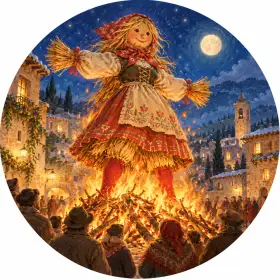
The Giubiana is a very thin witch with long, long legs and red stockings. On the last Thursday of January, people said, she walked through the woods of Brianza looking for children to carry off. A clever mother tricked her: she left a pot of yellow risotto with sausage on the windowsill. The witch stopped to eat it, time went by, dawn broke and she had to run away. Still today, in many towns, a big straw puppet is burnt in the square on the last Thursday of January: it is a farewell to winter.
Did you know? On the evening of the bonfire many Lombard families eat yellow risotto with luganega sausage, the dish that stopped the witch.
Sources: Regione Lombardia, in-lombardia.it, «La leggenda della Giubiana»; VareseNews (giornale locale), «Chi era veramente la Giobia» (2025)