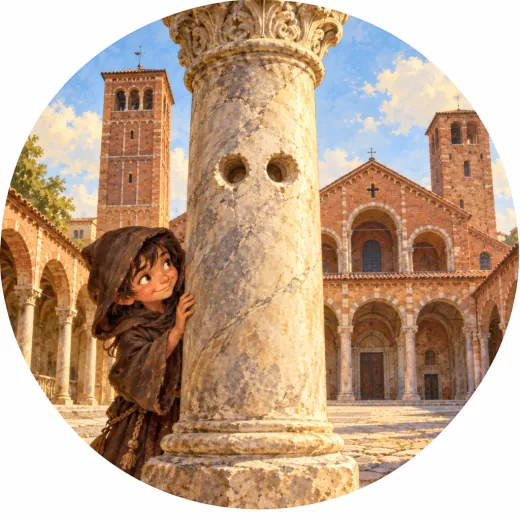
The Colonna del Diavolo of Sant'Ambrogio
“la colòna del diavol”, the Devil’s Column in Milanese
a little scary
In front of the basilica of Sant'Ambrogio in Milan stands a Roman column, the Colonna del Diavolo (the Devil's Column), with two holes side by side. Legend says the devil clashed with Ambrose, the city's bishop, and in the fight drove his horns into the marble, leaving those two holes. In another version he tried to run the saint through with his horns, missed, and got stuck in the column. Some also say a smell of sulphur sometimes comes out of the holes.
Did you know? The two holes may once have held iron fittings or chains, yet many Milanese, walking past, poke their fingers into them out of curiosity or for luck.
The story
If you go to Milan, and stop in front of the basilica of Sant'Ambrogio, under the brick portico, you can do something strange: poke a finger into a hole.
In fact, into two.
Next to the entrance there is a stone column, old, worn by time. At first sight it seems an ordinary column. But if you look closely, you see that at a certain height it has two holes close together, side by side, wide enough to put your fingers in.
The Milanese call it the Colonna del Diavolo, the Devil's Column. And they will tell you why.
The story, they say, is very ancient. It begins with Ambrose.
Ambrose was the bishop of Milan, a stern and gentle man, one of the most important of his time. It was he who founded the basilica that today bears his name, and it was there that, according to tradition, a young seeker of truth, Augustine, met him and converted. In short: a powerful saint.
And the devil, as everyone knows, has a passion for powerful saints.
One day, the legend tells, the demon decided to test Ambrose. He appeared in front of the basilica, and the clash began. Everyone has their own versions. In one, the devil tries to stab the saint with his horns. In another, he tries to seize him. In all of them, the saint steps aside, or pushes him back. It is told that he got a kick, so hard that it made him stagger.
The devil, who never had good aim, crashed into the column.
His horns, they say, stuck in the stone. Two blows, two holes, one beside the other. The devil stayed there, stuck, pulling and cursing, while Ambrose, calm, walked away. They say he stayed stuck all night. In the end he managed to free himself, leaving in the marble the marks that can still be seen today.
Some add a darker detail. They say that from those holes, sometimes, a smell of sulphur comes out, and that if you put your ear to them you can hear, far away, the noises of hell. Only a few sources write it down. But the Milanese have never stopped trying.
As for the column, it really is ancient. It was Roman, almost everyone says that, though they do not agree on the date. Some trace it to the third century, some think it was part of an imperial palace, some say it was reused later for other purposes, and some, honestly, admit that nobody knows where it comes from. And the two holes? Some give a simpler explanation: perhaps they held iron fittings, chains or armour. One thing alone is certain: the column was there long before anyone invented the devil with horns.
But the legend, for centuries, has been stronger than any date.
That is why, still today, people passing in front of Sant'Ambrogio often stop. Some do it out of curiosity, some for luck. They put their fingers in the two holes, check whether they are still warm or smell of burning, laugh, and go away.
You never know.
Meanwhile, inside the basilica, beneath the altar, rest the bodies of Ambrose and of two martyrs, Gervasius and Protasius. They sleep peacefully. No devil, since then, has managed to disturb them.
Least of all one, who since that time prefers to keep well away.
Relatives around the world
In the trails
Listen / Read next
- Music to read by: Cinematic JourneyEpic film-style music, no lyrics, by Ciro Simone IrmiciSpotifyYouTube Music
- The words of the dialect: MilaneseNonnese, the dictionary of Italian dialects
