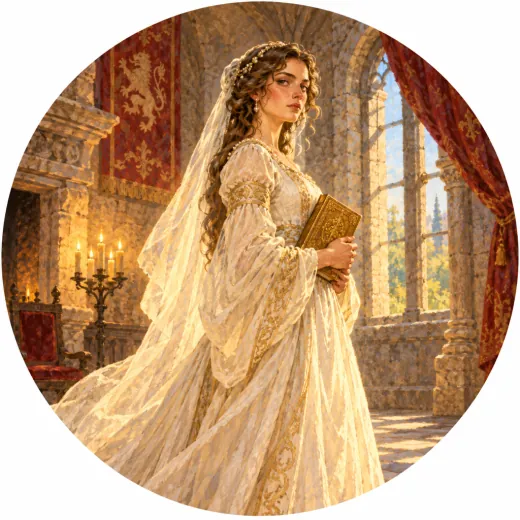
The Dama Bianca of Padernello
Biancamaria Martinengo
scary
In the plain near Brescia there is a castle surrounded by a moat full of water: the castle of Padernello, home of the Martinengo counts. The legend tells of Biancamaria, the count's daughter, a shy girl who loved nature. One summer evening, sitting among the battlements, she saw the fireflies, believed she could join them and fell. Since then, they say, a figure dressed in white crosses the great hall holding a golden book that keeps a secret.
Did you know? According to the legend the Dama Bianca (the White Lady) appears only once every ten years, always on the night of 20 July.
The story
In the plain of Brescia, where the fields are as flat as tables and the irrigation channels carry water between the rows of vines, there is a castle that looks as if it came out of a book of fairy tales.
It is made of red brick, with towers and battlements. All around, a moat full of water. To get in, you have to cross a drawbridge, and the bridge still works. It is called Padernello, and it dates from the fifteenth century.
The Martinengo counts once lived there. Men of arms, used to commanding and fighting. Then, over the centuries, the castle changed owners, became a villa, was abandoned, and after 1965 nobody lived there any more. Brambles grew on the walls, the rooms filled with dust. For years, the castle was only an empty house in the middle of the fields.
But, they say, it was not truly empty.
Because there is a story at Padernello. A story that begins in 1479, when a family arrived at the castle to spend the autumn.
Among the travellers was a girl. Her name was Biancamaria. She was thirteen, or a little less, and she was the daughter of Count Gaspare Martinengo, a condottiere, and of a woman named Caterina Colleoni.
Biancamaria was not like her father. He was a man of the sword: he had fought wars, had commanded soldiers, knew only that. She was pale and fragile, with big eyes and a light step. She did not like noise. She could not bear the violence of the armed men who filled the courtyards and halls. She loved trees, flowers, the water of the moats, silence. She spoke little. Whenever she could, she slipped away to look at the fields.
At Padernello, for the first time, she found what she was looking for. Vineyards, channels, woods. A place where war did not reach. Autumn passed, and winter, then spring. She was happy, as far as one can be at thirteen, in a world that does not let you choose.
Then came the summer.
On the evening of 20 July 1480, the sky was warm and clear. Biancamaria climbed to the upper part of the castle, and sat among the battlements, with her legs resting on the stone. Below her, the moat shone like a mirror. Beyond, the fields were lost in the dark.
And then she saw them.
Small golden lights, appearing out of the grass. One, then ten, then a hundred. The fireflies. They rose and fell, like a breath, like stars fallen into the night that longed to go back to the sky.
Biancamaria was spellbound. She had never seen anything so beautiful. She leaned out a little. Then a little more. The lights seemed near to her, very near, as if all she had to do was reach out her hand. In her heart, they say, a simple and luminous thought was born: I can fly too. I can go with them.
At the moment of greatest joy, she leaned out so far that she fell. Some say she threw herself, sure she could fly away with the fireflies.
They found her the next morning.
That was how Biancamaria's life went out. But, says the legend, it did not truly end there.
From that night, every ten years, on the night of 20 July, something stirs in the castle of Padernello. There is no wind. There are no sounds. But along the grand staircase, the stone one that leads to the noble rooms, a figure appears.
It is a girl. She wears a long white dress that moves without wind. She walks slowly, step after step. Her face is pale, her gaze fixed. And she holds tight in her hands a book. An open book, with gilded pages that shine in the dark as if they had many little fireflies inside.
They say that book holds a secret. Nobody knows which. Nobody has ever been able to read what is written in it. But it is precisely that secret, they tell, that keeps her there, that makes her return every time. It is like something she must say and has never been able to.
Because the Dama Bianca, the White Lady, is not a wicked ghost. She frightens nobody. She seeks no revenge. She looks for just one thing: someone willing to listen to her.
For years, so the story goes, nobody has stopped. Those who saw that white light on the stairs ran away. Those who heard a rustle closed their eyes. And yet she stays there, on the highest step, with the book open, waiting.
Perhaps one day someone will have the courage to stay.
Today the castle has come back to life. The Foundation that looks after it has cleared the brambles, restored the towers, opened the doors to visitors. Within the walls there are exhibitions, parties, concerts. But on 20 July, every ten years, they say that the evening grows quieter than usual.
And if, on that night, while you stand in the courtyard watching the fireflies over the fields, you hear behind you the rustle of a dress, do not run.
Stop. Listen.
She might have something to tell you.
Relatives around the world
Listen / Read next
- Music to read by: Cinematic JourneyEpic film-style music, no lyrics, by Ciro Simone IrmiciSpotifyYouTube Music
- The words of the dialect: MilaneseNonnese, the dictionary of Italian dialects
