The Ghost of Azzurrina
Guendalina, known as Azzurrina
scary
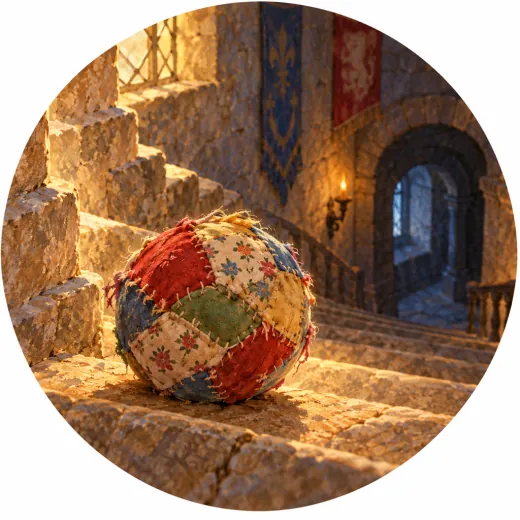
In the castle of Montebello, in the hills near Rimini, people tell of Guendalina, the lord's daughter, who lived in the fourteenth century. She was albino, with very white hair, and in those days some feared it was a sign of witchcraft: so her mother dyed her hair black with herbs, and the colour turned blue. That is why they called her Azzurrina, “little blue”. One stormy day she was playing with a rag ball; the ball rolled down the cellar stairs and she followed it. Nobody ever found her again.
Did you know? Albinism is a genetic condition: skin and hair have little colour, and it has nothing to do with magic.
The story
In Romagna, on the hills above Rimini, there is a castle called Montebello. It has stone walls, a bridge, a tower, and in the cellars a cold hollow where ice and meat were once kept. To those who visit it, even today, they tell a story.
They say that about six hundred and fifty years ago, a baby girl was born at Montebello. Her name was Guendalina, and she belonged to the Malatesta family. Her father, the lord of the castle, awaited her with eagerness. But when he saw her, he was afraid.
The baby was very white. White hair, white skin, eyes as pale as the water of ice. Today we would know what it is: it is called albinism. It is not a harmful illness, only a different way of being born. But in those days people were full of fears, and a child as white as snow made them think of something wrong. It was whispered that she brought bad luck, that she was a sign of the devil.
Guendalina's mother did not believe it, but she was afraid for her. So she did a desperate thing. She dyed her daughter's hair black.
To colour it, she used plants and herbs. But those dyes did not hold well. Every time the child washed, the colour faded, and blue glints appeared in the black hair, like the ones in her eyes. Everyone in the castle began to call her Azzurrina, Little Blue.
Azzurrina grew up like this, within the walls of Montebello. She never went out. Her father was afraid that the outside world would hurt her, or that someone would look at her with hatred. He set two guards to protect her, day and night, Domenico and Ruggero. She was never to be left alone.
She was a child who played with what she had. A ball of rags, a doll. She ran through the halls, between the columns, with her blue hair flying behind her.
Then came 21 June 1375. It was the day of the summer solstice, the longest of the year. Her father was far away, in battle. And in the afternoon the sky filled with black clouds.
A violent storm began. The thunder made the windows shake, the rain beat on the roofs. Azzurrina, who was about five years old, could not play in the courtyard. She played in the hall, with her ball of rags, and the two guards kept an eye on her.
At a certain point the ball slipped from her hands. It rolled across the hall, bounced over the threshold, and went down the stairs that led to the cellars, towards the icehouse.
Azzurrina ran after it.
The guards followed, but she was faster. One second, two. Then they heard it. A cry. A single cry, thin, like a thread snapping.
They ran down the stairs. The icehouse had only one entrance, narrow, of stone. They went in together, with torches.
Inside it was cold, it was dark, there was the sound of dripping water. But of Azzurrina there was no trace. There was no child, there was no ball. They searched every corner. They searched for hours, then for days. They brought in men from the whole village. They did not find so much as a shoe.
Azzurrina had vanished.
Since then, they say, every five years, on the day of the summer solstice, the ghost of the child makes herself heard again. She cannot be seen. She can only be heard. A voice, a cry, sometimes a thin laugh, that rises from below, from the icehouse, and fills the castle.
For years, during guided tours, visitors were played recordings of those voices. They are uncertain voices, distant noises, something that might be a little girl crying.
And now honesty, because a true story can also say what it does not know.
There is no ancient document that speaks of Azzurrina. Historians have never found a deed, a letter, a chronicle. It is said that a priest wrote the story down in the seventeenth century, in a book called "Mons belli et Deline", but nobody has ever seen that book. The first reports of the legend date from 1989, when the castle, restored, opened to visitors. Those who study such things, like Massimo Polidoro, point out that the story was born when a ghost was needed.
In 2010, on 21 June, some researchers from CICAP set up to listen with professional instruments. They heard nothing.
And yet the story lives on. Perhaps because inside it there is something very old and very true: a child who was different, whom someone wanted to hide in order to protect her, and whom, in the end, nobody was able to save.
Every five years, on the day of the solstice, at Montebello someone stops on the staircase and strains to listen.
You never know.
Relatives around the world
Listen / Read next
- Music to read by: Cinematic JourneyEpic film-style music, no lyrics, by Ciro Simone IrmiciSpotifyYouTube Music
