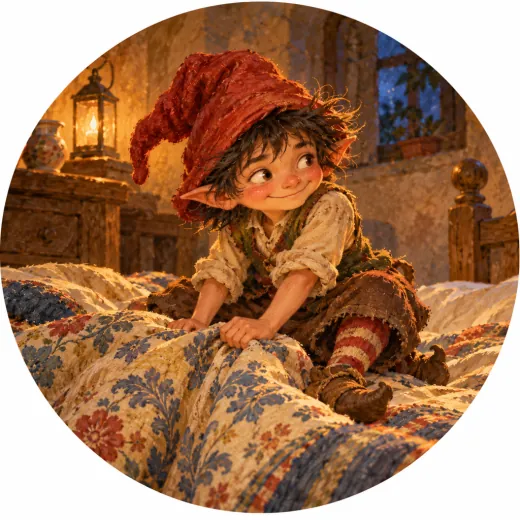
The Mazapégul
mazapégul, in the Romagna dialect
a little scary
The Mazapégul is the night elf of Romagna: small, hairy, somewhat cat-like, with a red cap on his head. At night he jumps onto the chest of a sleeper and sits there, giving bad dreams and shortness of breath. He makes things disappear, unsettles the animals and plaits horses' tails. If he grows fond of a girl, he plays tricks on her sweetheart. To get rid of him, say the people of Romagna, you must steal his cap: without it, he loses all his powers.
Did you know? The Mazapégul has many names from village to village: mazapigur, calcarel, fuletà.
The story
In Romagna, among the hills of the Apennines and the countryside still dark at night, live many creatures that cannot be seen by day. One of the cleverest is called the Mazapégul.
He is not big. He could fit in your hands. He has fine grey fur and two lively eyes. Scholars of sprites, when they try to describe him, start pulling odd faces: "He's a bit of a cat," they say, "a bit of a bunny, a bit of a monkey." But there is one detail that never fails: on his head he wears a little red cap, small as a thimble.
He is an irreverent sort. He laughs when he should not, touches what should not be touched, and cannot bear to be ignored.
By day he sleeps in barns, behind stones, in the cracks of walls. At night, no. At night he works.
First he goes to visit the animals. He slips into the stable, silent, and goes up to the horses. With them he gets on well. It seems he likes to stroke them, talk to them, and plait their manes and tails into long braids. In the morning the farmer walks into the stable and finds the horses all combed, with embroidery no man could make, and knots so tight they have to be cut.
Then, if the night is long, the Mazapégul climbs up into the house. He looks for people. In particular, the tradition says, he likes beautiful young girls. If a girl treats him kindly, or at least politely, he remembers. And it is said that sometimes, in return, he leaves a small gift: a pair of socks, a tidied room, a trouble avoided. For those who treat him well, he is a lucky charm.
But beware of anyone who neglects him.
Because the Mazapégul, when he feels pushed aside, turns mischievous. He makes keys disappear, and knives, and your favourite spoon. He spoils work just done: the dough on the table, the thread already spun, the bread set to rise. And if someone truly makes him angry, he can raise a whirlwind, a gust that lifts everything, from the washing on the line to people.
So what do you do to get rid of him?
The old Romagnoli had plenty of remedies. Some are serious. Others sound like jokes.
The first, the most important, is to steal his cap. They say the Mazapégul, without his little red cap, loses all his power. He becomes weak and clumsy, like a thief with no hands. But the cap is small, and he is quick, and it is not easy.
Another remedy is to disgust him. Make him a gesture, a grimace, something that revolts him so much that he leaves and never comes back. Nobody knows exactly which gesture: everyone had their own.
A third remedy is the strangest. To be rid of the Mazapégul you can recite a poem while walking in balance along a rope. Whoever manages it, they say, wins. But if you fall, the sprite laughs for the rest of the year.
And then there is the grandmothers' remedy, which is the cleverest. Put a handful of grains of rice on the windowsill.
The Mazapégul, who is a fussy sort, cannot leave something to be counted. When he sees that little heap, he stops. He takes a grain, puts it to one side. Then another. Then another again. He counts, and recounts, and if he loses count he starts over. When dawn comes, his head is full of numbers and his eyes are tired, and the only thing he wants is to go to sleep. His prank is over, and the house is safe.
So, even today, in the Romagna countryside, there are people who leave a little rice on the windowsill. Not out of superstition, they say. Out of habit. Because, after all, if a sprite plays pranks on you all night, the least you can do is keep him a little company.
And if in the morning you find your horse's tail plaited like a bride's braid, do not be angry.
It is him. He does it with affection.
Relatives around the world
In the trails
Listen / Read next
- Music to read by: Cinematic JourneyEpic film-style music, no lyrics, by Ciro Simone IrmiciSpotifyYouTube Music
Sources
- Agenzia Dire, «Italia di mostri, creature e leggende: dal serpegatto al mazapegul» (2024)
- Eraldo Baldini, studi sul folklore romagnolo
