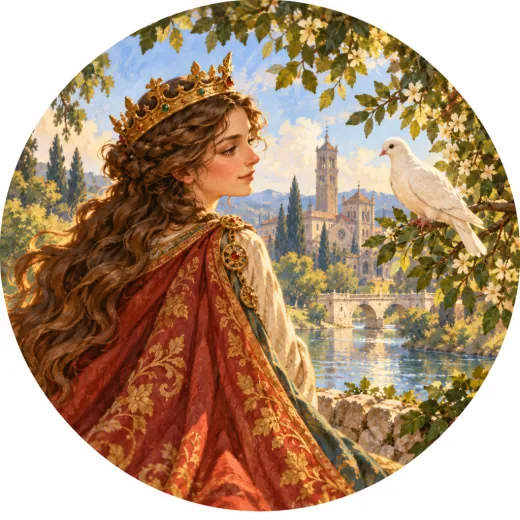
Theodelinda and the Dove of Monza
“Modo” and “Etiam”, meaning “here” and “yes” in Latin
not scary at all
Theodelinda was a real queen of the Lombards, daughter of a duke of the Bavarians, who lived around the year 600. She was looking for the right place to build a church, and one day, by the river Lambro, a white dove appeared and said: “Modo”, meaning “here”. The queen answered: “Etiam”, meaning “yes”. From those two words, the story goes, came Modoetia, the old name of Monza. The basilica really was built, and today's cathedral stands on the same spot.
Did you know? Monza Cathedral keeps the Iron Crown, used for centuries to crown kings and emperors.
The story
Some stories begin with a king. This one begins with a woman who was not yet thirty and who found herself, within a few months, a widow and queen of a people that was not her own.
Her name was Theodelinda. She was born, more or less, in 570, probably in Bavaria, the daughter of a duke. Her name, in the language of her ancestors, perhaps means "shield of the people". And that name, for her, was a prophecy.
In May of 589 she married, at Verona, the king of the Lombards, Authari. The Lombards had arrived in Italy a little over twenty years before. They were warriors, used to the sword and the horse, with long hair and beards. Many were not Christians, or were in their own way, following a faith the Church of Rome considered wrong. Theodelinda, on the other hand, was Catholic.
A few months passed. In September of 590, Authari died. Some say of illness, some of poison. The kingdom was without a king.
It was then that the Lombards did something surprising. They did not choose a warrior. They let the queen decide. This story is told by Paul the Deacon, centuries later, and scholars, to tell the truth, doubt that things went exactly like that. More probably, the new husband came forward on his own. But the tale remains beautiful: the Lombards told the widowed queen to choose, from among them, who would reign beside her.
She chose Agilulf. He was a duke, from Turin, a strong and wise man. They married in the autumn, at Lomello. And from that day Theodelinda began, with patience, her work.
She did not make wars. She wrote letters. She wrote to the pope, Gregory, who was in Rome and who wanted with all his heart that the Lombards should stop being enemies of the Church. She sent him messengers, received gifts. She persuaded her husband to listen. She had her son, Adaloald, baptised in the Catholic faith in 603. She supported the founding of a monastery, at Bobbio, which would become one of the greatest centres of culture in medieval Europe.
And she had buildings raised. She chose a small town that already existed, near Milan, on the banks of the river Lambro, and made it her summer residence: there she had a palace made, and next to the palace a chapel. That place is called Monza.
And this is where the legend comes in.
They say that Theodelinda was looking for the right place to build a church dedicated to Saint John the Baptist. She did not want just any church. She wanted a blessed place. She walked along the river, looked at the hills, and could not make up her mind.
One afternoon, tired, she stopped on the bank and fell asleep. In her sleep, a white dove appeared to her. It was small, luminous, and it settled on a branch near her. Then it spoke, in a thin, clear voice.
"Modo," it said.
Modo, in Latin, means "here".
The queen, who in her sleep understood everything, answered without hesitating: "Etiam."
Yes.
When she woke, the place was the one. The dove was gone, but she was certain. She had the church built right there, on the bank of the Lambro. And from the meeting of the two words, "Modo" and "Etiam", they say, came the first name of the city: Modoetia. Monza.
Scholars, when they speak of it, are cautious. They say it is a tradition, not a historical fact. But at Monza nobody takes offence: after all, the basilica really exists, and today's Duomo still stands in the same place. In the fifteenth century, the Zavattari painters depicted the queen's life on the walls of the chapel, scene by scene, in colours that still shine.
Theodelinda died at Monza in 627 or 628. She was buried in San Giovanni. In 1308, her body was moved to the Duomo, in a sarcophagus, in the chapel that bears her name.
Behind the altar of that chapel, today, another precious thing is kept: the Iron Crown. A ring of precious metal, with a strip of iron inside. For centuries it served to crown kings and emperors.
And perhaps that is as it should be. A woman who had made peace with words left behind her, in the city she had chosen as her own, the symbol of all kings.
But if you go to Monza, on a quiet evening, and sit on the bank of the river, listen. Sometimes, among the branches, there is a beat of wings. And a thin voice, hardly more than a breath, says a single word.
Here.
Listen / Read next
- Music to read by: Cinematic JourneyEpic film-style music, no lyrics, by Ciro Simone IrmiciSpotifyYouTube Music
- The words of the dialect: MilaneseNonnese, the dictionary of Italian dialects
