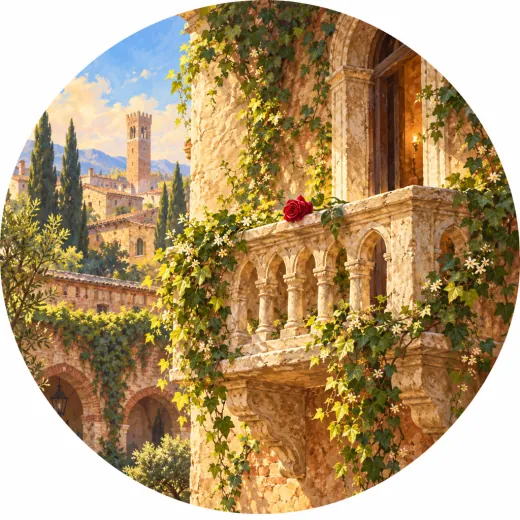
Romeo and Juliet in Verona
the story of the two lovers of Verona
not scary at all
Two young people from Verona fall in love, but they belong to two enemy families, the Montagues and the Capulets. They marry in secret, then a series of misunderstandings tears them apart and the story ends badly for both. It is not an old legend passed down by word of mouth: a similar tale already appears in Masuccio Salernitano (1476, set in Siena), but it was Luigi da Porto, from Vicenza, around 1530, who first set it in Verona; then William Shakespeare made it famous all over the world. Yet Verona has made it its own: there is a “Juliet's house” with a balcony and a statue, visited every year by huge numbers of people.
Did you know? Every year thousands of letters addressed to Juliet arrive in Verona, and a group of volunteers answers every one of them.
The story
There is a city, in the Veneto, where a story invented five hundred years ago has become truer than its monuments. The city is Verona. And the story begins, like many others, with a party.
That evening the Capulets had opened the doors of their palace, and inside there were music, torches, cloaks and masks. The whole city knew that the Capulets and the Montagues hated one another. Nobody remembered why any more. The fathers had hated each other, the sons hated each other, and in the streets they met only to reach for the hilt of a sword.
And yet there was a boy among the guests who should not have been there. His name was Romeo, and he was a Montague. He had come in with a mask on his face, among his friends, because he had been told that at the party there would be a girl everybody was talking about.
He was not looking for her. He did not yet know that he would find her.
Juliet was almost eighteen. She was the daughter of the house, and that evening she danced the way you dance when you are young and know that everyone is watching. It was in a pause between dances that Romeo took her hand. Her hand was cold from the wind outside, and he said something light to her, as a joke. She answered with another.
That was enough. They say they talked for only a few minutes, between one dance and the next, among people who were laughing. Then they were pulled apart, the way you pull apart two things that must not touch.
Only afterwards did one of them ask the other's name. And that was when the world stopped. He was a Montague. She was a Capulet.
From that evening they thought of nothing else. Romeo came back beneath her windows, at night, and they spoke in the dark, in whispers, unable to touch. And after a few days they decided the maddest and simplest thing: to marry.
To do it, they had only one helper, a friar. His name was Lawrence, and he was a good man, who hoped that this marriage might bring peace between the two families. In the little cell of the convent, with its smell of wax and dried herbs, the friar married them in secret. Nobody was to know. Nobody knew.
For a few days they were happy, in secret.
Then, in a square, a brawl broke out.
It was a meeting like many others, between young men with swords at their sides. Tybalt, a cousin of Juliet's, went looking for Romeo to kill him. Romeo did not want to fight: that man was now his kinsman, even if Tybalt did not know it. But swords, once they leave the scabbard, do not listen to reason. Tybalt fell. Romeo had killed him.
The news ran through Verona before the blood was dry. The prince, who wanted no more deaths, condemned Romeo to exile. If he came back, he would be killed.
That night Juliet wept for two losses at once: the dead cousin and the husband far away.
The days passed. And her father, who knew nothing, decided to give her in marriage to another man, a rich and suitable nobleman, who was fine by everyone. She said no. She said no with every word she could find, but in those times daughters did not decide. They told her: either you obey, or you leave.
Juliet ran to the friar. She was desperate, and he, to save her, had a dangerous idea.
He gave her a potion made of herbs. When she drank it, she would sleep so deeply that she would seem dead: the heart almost still, the body cold, the breath invisible. The family would mourn her and bury her in the family tomb. Then he, the friar, would send word to Romeo, and Romeo would come to fetch her when she woke. They would run away together, far from Verona and from their names.
Juliet drank.
Everything went as the friar had said. They found her motionless and white, and they truly wept for her. They carried her into the church with flowers, then shut her in the tomb.
But the message for Romeo never arrived.
He learned only one thing, and he learned it from a man who had hurried to find him with the cruellest news: Juliet was dead. Romeo listened to nothing more. He took some poison, mounted his horse, and rode back to Verona in the dead of night, with the certainty of a boy who has nothing left to lose.
He opened the tomb. Juliet was there, motionless, beautiful. He knelt beside her, took her hand, and drank the poison.
And just then Juliet woke.
This is the cruellest moment in the whole story. In the version that Da Porto left us, the two still had a few moments. She saw him, and he saw her alive. They said a few words, the last ones. He understood his mistake too late, and the poison had already done its work. Then he died in her arms.
Juliet was left alone with him in that tomb, with no reason left to go back to a life without him. She held her breath, Da Porto tells us, and grief did the rest.
That is how the Montagues and the Capulets, who for years had not been able to make peace, made it in front of two young bodies, in a tomb, when it was too late.
This story was never a legend. A similar story had already been written by Masuccio Salernitano in 1476, set in Siena, with two lovers called Mariotto and Ganozza. It was a gentleman from Vicenza, Luigi da Porto, around 1530, who first moved it to Verona and gave the two the names Romeo and Juliet. After him William Shakespeare told it in a thousand ways. But Verona has kept it for itself. Today there is a courtyard with a stone balcony, and beneath the balcony a bronze statue. People who pass touch her breast for luck in love, and leave notes on the walls.
And every year thousands of letters arrive in Verona with a single address: "To Juliet." A group of volunteers opens them all, and answers every one.
Perhaps that is why the story does not die. Because there is always someone, somewhere, who needs to be told that love, even when it loses, is worth it.
Relatives around the world
Listen / Read next
- Music to read by: Cinematic JourneyEpic film-style music, no lyrics, by Ciro Simone IrmiciSpotifyYouTube Music
- The words of the dialect: VenetianNonnese, the dictionary of Italian dialects
Sources
- Luigi da Porto, «Historia novellamente ritrovata di due nobili amanti» (circa 1530)
- William Shakespeare, «Romeo and Juliet» (1597)
