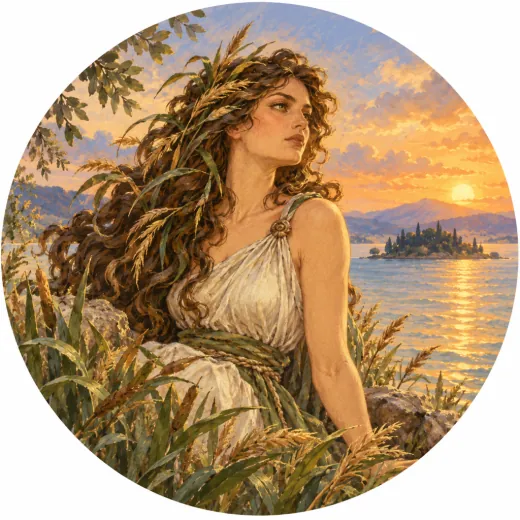
Agilla and Trasimeno
the legend of Lake Trasimeno
a little scary
Trasimeno was a prince, son of the Etruscan king Tyrrhenus. One day he reached the shores of a great lake with his father, and the nymph who lived there, Agilla, fell in love with him and drew him in with her song. They married, but the day after the wedding the prince went swimming and vanished among the waves. Agilla searched for him day after day until, exhausted, she died. People say that on summer evenings the wind in the branches and the waves is still her voice calling him. The lake is said to have taken his name.
Did you know? Trasimeno is the largest lake in central Italy, but it is very shallow: in only a few spots is it deeper than six metres.
The story
They say that Lake Trasimeno, once upon a time, had another name. In fact, more than one. Over the years it has been called Clitonio, Agillino, Plestina, even the lake of Perugia. But the loveliest story has nothing to do with the names of mapmakers. It is the story of a nymph and a prince.
The prince was called Trasimeno. He was the son of Tirreno, a king of the Etruscans, and he had crossed half of central Italy to get there. It was summer, and the heat seemed to bend the air. Before him, among the hills, a great lake opened out, still as a silver plate.
Trasimeno did not think twice. He took off his cloak and dived in.
The water was cool and green, and he swam for a long time, not knowing that he was being watched.
Because in that lake lived Agilla.
She was a nymph, one of those water creatures that nobody sees unless they wish to be seen. That day, beneath the surface, she stayed and watched him: the way he swam, the sun on his wet shoulders, the face of a boy who did not know he was alone only in appearance. Agilla had never seen a man like him. And in an instant she understood that she would not want to see any other.
So she sang.
Nobody has ever written down the words of her song, but everyone says it was impossible not to follow it. It was a voice that came from the water and the wind together. Trasimeno stopped swimming, listened, and then let himself be carried, slowly, towards the middle of the lake, where there is an island called Polvese.
There they met.
Not many words were needed. They stayed together all day, walking along the shore of the island and watching the water change colour with the light. Then the next day, and the one after that. She showed him where the water was clearest and where the fish hid. He told her about long roads and cities she had never seen, and she listened as you listen to the sea inside a shell. The prince, who had come for a swim, no longer thought of leaving. And the nymph, who had been alone for so long, found that the lake seemed smaller, because at last there was someone to share it with.
One day Trasimeno said: "I want to marry you."
For Agilla it was like hearing her own name for the first time. But it was not a simple matter. Trasimeno's father, King Tirreno, did not approve of the union. A prince marrying a nymph of the lake? But Trasimeno insisted, spoke, and spoke again. In the end the king gave way and gave his blessing.
The wedding was held on the lake, on the water that had brought them together. They say it was a bright day, without wind, and that even the trees on the shore seemed to hold their breath so as not to spoil the feast. Agilla was happy. For the first time, her song no longer searched for anyone: it had found him.
But happiness, in this story, lasted only one night.
The morning after the wedding, Trasimeno got up early. The sun was already high over the lake, the water was warm, the sky without a cloud. Perhaps he wanted to swim, as on the day he arrived. Perhaps he only wanted to greet the place that was becoming his home. He dived in, and swam towards the middle.
Agilla saw him from the shore.
She saw him swimming, far away, smaller and smaller, and then she saw him vanish. There was no cry. There was no wave higher than the others. The lake was calm, just as before. Only, Trasimeno was no longer there.
Agilla waited. She waited for him to surface, with a smile and a splash, as he had done so many times. He did not surface.
Then she dived in too, and searched for him.
She searched the bottom, among the stones and the plants. She searched along the banks, among the trees and the coves. She searched the surface, scanning every reflection. She searched for him the first day, and the second, and the third. She did not stop to eat, she did not stop to sleep. She called his name, and the lake sent her own voice back to her.
Day after day, the nymph wasted away. Her voice, the voice that had made a prince fall in love, broke into a sigh. Her strength left her. And in the end, worn out by grief and effort, Agilla died, without ever having found her husband.
The lake did not forget.
Since then, they say, the prince's name has stayed attached to those waters: Lake Trasimeno.
And there are still people who swear they can hear her. On the days when the wind blows over the lake and passes through the branches of the trees around it, there is a long, low sound, like a breath. That, they say, is the lament of Agilla, who has not yet been consoled. When a boat crosses the water and the waves of its wake ripple and spread out to the shore, they say it is she, still searching. That she looks at every boat that passes, hoping to see her prince on board.
Listen, next time you go to the lake, when the wind drops and the surface turns smooth again.
Perhaps, for a moment, you will hear her call.
Relatives around the world
Listen / Read next
- Music to read by: Cinematic JourneyEpic film-style music, no lyrics, by Ciro Simone IrmiciSpotifyYouTube Music
