The Wolf of Gubbio
“brother wolf”
a little scary
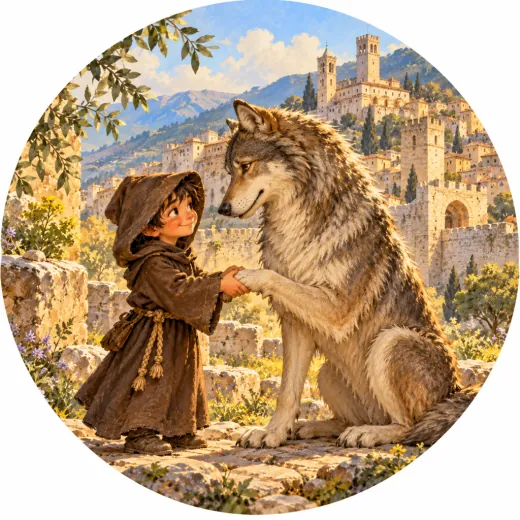
A big, hungry wolf was frightening the people of Gubbio, who no longer dared to leave the city walls. Saint Francis went to meet it alone, called it “brother wolf” and spoke to it calmly. They made a pact: the town would feed the wolf every day, and it would never hurt anyone again. The wolf, the story says, placed its paw in the saint's hand to promise. It lived in town for two more years, going from door to door, and when it died everyone mourned it.
Did you know? The story of the wolf was written more than a hundred years after Saint Francis died, in the “Little Flowers”: it is not in his earliest biographies.
The story
Once upon a time, in Umbria, there was a city of stone with high walls called Gubbio. And outside those walls, in the wood that came almost up to the ramparts, there was a wolf.
A wolf such as had never been seen. Big, heavy, with long legs and a breath you could see in winter like a cloud. People called him "the very great, terrible and fierce wolf", and they were not exaggerating. Because that wolf was not content with sheep and goats, the beasts of the fields. It was said that he had eaten men too.
The townspeople, for a while, had tried to defend themselves. They went out in groups, armed with pitchforks, sticks, rusty swords, with the dogs barking more from fear than from courage. But each time, when the wolf appeared among the trees, a grey shadow with shining eyes, someone felt a shiver down the spine, someone ran away, someone stayed on the ground. Nobody could stop him.
So, little by little, the people of Gubbio stopped going out. The fields were left without anyone to work them, the roads that led out of the city filled with grass. At night, from the walls, a long, distant howl could be heard, which made the children cling to their mothers' skirts. And every morning someone looked out of the window and wondered: "Who will be next?"
In that period, a man arrived in Gubbio, barefoot, in a grey habit, whom everyone knew by name. He was called Francis, and he was from Assisi.
When he heard about the wolf, Francis said nothing for a while. He listened. And in his heart he felt something like compassion, not only for the people, but also for that beast that nobody had ever looked at with eyes other than fear.
"I want to go and speak to him," he said.
The citizens thought he had gone mad. "Do not go," they told him. "He will kill you. He has eaten men stronger than you."
But Francis had faith in God. He made the sign of the cross. Then, with a few companions, he went out of the gates of the city.
The companions walked behind him with their hearts in their mouths, and at a certain point they stopped. Their legs would not go on. Francis went on alone, slowly, unhurried, towards the place where the wolf was. Behind him, at a distance, many citizens followed, on the walls, among the bushes, pretending not to be afraid. They wanted to see the miracle, or the end of that strange man.
And then the wolf appeared.
He came out of the wood with his mouth wide open, white teeth showing, running towards Francis. Someone, behind, cried out. Someone closed their eyes.
Francis raised his hand and made the sign of the cross in the air, in front of the wolf. And in a calm voice, almost cheerful, he said:
"Come here, Brother Wolf. I command you, in the name of Christ, not to harm me or anyone."
What happened after those words, the citizens told for centuries. The wolf stopped. He shut his mouth at once, as if someone had shut it for him. And then, head down, with a slow step, he came up to Francis and lay down at his feet. Meek as a lamb.
Then Francis spoke, and his tone became serious.
"Brother Wolf, you have done great harm in this land. You have killed animals, who are creatures of God. And you have killed men, who are made in the image of God. For this you would deserve the gallows, like thieves and murderers. And everyone here hates you, and they are right."
The wolf stayed motionless, with his ears down.
"But I want to make peace between you and the city," Francis went on, more softly. "If you promise to harm nobody any more, the people will not persecute you. I know that you did it from hunger. Well, the people will give you food every day, as long as you live. So you will no longer be hungry, and you will have no more reason to do harm. Do you agree?"
The wolf wagged his tail. He moved his ears. He lowered his head in a long, solemn bow. It was as if he said yes, with his whole body.
"Then give me a proof," said Francis, holding out his hand.
And the wolf, in front of everyone, raised his right front paw and placed it in the man's hand.
Nobody, at that moment, dared to breathe.
Then Francis turned and began to walk towards the city. And the wolf followed him, head down, at a slow pace, like a little lamb following the shepherd.
When the people of Gubbio saw that man in a habit arriving with the wolf at his side, from the walls, from the gates, from the windows, the news ran faster than the wind. Men, women, grown-ups, children, young and old, all ran to the square. Nobody wanted to miss that scene.
There, in front of everyone, with the wolf sitting beside him, Francis spoke.
He said that God sometimes allows such misfortunes to happen because of men's sins. And that the fire of hell is far more terrible than the rage of a wolf, because a wolf can kill only the body. He urged everyone to repent, and promised that, if they did, God would free them from the wolf and from the eternal fire.
Then he said:
"Behold, Brother Wolf promises to offend nobody any more. I stand surety for him. And you, do you promise to feed him every day?"
The crowd answered yes, in a loud voice.
Then Francis turned to the wolf: "And you, Brother Wolf, do you promise to respect this pact?"
The wolf knelt. He bowed his head. He moved his tail and ears, as he had done before, as a sign of assent. Then, in front of everyone, he placed his paw once more in Francis's hand.
A great joy rose from the square. People shouted, wept, laughed. They praised God, who had sent them Francis to free them from that fear.
And from that day the wolf lived for two years in Gubbio.
He went into houses, from door to door, harming nobody. And the people fed him with affection, asking nothing in return. One thing is told that seems incredible: not even a single dog, in the whole city, ever barked at him.
Then, after two years, the wolf died of old age. The citizens were grieved. They had seen him every day, going through the streets, docile as a house dog, and each time they remembered the virtue and holiness of Francis, who had changed him.
Even today, in Gubbio, there is a little church called San Francesco della Pace, Saint Francis of Peace. They say that there, under the floor, the wolf lies. And whoever passes, in silence, among those ancient stones, thinks again of an old story: that of a wolf who, perhaps, wanted only someone who was not afraid of him.
Relatives around the world
Listen / Read next
- Music to read by: Cinematic JourneyEpic film-style music, no lyrics, by Ciro Simone IrmiciSpotifyYouTube Music
- And in our homes: the dogBestiepedia, guides for people who live with a pet
Sources
- Anonimo, «I Fioretti di San Francesco», capitolo XXI (XIV secolo)
- Avvenire, «Gubbio, sulle orme di Frate Lupo»
