Romulus and Remus
Romulus et Remus
a little scary
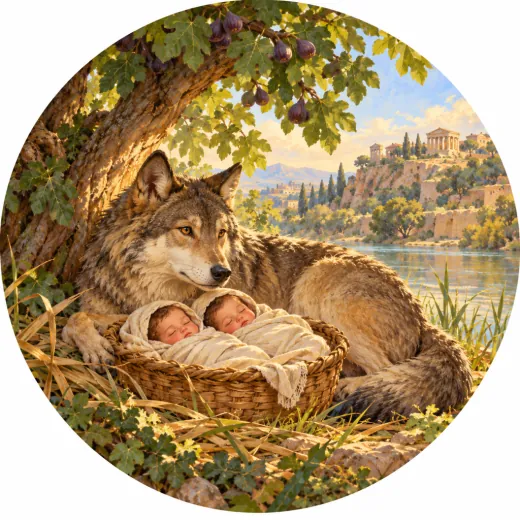
Romulus and Remus were twins, the sons of the god Mars and of Rhea Silvia. A wicked king, who was afraid of losing his throne, ordered them to be left in the Tiber in a basket. The basket came to rest on the bank, under a fig tree, and there a she-wolf heard the babies crying and fed them with her milk, until a shepherd, Faustulus, found them and raised them. When they grew up they decided to found a city, but they quarrelled over where it should be and who should name it. Romulus won, and the city was called Rome. According to tradition, it was 21 April 753 BC.
Did you know? Every 21 April Rome still celebrates its birthday, the Natale di Roma.
The story
Once upon a time there was a king called Numitor, who ruled over Alba Longa, a city in the Latin hills.
He had a younger brother, Amulius, who was jealous of him. One day, in a sudden coup, Amulius stole the throne, drove Numitor out of the city and had his sons killed. He spared only a daughter, Rhea Silvia, but he forced her to become a priestess of Vesta, the goddess of the hearth. A Vestal could not marry, so she would have no children, so there would be no heirs.
But the gods had other ideas.
One day Rhea Silvia was seen in the sacred wood, and she came out of it with a secret. She said that Mars, the god of war, had met her there. In Livy's time, some people said it had been an ordinary man instead. What is certain is that a few months later the priestess gave birth to twins: two sturdy baby boys with loud cries.
When Amulius heard the news, he went pale.
“Take those babies,” he ordered his servants. “Put them in a basket and throw them into the river.”
The servant who had to obey was a quiet man, and he did what he could. That year the Tiber was swollen with rain and had burst its banks, and he could not get close to the current. So he left the basket where the water was shallow, on the bank among the reeds, hoping the river would do the rest. Then he walked away.
As the river went down, it left the basket on dry ground, under a fig tree.
That afternoon the babies lay crying in the sun, alone and hungry. Suddenly a grey shadow slipped out of the bushes. It was a she-wolf, thin and tired, her teats heavy with milk. She came closer and sniffed the two little bundles. And instead of tearing them apart, she lay down beside them. Without thinking, the babies began to feed.
It was a shepherd who found them, days later. His name was Faustulus, and he looked after the king's flocks. He hid behind a rock and watched, not daring to breathe, as the wolf licked the twins. When the animal had gone, he picked the babies up and carried them to his wife, Acca Larentia. They named them Romulus and Remus.
They say Faustulus understood at once that these two were not shepherds' children. In the evenings he watched them and saw something royal in the way they behaved. But he kept the secret for years. The boys grew up among the shepherds on the Palatine Hill. They learned to hunt, to wrestle, to run. They were strong, handsome and brave, and soon they became the leaders of the young men in the area. Nobody knew who they really were.
One day, in a brawl with some of Numitor's shepherds, Remus was captured and brought before the old king, who was living a humble, forgotten life. Numitor looked at the young man, at his face, at his eyes, and felt his heart leap.
“Who are you?” he asked. “Where do you come from?”
Remus told him the story, as much as he knew of it: the basket, the wolf, Faustulus. And Numitor understood everything. The twins were his grandsons.
Together, grandfather and grandsons planned a revolt. Romulus and Remus marched on Alba Longa with the shepherds, killed Amulius and gave the throne back to Numitor.
But by now Alba Longa felt too small for the two young men.
“Let's found a new city,” they said. “Where we grew up.”
That was where the trouble began. Where, exactly? Romulus wanted the Palatine. Remus preferred the Aventine. They decided to ask the gods for a sign: each of them sat on his own hill and waited for birds to fly over.
Remus saw them first: six vultures. Shortly afterwards, Romulus saw twelve. Each of them declared himself the winner. One because he had seen them first, the other because he had seen more.
Romulus began to mark out the walls with a plough, cutting a sacred furrow around the Palatine. No one was allowed to cross it without permission: it was the border between the city and the rest of the world.
Remus looked at the furrow, a strip of turned earth that did not seem like much to him. And, as a joke or as a challenge, he jumped over it.
“Look at these walls!” he laughed. “One hop and you're in.”
Here the stories split. Some say that Romulus, in a fit of rage, struck him down and said, “So die anyone who leaps over my walls!” Others say that a fight broke out between their men, and Remus died in the crowd, without Romulus wanting it. Livy tells both versions, because even the ancients no longer knew which one was true.
Romulus stood by his brother's body in silence. Then he went on digging.
On 21 April 753 BC, so the tradition says, the most famous city in history was born. The shepherds' festival, the Parilia, became its birthday, and the people of Rome still remember it today.
Romulus soon realised that a city is not made of walls alone. It needed people. So, Livy tells us, he opened a place of refuge on the Capitoline Hill, where anyone could come in: runaway slaves, exiles, shepherds with no land, men with a past they wanted to forget. Within a few months, the crowd of newcomers was larger than the handful of people already living there. That is how Rome was born: from people who had nowhere else to go. Romulus was its first king. He gave it its name: Rome.
All his life, though, whenever he walked past the wall, he remembered that jump. He had built a city, and to do it he had lost the person he had been born with.
The Romans told this story with pride, and with a small shadow. They knew that every great thing is born from something else that had to be left behind. Even a city. Even Rome.
And they say that the she-wolf, the old wolf of the Tiber, came back every evening to see if anyone was still sleeping under the fig tree.
Relatives around the world
In real history
Listen / Read next
- Music to read by: Cinematic JourneyEpic film-style music, no lyrics, by Ciro Simone IrmiciSpotifyYouTube Music
Sources
- Livy, History of Rome, Book I
- Plutarch, Life of Romulus
