Mars
Mars, in Latin
a little scary
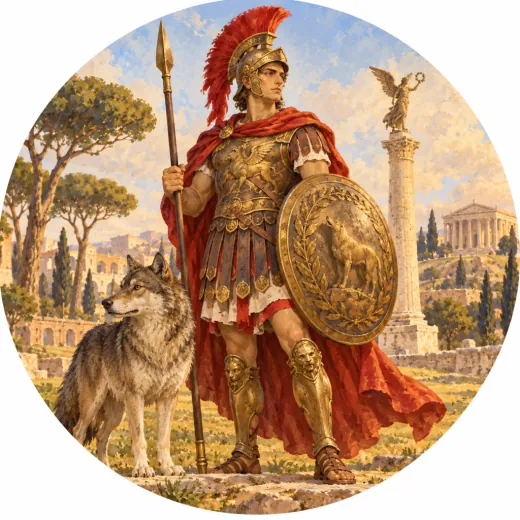
Mars was the god of war, but for the Romans he was much more: according to the legend he was the father of Romulus and Remus, and so the ancestor of the whole Roman people. Spring was his season, when farm work and military campaigns began again. In Rome a large open space near the Tiber, where soldiers trained, was called the Campus Martius, the field of Mars, although Livy, speaking of Romulus, names only “a field near the Goat's Marsh”.
Did you know? The month of March bears his name: for the earliest Romans it was the first month of the year.
The story
For the very first Romans, the year did not begin in January. It began in March.
It was the month when the cold ended, work in the fields started again and armies set off on the march once more. It was the month of Mars, the god of war. Ovid, the poet, says that Romulus, the founder of Rome, had wanted it that way, to honour his father.
Because for the Romans, Mars was not only the god of weapons. He was a father.
It all began in another city, Alba Longa. King Numitor reigned in peace, until his brother Amulius took the throne from him by force. Amulius knew he was not safe: one day Numitor's children might take revenge. So he made his niece Rhea Silvia a priestess of Vesta. Vesta's priestesses were not allowed to marry, and so they would have no children. The throne, Amulius thought, was safe.
One summer morning Rhea Silvia went down to the river with a jar, to fetch water for the rites. It was hot. She sat down on the bank in the shade of the willows, while the breeze dried the sweat on her forehead. Sleep came over her.
The god saw her. There was no thunder, no swords, no chariots. There was only the river, and a god watching.
When Rhea Silvia woke up, nothing was the same.
In the months that followed she gave birth to twins. When Amulius found out, he had her put in chains and ordered the babies to be thrown into the river. She said their father was Mars. Livy says that perhaps she really believed it, or perhaps it seemed more honourable to blame a god. Nobody knows.
A servant carried the basket to the Tiber. It had rained for days, and the river, grey and swollen, had burst its banks and was rushing across the fields, dragging branches and tree trunks with it. The servant did not dare go near the current: he set the basket down at the edge of the water and left without looking back. Then the waters slowly drew back, and the basket was left on dry ground, in a shallow pool, under a fig tree.
The babies were crying. On the nearby hills there was a she-wolf, and she came down to the river to drink. She heard the crying and stopped. Then, instead of doing what wolves do, she brought her muzzle close, lay down and offered her teats to the two little ones, who stopped crying at once. The woods all around stayed silent, as if even the birds were watching. When a shepherd called Faustulus, who looked after the king's flocks, reached the spot, he found her licking them with her tongue, the way mothers do.
Faustulus took them home to his wife, and the twins grew up among the shepherds. Their names were Romulus and Remus. They grew strong and brave. As boys they went hunting, faced wild beasts, defended the shepherds from robbers and shared the loot with them. One day Numitor's shepherds captured Remus and took him to the old king. Numitor looked at him for a long time: the boy reminded him of someone. He asked questions, counted the years, and understood. When the twins learned who they were, they went back to Alba, took the throne from Amulius and gave it back to Numitor. Then they went off to found a new city, in the place where the river had left them.
It was Romulus who gave it his name. And it was he, says Ovid, who put March first among the months of the year, in memory of his father.
For many years Romulus ruled Rome. Then one day something strange happened.
The king was reviewing his army on a plain near a marsh, the Goat's Marsh. Suddenly the sky went dark. A storm broke, with thunder so loud that the people covered their faces. A thick cloud wrapped itself around the king, and the soldiers could no longer see him.
When the light came back, the throne was empty.
No one knew what to say. The plain seemed to have grown larger without him. The soldiers stood still, staring at the place where the king had been. Someone shouted his name, and no one answered. Then they began to murmur: people said the senators had killed him and hidden the body. But Ovid tells another version, and this one took place in the sky.
Mars went before Jupiter. “Father,” he said, “Rome is strong now. You promised me a son in the sky. Now is the time to keep your word.”
Jupiter nodded. The sky trembled, and the stars shook. Mars took up his spear, climbed into his chariot, whipped his horses and came down through the air to his son. He lifted him from the earth, and the chariot rose up again, among the clouds. Romulus's body, says Ovid, melted into the air, and in its place appeared a more beautiful face, worthy of the god's chariot.
Soon afterwards a man named Proculus Julius came before the assembly. He was a respected man. He spoke quietly, without hurrying, and the people listened without moving.
“Romans,” he said, “the father of this city, Romulus, came down from the sky at dawn and appeared before me. I was filled with awe. I begged him to let me look upon his face. He said to me: go, tell the Romans that the gods want my Rome to be the capital of the world. So let them devote themselves to the art of war, and let them know, and teach their descendants, that no human power can withstand the arms of Rome.” And having said this, Livy tells us, he went up into the sky.
The people believed him, and Livy himself is amazed at how much faith they had in that man. The people were comforted, stopped murmuring, and went home with lighter hearts.
And so the god of war, who had never known peace, left the world a city and a son.
Every spring, when the cold ends and the roads dry out, March begins again. Its name is still the god's.
Relatives around the world
Listen / Read next
- Music to read by: Cinematic JourneyEpic film-style music, no lyrics, by Ciro Simone IrmiciSpotifyYouTube Music
Sources
- Ovid, Fasti, Book III
- Livy, History of Rome, Book I
