Jupiter
Iuppiter, in Latin
a little scary
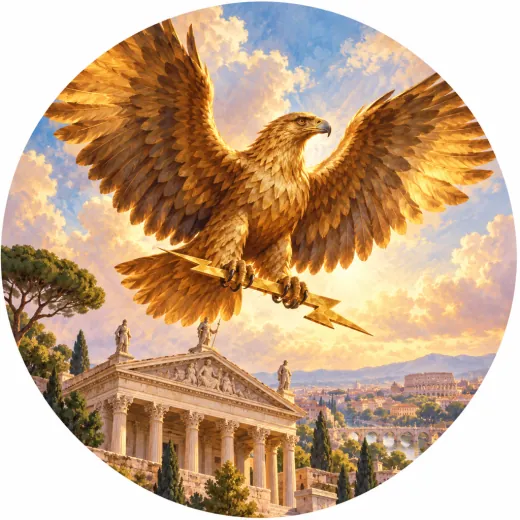
Jupiter was the king of the Roman gods, the lord of the sky, of light and of the thunderbolt. The Romans gave him many of the stories of the Greek Zeus, but for them he was above all the protector of the State. His most important temple stood on the Capitoline Hill. According to Livy, Romulus promised him a temple under the name of Jupiter Stator, so that he would stop the flight of the Romans. When a general won a great war, he paraded through Rome in a “triumph” and climbed all the way up to Jupiter's temple to thank him. His symbol was the eagle.
Did you know? according to Pliny the Elder, the eagle became the permanent standard of the Roman legions under Gaius Marius, in 104 BC.
The story
Before there was a city, the Capitol was a hill of brambles.
Virgil tells the story. One evening an old king named Evander was taking Aeneas to see the places in his little kingdom. They walked among straw huts. Where the Forum stands today, oxen were grazing, and their lowing reached the two men. Evander pointed everything out with pride: a gate, a cave, a wood. Aeneas listened and looked. It seemed a small kingdom, but he had nothing left at Troy, and these places seemed to promise something.
They climbed a height covered in thorns and trees. The sun was going down, and the shadows of the trees stretched long across the rock.
“Here,” said Evander, and he lowered his voice. “This hill, with its crown of leaves, has a god inside it. Which god, I do not know. The Arcadians, my people, believe they have seen Jupiter himself, when he shakes the black shield with his right hand and gathers the storms.”
The farmers of the area, Virgil explains, were afraid of that place. They trembled before the wood and the rock, even if they could not have said why. The hill was already sacred, before anyone had given it a god's name.
Centuries later there would be a temple with a golden roof on that hill. First, though, there was a battle.
Rome had only just been born. Romulus, its first king, had just founded the city on the Palatine, and already the Sabines, the neighbouring people, were against him. Because of a Roman girl who had betrayed the city, the Sabines had seized the citadel, high on the Capitol. From there they came down to fight, into the valley between the two hills.
The fighting was hard. In the valley the dust rose to the sky, and all you could hear was shouting and iron clashing on iron. The Roman commander fell, and the soldiers began to fall back. Then to run. The Sabine leader, Mettius Curtius, chased them on horseback right across the valley and drove them all the way to the old gate of the Palatine.
Romulus, swept along by the fleeing crowd, stopped dead, dust on his face, out of breath. He raised his weapons to the sky.
“Jupiter,” he said. “It was at your sign that I laid the first foundations of this city here on the Palatine. The Sabines hold the citadel, bought with treachery, and now they are coming down at us in arms. You, father of gods and men, at least drive the enemy back from here. Take the fear from the Romans and stop this shameful flight. And I promise you a temple, here, to Jupiter Stator, so that our descendants may know that the city was saved by your help.”
Stator means “the one who stops”. It was the right name for that moment.
For an instant nothing could be heard on the field, not even the horses. Then, as soon as he had finished, as if he knew his prayer had been heard, Romulus shouted, “Romans! Jupiter, Best and Greatest, orders you to stand here and fight again!”
The soldiers stopped. Livy says it was as if a voice had come down from the sky. How many truly heard it, no one says. They turned round, and Romulus was already in the front line, ahead of them. Mettius Curtius, hearing the noise of the Romans coming back, spurred his horse: the horse took fright and threw him into a marsh. The battle began again.
It ended when the women of both peoples, their hair loose, threw themselves between the spears. But that is another story, and it ended well: the two peoples became one.
Many kings came and went. The last, Tarquin, wanted to finish the temple his father had promised to Jupiter on the hill. It was a great task. The money for the foundations came from the spoils of a city conquered in war, Suessa Pometia. He brought in workmen from all over Etruria, and for months nothing could be heard on the hill but the sound of chisels.
The hill, however, was already full of altars and little shrines dedicated to many gods. Before building, each of them had to be asked for permission. The seers consulted the signs, and one after another the gods agreed to move.
All except two.
Terminus, the god of boundaries, and Youth would not move. The seers took it as a good sign: if Terminus does not move, the boundaries of Rome will not move. If Youth does not leave, the city will not grow old. The altars stayed where they were, inside Jupiter's temple.
Then the workmen began to dig the foundations, and suddenly one of them stopped working.
He had found a head. A human head, whole, its face untouched, like someone who had fallen asleep in the earth.
All the workmen stopped to look. No one spoke. The wind stirred on the hill, and the dust settled slowly around the digging. Whose face it was, no one ever found out. It was there, that was all, and it seemed to be waiting.
They sent for the seers of Rome and the seers of Etruria, and all of them said the same thing. That head meant that this would be the citadel of an empire and the head of the world. From the earth, the god had answered.
From that day on, for the Romans, the Capitol was the home of Jupiter Best and Greatest, the greatest and best of their gods. For centuries no place in Rome was more sacred.
All this began with a prayer in a battle almost lost, an evening among the thorns, a hill that frightened people even before it had a temple.
And when the sky over Rome grows dark, and the storms gather above the rooftops, there are still people who look up. They are not sure what they are looking for. But they know, like Evander's shepherds, that this hill has a god inside it.
Relatives around the world
In the trails
Listen / Read next
- Music to read by: Cinematic JourneyEpic film-style music, no lyrics, by Ciro Simone IrmiciSpotifyYouTube Music
Sources
- Livy, History of Rome
- Virgil, Aeneid
